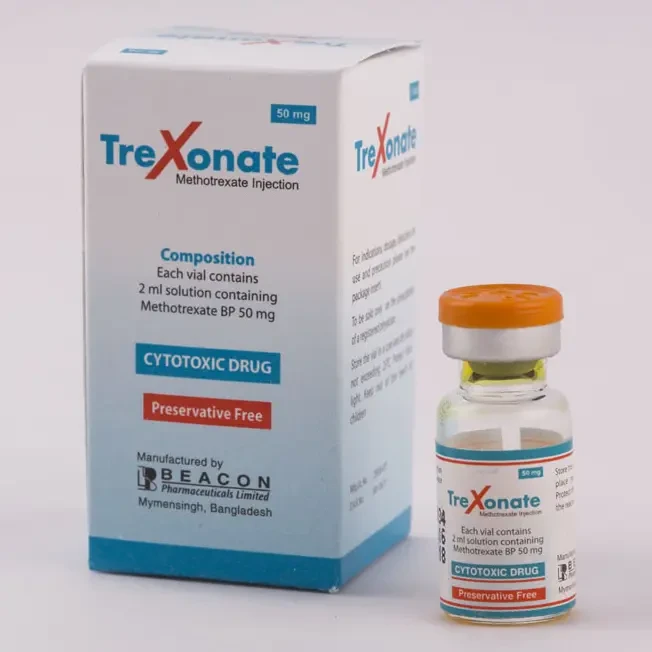
Introduction
Methotrexate is a folate derivative that inhibits several enzymes responsible for nucleotide synthesis. This inhibition leads to suppression of inflammation as well as prevention of cell division. Because of these effects, methotrexate is often used to treat inflammation caused by arthritis or to control cell division in neoplastic diseases such as breast cancer and non-Hodgkin's lymphoma.
Due to the toxic effects of methotrexate, it is indicated for treatment of some forms of arthritis and severe psoriasis only if first line treatment has failed or patients are intolerant of those treatments.
Methotrexate was granted FDA approval on 7 December 1953.
Uses
Methotrexate is an antineoplastic agent used the treatment of a wide variety of cancers as well as severe psoriasis, severe rheumatoid arthritis, and juvenile rheumatoid arthritis.
Methotrexate oral solution is indicated for pediatric acute lymphoblastic leukemia and pediatric polyarticular juvenile idiopathic arthritis. Methotrexate injections for subcutaneous use are indicated for severe active rheumatoid arthritis, polyarticular juvenile idiopathic arthritis and severe, recalcitrant, disabling psoriasis.
Other formulations are indicated to treat gestational choriocarcinoma, chorioadenoma destruens, hydatiform mole, breast cancer, epidermoid cancer of the head and neck, advanced mycosis fungoides, lung cancer, and advanced non-Hodgkin's lymphoma. It is also used in the maintenance of acute lymphocytic leukemia. Methotrexate is also given before treatment with leucovorin to prolong relapse-free survival following surgical removal of a tumour in non-metastatic osteosarcoma.
Associated Conditions
Pharmacodynamics
Methotrexate inhibits enzymes responsible for nucleotide synthesis which prevents cell division and leads to anti-inflammatory actions. It has a long duration of action and is generally given to patients once weekly. Methotrexate has a narrow therapeutic index.
Do not take methotrexate daily.
Mechanism of Action
Methotrexate enters tissues and is converted to a methotrexate polyglutamate by folylpolyglutamate.
Methotrexate's mechanism of action is due to its inhibition of enzymes responsible for nucleotide synthesis including dihydrofolate reductase, thymidylate synthase, aminoimidazole caboxamide ribonucleotide transformylase (AICART), and amido phosphoribosyltransferase. Inhibtion of nucleotide synthesis prevents cell division.
In rheumatoid arthritis, methotrexate polyglutamates inhibit AICART more than methotrexate. This inhibition leads to accumulation of AICART ribonucleotide, which inhibits adenosine deaminase, leading to an accumulation of adenosine triphosphate and adenosine in the extracellular space, stimulating adenosine receptors, leading to anti-inflammatory action.
Absorption
Methotrexate has a bioavailability of 64-90%, though this decreases at oral doses above 25mg due to saturation of the carrier mediated transport of methotrexate.. Methotrexate has a Tmax of 1 to 2 hours. oral doses of 10-15µg reach serum levels of 0.01-0.1µM.
Volume of Distribution
The volume of distribution of methotrexate at steady state is approximately 1L/kg.
Protein Binding
Methotrexate is 46.5-54% bound to plasma proteins.
Route of Elimination
Methotrexate is >80% excreted as the unchanged drug and approximately 3% as the 7-hydroxylated metabolite. Methotrexate is primarily excreted in the urine with 8.7-26% of an intravenous dose appearing in the bile.
Half Life
The half life of low dose methotrexate is 3 to 10 hours in adults. The half life for high dose methotrexate is 8 to 15 hours. Pediatric patients taking methotrexate for acute lymphoblastic anemia experience a terminal half life of 0.7 to 5.8 hours. Pediatric patients taking methotrexate for juvenile idiopathic arthritis experience a half life of 0.9 to 2.3 hours.
Clearance
Methotrexate clearance varies widely between patients and decreases with increasing doses. Currently, predicting clearance of methotrexate is difficult and exceedingly high serum levels of methotrexate can still occur when all precautions are taken.
Toxicity
The oral LD50 in rats is 135mg/kg and in mice is 146mg/kg.
Symptoms of overdose include hematologic and gastrointestinal reactions like leukopenia, thombocytopenia, anemia, pancytopenia, bone marrow suppression, mucositis, stomatitis, oral ulceration, nausea, vomiting, gastrointestinal ulceration, and gastrointestinal bleeding. In the event of an overdose, patients should be treated with glucarpidase and not be given leucovorin for 2 hours before or after glucarpidase.
Food Interactions
- Avoid alcohol.
- Avoid milk and dairy products. Milk and dairy products reduce absorption.
- Exercise caution with St. John's Wort.
- Limit caffeine intake. Caffeine may reduce the effectiveness of methotrexate.
- Take with or without food.
Dosage
Choriocarcinoma and similar trophoblastic diseases: Orally or intramuscularly in doses of 15 to 30 mg daily for a five-day course. The courses are usually repeated for 3 to 5 times as required, with rest periods of one or more weeks interposed between courses, until any manifesting toxic symptoms subside. Since hydatidiform mole may precede choriocarcinoma, prophylactic chemotherapy with methotrexate has been recommended. Chorioadenoma destruens is considered to be an invasive form of hydatidiform mole. Methotrexate is administered in these disease states in doses similar to those recommended for choriocarcinoma
Acute Lymphoblastic Leukemia
- Induction dose: 3.3 mg/m2 in combination with prednisone 60 mg/m2 daily for 4 to 6 weeks
- Maintenance dose: Orally or IM administration 2 times a week in total weekly doses of 30 mg/m2
- Alternate maintenance dose: 2.5 mg/kg IV every 14 days. If and when relapse does occur, reinduction of remission can again usually be obtained by repeating the initial induction regimen
- Burkitt's tumor Stages I to II: 10 to 25 mg once a day for 4 to 8 days
- Burkitt's tumor Stage III: Methotrexate is commonly given concomitantly with other antitumor agents
- Duration of therapy: All stages usually require several courses of therapy interposed with 7 to 10 day rest periods
- Lymphosarcoma Stage III: 0.625 to 2.5 mg/kg daily as a part of combination chemotherapy
Mycosis Fungoides: Early stage dosing: 5 to 50 mg once a week; alternatively, 15 to 37.5 mg 2 times a week may be used in patients who have responded poorly to weekly therapy
Breast Cancer: 40 mg/m 2 intravenously on the 1 st and 8 th day every 4 weeks in combination with cyclophosphamide and fluoracil for 6-12 cycles
Head and Neck Cancer: 40 mg/m2 IV weekly until disease progression or unacceptable toxicity (3 weeks equals one cycle; goal is to complete at least six cycles).
Adult Rheumatoid Arthritis: Single doses of 7.5 mg once per week, Maximum dose: 20 mg/week in adults
Polyarticular-Course Juvenile Rheumatoid Arthritis: 10 mg/m2 once weekly
Psoriasis: Single dose: 10 to 25 mg once per week, maximum dose: 30 mg/week