Introduction
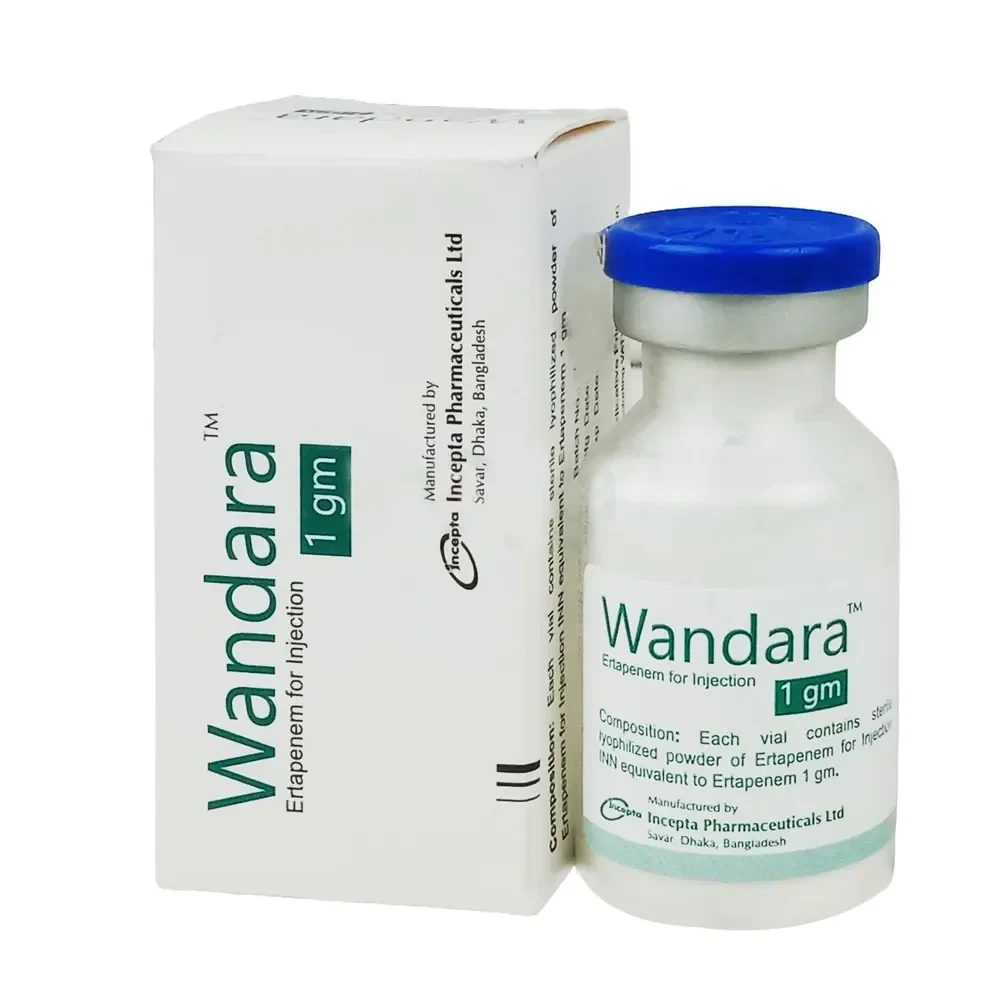
Ertapenem is a carbapenem antibiotic drug that is structurally similar to meropenem and possesses a 1-beta-methyl group.
Uses
Ertapenem is a carbapenem antibiotic used for the treatment of moderate to severe bacterial infections caused by specific sensitive organisms.
For the treatment the following moderate to severe infections caused by susceptible isolates of the designated microorganisms: (1) complicated intra-abdominal infections due to Escherichia coli, Clostridium clostridioforme, Eubacterium lentum, Peptostreptococcus species, Bacteroides fragilis, Bacteroides distasonis, Bacteroides ovatus, Bacteroides thetaiotaomicron, or Bacteroides uniformis, (2) complicated skin and skin structure infections, including diabetic foot infections without osteomyelitis due to Staphylococcus aureus (methicillin susceptible isolates only), Streptococcus agalactiae, Streptococcus pyogenes, Escherichia coli, Klebsiella pneumoniae, Proteus mirabilis, Bacteroides fragilis, Peptostreptococcus species, Porphyromonas asaccharolytica, or Prevotella bivia, (3) community acquired pneumonia due to Streptococcus pneumoniae (penicillin susceptible isolates only) including cases with concurrent bacteremia, Haemophilus influenzae (beta-lactamase negative isolates only), or Moraxella catarrhalis, (4) complicated urinary tract infections including pyelonephritis due to Escherichia coli, including cases with concurrent bacteremia, or Klebsiella pneumoniae, (5) acute pelvic infections including postpartum endomyometritis, septic abortion and post surgical gynecologic infections due to Streptococcus agalactiae, Escherichia coli, Bacteroides fragilis, Porphyromonas asaccharolytica, Peptostreptococcus species, or Prevotella bivia.
Associated Conditions
Pharmacodynamics
Ertapenem has in vitro activity against gram-positive and gram-negative aerobic and anaerobic bacteria.
Mechanism of Action
The bactericidal activity of ertapenem results from the inhibition of cell wall synthesis and is mediated through ertapenem binding to penicillin binding proteins (PBPs). In Escherichia coli, it has strong affinity toward PBPs 1a, 1b, 2, 3, 4 and 5 with preference for PBPs 2 and 3. Ertapenem is stable against hydrolysis by a variety of beta-lactamases, including penicillinases, and cephalosporinases and extended spectrum beta-lactamases. Ertapenem is hydrolyzed by metallo-beta-lactamases.
Absorption
Ertapenem is almost completely absorbed following intramuscular administration. The bioavailability of a 1 g intramuscular dose approximated 92% in 26 healthy subjects [77% male; median (range) age, 29 (22–41) years]. Plasma concentrations of total ertapenem were similar whether given intramuscularly or intravenously.
Volume of Distribution
- 0.12 liter/kg [adults]
- 0.2 liter/kg [pediatric, 3 months to 12 years]
- 0.16 liter/kg [pediatric patients 13 to 17 years]
Protein Binding
Ertapenem is highly bound to human plasma proteins, primarily albumin, in a concentration-dependent manner. The protein binding of ertapenem decreases as plasma concentrations increase. At a plasma concentration of <100 µg/mL, approximately 95% of ertapenem is protein bound. Protein binding of ertapenem decreases to approximately 85% at an approximate plasma concentration of 300 µg/mL.
Route of Elimination
Of the 80% recovered in urine, approximately 38% is excreted as unchanged drug and approximately 37% as the ring-opened metabolite.
Half Life
The mean plasma half-life is approximately 4 hours.
Clearance
- 1.8 L/h
Food Interactions
No interactions found.
Dosage
Pediatric (3 months to 12 years): 15 mg/kg twice daily (not to exceed 1 g/day).
Ertapenem may be administered by IV infusion or IM injection. When administered intravenously, it should be infused over a period of 30 minutes.
IM administration of Ertapenem may be used as an alternative to IV administration in the treatment of those infections for which intramuscular therapy is appropriate.
The usual duration of therapy with Ertapenem is 3 to 14 days but varies by the type of infection and causative pathogen(s). When clinically indicated, a switch to an appropriate oral antimicrobial maybe implemented if clinical improvement has been observed.
Prophylaxis of surgical site infection following elective colorectal surgery: To prevent surgical site infections following surgery in adults, the recommended dosage is 1 g IV administered as a single intravenous dose given 1 hour prior to the surgical incision.
Patients with renal insufficiency: Ertapenem may be used for the treatment of infections in adult patients with renal insufficiency. In patients whose creatinine clearance is >30 mL/min no dosage adjustment is necessary. Adult patients with advanced renal insufficiency (creatinine clearance ≤30 mL/min), including those on haemodialysis, should receive 500 mg daily.
There are no data in paediatric patients with renal insufficiency.
Patients on Haemodialysis: If Ertapenem is given at least 6 hours prior to haemodialysis, no supplementary dose is needed. When adult patients on haemodialysis are given Ertapenem within 6 hours prior to haemodialysis, a supplementary 30% dose is recommended following the haemodialysis session. There are no data in patients undergoing peritoneal dialysis or haemofiltration. There are no data in paediatric patients on haemodialysis.
No dosage adjustment is recommended in patients with impaired hepatic function