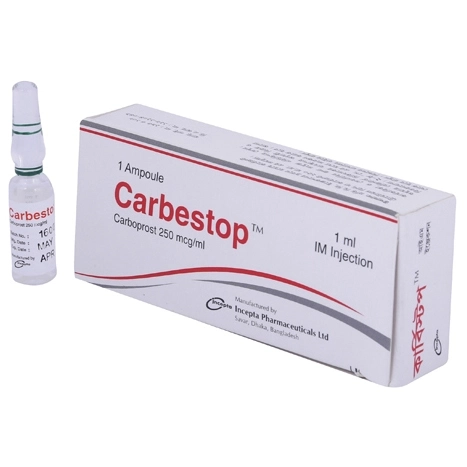
Introduction
A nonsteroidal abortifacient agent that is effective in both the first and second trimesters of pregnancy.
Uses
Carboprost tromethamine is a prostaglandin used to treat postpartum uterine hemorrhage due to atony when other methods of management have not been effective.
For aborting pregnancy between the 13th and 20th weeks of gestation as calculated from the first day of the last normal menstrual period and in the following conditions related to second trimester abortion: 1. Failure of expulsion of the fetus during the course of treatment by another method; 2. Premature rupture of membranes in intrauterine methods with loss of drug and insufficient or absent uterine activity; 3. Requirement of a repeat intrauterine instillation of drug for expulsion of the fetus; 4. Inadvertent or spontaneous rupture of membranes in the presence of a previable fetus and absence of adequate activity for expulsion. Also for the treatment of postpartum hemorrhage due to uterine atony which has not responded to conventional methods of management.
Associated Conditions
Pharmacodynamics
Carboprost tromethamine administered intramuscularly stimulates in the gravid uterus myometrial contractions similar to labor contractions at the end of a full term pregnancy. Whether or not these contractions result from a direct effect of carboprost on the myome-trium has not been determined. Nonetheless, they evacuate the products of conception from the uterus in most cases. Postpartum, the resultant myometrial contractions provide hemostasis at the site of placentation. Carboprost tromethamine also stimulates the smooth muscle of the human gastrointestinal tract. This activity may produce the vomiting or diarrhea or both that is common when carbo-prost tromethamine is used to terminate pregnancy and for use postpartum. In laboratory animals and also in humans carboprost tromethamine can elevate body temperature. With the clinical doses of carboprost trometh-amine used for the termination of pregnancy, and for use postpartum, some patients do experience transient temperature increases. In laboratory animals and in humans large doses of carboprost tromethamine can raise blood pressure, probably by contracting the vascular smooth muscle. With the doses of carboprost tromethamine used for terminating pregnancy, this effect has not been clinically significant. In laboratory animals and also in humans carboprost tromethamine can elevate body temperature. With the clinical doses of carboprost tromethamine used for the termination of pregnancy, some patients do experience temperature increases. In some patients, carboprost tromethamine may cause transient bronchoconstriction.
Mechanism of Action
Carboprost is a synthetic prostaglandin. It binds the prostaglandin E2 receptor, causing myometrial contractions, casuing the induction of labour or the expulsion of the placenta. Prostaglandins occur naturally in the body and act at several sites in the body including the womb (uterus). They act on the muscles of the womb, causing them to contract.
Toxicity
Symptoms of overdose include irritation, nausea, vomiting, diarrhea, coughing, dyspnea, asthma, hypertension, flushing, and pyrexia.
Food Interactions
No interactions found.
Dosage
For Refractory Postpartum Uterine Bleeding: An initial dose of 250 mcg of Carbestop (1 ml) is to be given deep, intramuscularly (IM). If needed the dose of 1 ml may be repeated between 15 to 90 minutes. The total dose of Carbestop should not exceed 2 mg (8 doses).