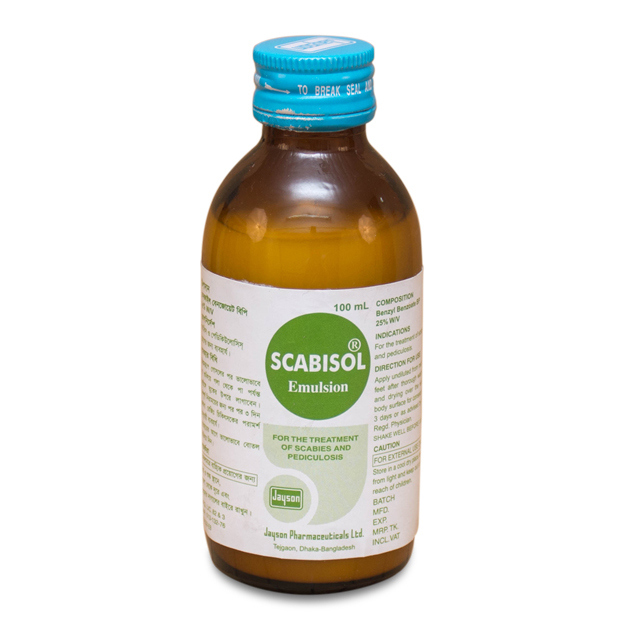
Introduction
Benzyl benzoate is one of the older preparations used to treat scabies. Scabies is a skin infection caused by the mite sarcoptes scabiei. It is characterised by severe itching (particularly at night), red spots, and may lead to a secondary infection. Benzyl benzoate is lethal to this mite and so is useful in the treatment of scabies. It is also used to treat lice infestation of the head and body. Benzyl benzoate is not the treatment of choice for scabies due to its irritant properties.
Uses
Benzyl benzoate is a topical treatment for scabies and lice.
Used to kill lice and the mites responsible for the skin condition scabies.
Associated Conditions
Pharmacodynamics
Benzyl benzoate is one of the older preparations used to treat scabies. Scabies is a skin infection caused by the mite sarcoptes scabiei. It is characterised by severe itching (particularly at night), red spots, and may lead to a secondary infection. Benzyl benzoate is lethal to this mite and so is useful in the treatment of scabies. It is also used to treat lice infestation of the head and body. Benzyl benzoate is not the treatment of choice for scabies due to its irritant properties.
Mechanism of Action
Benzyl benzoate exerts toxic effects on the nervous system of the parasite, resulting in its death. It is also toxic to mite ova, though its exact mechanism of action is unknown. In vitro, benzyl benzoate has been found to kill the Sarcoptes mite within 5 minutes.
Absorption
No data are available on percutaneous absorption of benzyl benzoate. Some older studies have suggested some percutaneous absorption, however the amount was not quantified.
Toxicity
Oral, rabbit: LD50 = 1680 mg/kg; Skin, rabbit: LD50 = 4000 mg/kg. Symptoms of overdose include blister formation, crusting, itching, oozing, reddening, or scaling of skin; difficulty in urinating (dribbling); jerking movements; sudden loss of consciousness.
Dosage
Pediculosis: The affected region is coated with Scabisol followed by a wash 24 hours later with soap and water. In severe cases this procedure may need to be repeated two or three times. An examination should always be made a week after the last treatment to confirm disinfestation.
USE IN CHILDREN: It can be diluted with an equal quantity of water for older children and with three parts of water for babies.