Introduction
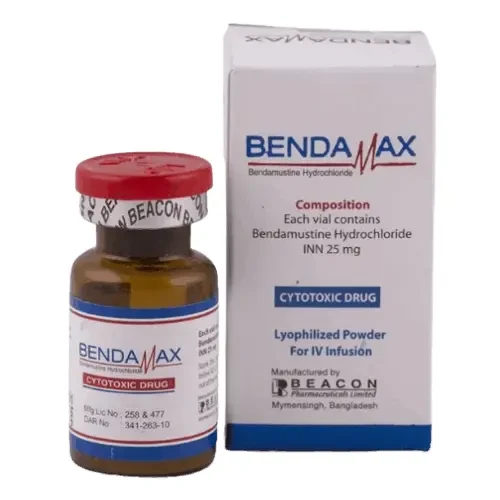
Bendamustine is a nitrogen mustard drug indicated for use in the treatment of chronic lymphocytic leukemia (CLL) and indolent B-cell non-Hodgkin lymphoma (NHL) that has progressed during or within six months of treatment with rituximab or a rituximab-containing regimen. Bendamustine is a bifunctional mechlorethamine derivative capable of forming electrophilic alkyl groups that covalently bond to other molecules. Through this function as an alkylating agent, bendamustine causes intra- and inter-strand crosslinks between DNA bases resulting in cell death. It is active against both active and quiescent cells, although the exact mechanism of action is unknown.
Uses
Bendamustine is an antineoplastic agent used for the treatment of chronic lymphocytic leukemia (CLL) and indolent B-cell non-Hodgkin lymphoma (NHL) that has progressed following rituximab therapy.
Bendamustine is indicated for use in the treatment of chronic lymphocytic leukemia (CLL) and indolent B-cell non-Hodgkin lymphoma (NHL) that has progressed during or within six months of treatment with rituximab or a rituximab-containing regimen.
Associated Conditions
Pharmacodynamics
No mean changes in QTc interval greater than 20 milliseconds were detected up to one hour post-infusion.
Mechanism of Action
Bendamustine is a bifunctional mechlorethamine derivative capable of forming electrophilic alkyl groups that covalently bond to other molecules. Through this function as an alkylating agent, bendamustine causes intra- and inter-strand crosslinks between DNA bases resulting in cell death. It is active against both active and quiescent cells, although the exact mechanism of action is unknown.
Absorption
Following a single IV dose of bendamustine hydrochloride Cmax typically occurred at the end of infusion. The dose proportionality of bendamustine has not been studied.
Volume of Distribution
The mean steady-state volume of distribution (Vss) of bendamustine was approximately 20-25 L. Steady-state volume of distribution for total radioactivity was approximately 50 L, indicating that neither bendamustine nor total radioactivity are extensively distributed into the tissues.
Protein Binding
In vitro, the binding of bendamustine to human serum plasma proteins ranged from 94-96% and data suggest that bendamustine is not likely to displace or to be displaced by highly protein-bound drugs.
Route of Elimination
Mean recovery of total radioactivity in cancer patients following IV infusion of [14C] bendamustine hydrochloride was approximately 76% of the dose. Approximately 50% of the dose was recovered in the urine and approximately 25% of the dose was recovered in the feces. Urinary excretion was confirmed as a relatively minor pathway of elimination of bendamustine, with approximately 3.3% of the dose recovered in the urine as parent. Less than 1% of the dose was recovered in the urine as M3 and M4, and less than 5% of the dose was recovered in the urine as HP2.
Half Life
40 minutes
Clearance
700 mL/min
Toxicity
Risk for tumor-lysis syndrome. Discontinue use in the event of severe/progressive skin reactions. Hematologic malignancies of different forms reported. Discontinue use in the case of severe infusion reactions. May cause extravasation. Mild to moderate renal impairment. Mild hepatic impairment. Sepsis (infections) may occur. Avoid use if pregnant. Possibility of anaphylaxis or infusion reactions- severe in rare cases.
Food Interactions
No interactions found.
Dosage
Multiple myeloma: 120-150 mg/m2 infused over 30-60 min on days 1 and 2 of a 28-day cycle. IV or oral prednisone may be given at a dose of 60 mg/m2 on days 1-4 of the cycle.
Non-Hodgkin's lymphoma: 120 mg/m2 infused over 30-60 min on days 1 and 2 of a 21-day cycle for up to 8 cycles. For severe haematological or non-haematological toxicity: Reduced to 90 mg/m2 on days 1 and 2 of each cycle. If severe toxicity recurs, further reduce dose to 60 mg/m2 on days 1 and 2 of each cycle.