Introduction
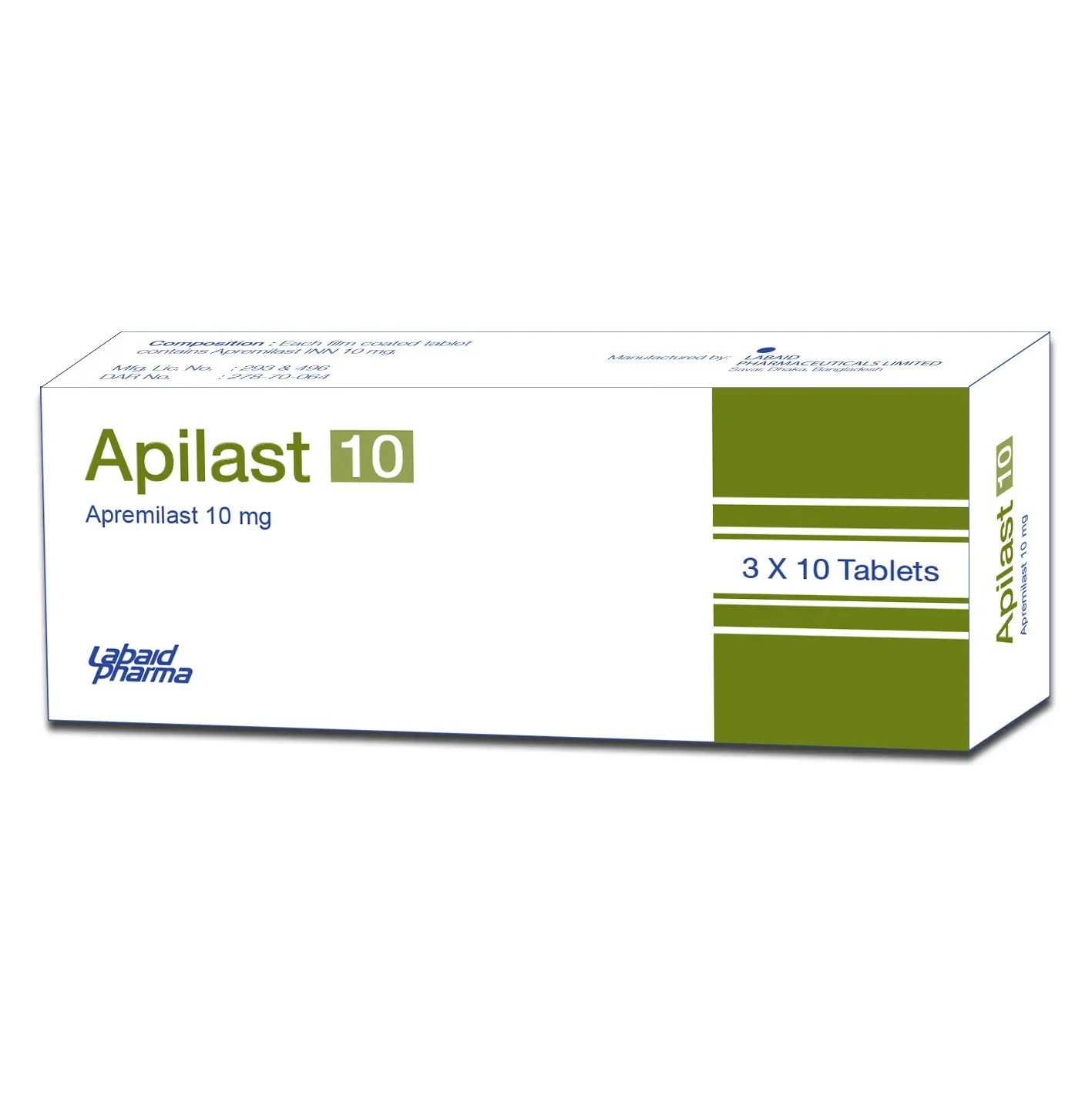
Apremilast is an oral phosphodiesterase 4 (PDE4) inhibitor with anti-inflammatory properties used to treat several inflammatory autoimmune disorders. By inhibiting PDE4, it increases intracellular cyclic AMP (cAMP) levels, which helps regulate inflammatory responses and reduce the production of pro-inflammatory cytokines. Apremilast is used to manage conditions such as psoriasis, psoriatic arthritis, and oral ulcers associated with Behçet's disease. It belongs to the same drug class as roflumilast and crisaborole.
Uses
Apremilast is a non-steroidal medication used for the treatment of inflammatory conditions such as psoriasis and psoriatic arthritis.
Apremilast is indicated for the treating of active psoriatic arthritis in adults, for the treating of active moderate to severe psoriatic arthritis in patients who are eligible for phototherapy and systemic treatment. In addition, apremilast is now indicated for the treatment of oral ulcers associated with Behcet's disease in adults.
Associated Conditions
Pharmacodynamics
Apremilast reduces but does not completely inhibit various inflammatory cytokines such as IL-1α, IL-6, IL-8, IL-10 MCP-1, MIP-1β, MMP-3, and TNF-α, relieving the symptoms of psoriasis and Behcet's disease, which are caused by an increase in these inflammatory mediators. This drug has also been proven to be effective in relieving the pain associated with oral ulcers in Behcet's disease.
A note on depression and weight loss
Apremilast may cause unwanted weight loss and worsen depression, leading to suicidal thoughts or actions. It is advisable to monitor for symptoms of depression and seek medical attention if they occur, especially in patients with pre-existing depression. The need for apremilast should be carefully assessed along with the risk of worsening depression and suicide. If weight loss occurs, the degree of weight loss should be evaluated, and consideration should be made for the possible discontinuation of apremilast.
Mechanism of Action
The full mechanism of action of this drug is not fully established, however, it is known that apremilast is an inhibitor of phosphodiesterase 4 (PDE4), which mediates the activity of cyclic adenosine monophosphate (cAMP), a second messenger. The inhibition of PDE4 by apremilast leads to increased intracellular cAMP levels. An increase in cAMP results in the suppression of inflammation by decreasing the expression of TNF-α, IL-17, IL-23, and other inflammatory mediators. The above inflammatory mediators have been implicated in various psoriatic conditions as well as Behcet's disease, leading to their undesirable inflammatory symptoms such as mouth ulcers, skin lesions, and arthritis. Apremilast administration leads to a cascade which eventually decreases the levels of the above mediators, relieving inflammatory symptoms.
Absorption
An oral dose of apremilast is well-absorbed and the absolute bioavailability is approximately 73%. Tmax is approximately 2.5 hours and Cmax has been reported to be approximately 584 ng/mL in one pharmacokinetic study. Food intake does not appear to affect apremilast absorption.
Volume of Distribution
The average apparent volume of distribution (Vd) is about 87 L, suggesting that apremilast is distributed in the extravascular compartment.
Protein Binding
The plasma protein binding of apremilast is about 68%.
Route of Elimination
Only 3% and 7% of an apremilast dose are detected in the urine and feces as unchanged drug, respectively, indicating extensive metabolism and high absorption.
Half Life
The average elimination half-life of this drug ranges from 6-9 hours.
Clearance
In healthy patients, the plasma clearance of apremilast is about 10 L/hour.
Toxicity
The oral LD50 in mice was greater than 2000 mg/kg in mice. In rats, oral LD50 was 2000 mg/kg males and 300 mg/kg in females.
Overdose information
In healthy subjects receiving a maximum dose of 100 mg (given as 50 mg twice daily) for about 5 days, no significant toxicity was observed. In cases of an overdose, supportive and symptomatic treatment should be administered. Contact the local poison control center for the most recent overdose management for apremilast.
Food Interactions
- Avoid St. John's Wort. Apremilast is a CYP3A substrate; therefore, co-administration with St. John's wort, a CYP3A inducer, may reduce the serum level of apremilast.
- Take with or without food.
Dosage
Day 1: 10 mg in morning
Day 2: 10 mg in morning and 10 mg in evening
Day 3: 10 mg in morning and 20 mg in evening
Day 4: 20 mg in morning and 20 mg in evening
Day 5: 20 mg in morning and 30 mg in evening
Day 6: 30 mg twice daily
Dosage adjustment in patients with severe renal impairment. Apremilast dosage should be reduced to 30 mg once daily in patients with severe renal impairment. For initial dosage titration, it is recommended that Apremilast be titrated using only the morning schedule and the evening doses be skipped.