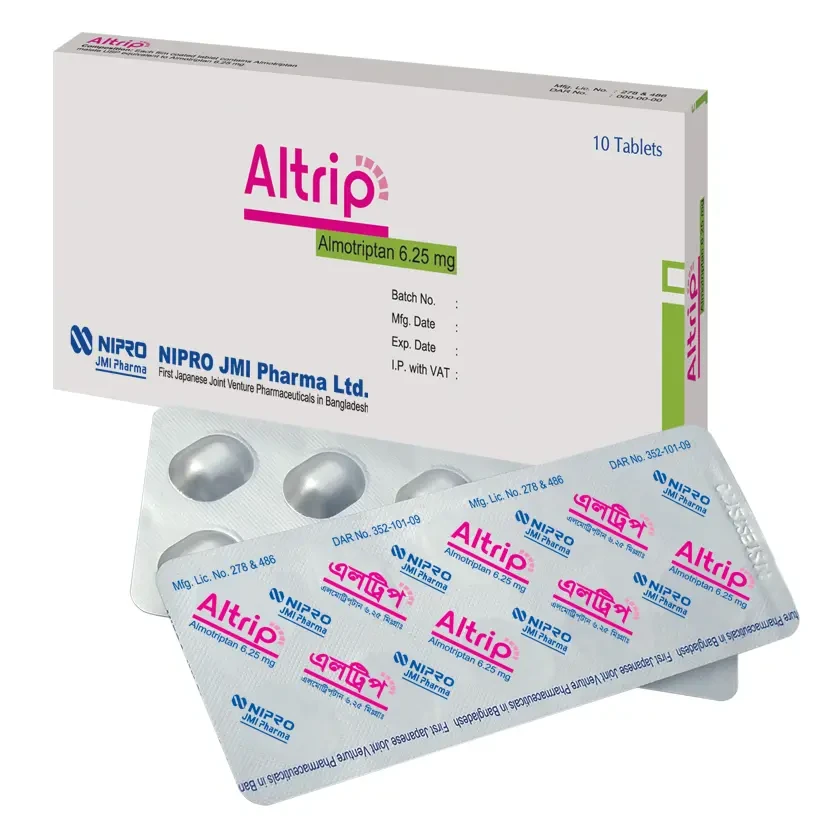
Introduction
Almotriptan is a triptan drug for the treatment of migraine headaches. Almotriptan is in a class of medications called selective serotonin receptor agonists. It works by narrowing blood vessels in the brain, stopping pain signals from being sent to the brain, and stopping the release of certain natural substances that cause pain, nausea, and other symptoms of migraine. Almotriptan does not prevent migraine attacks.
Uses
Almotriptan is a 5-HT1B/1D receptor agonist used to treat migraines.
For the treatment of acute migraine headache in adults
Associated Conditions
Pharmacodynamics
Almotriptan is a selective 5-hydroxytryptamine receptor subtype agonist indicated for the acute treatment of migraine attacks with or without aura in adults. Almotriptan is not intended for the prophylactic therapy of migraine or for use in the management of hemiplegic or basilar migraine. Almotriptan is an agonist for a vascular 5-hydroxytryptamine receptor subtype (probably a member of the 5-HT1D family) having only a weak affinity for 5-HT1A, 5-HT5A, and 5-HT7 receptors and no significant affinity or pharmacological activity at 5-HT2, 5-HT3 or 5-HT4 receptor subtypes or at alpha1-, alpha2-, or beta-adrenergic, dopamine1,; dopamine2; muscarinic, or benzodiazepine receptors. This action in humans correlates with the relief of migraine headache. In addition to causing vasoconstriction, experimental data from animal studies show that Almotriptan also activates 5-HT1 receptors on peripheral terminals of the trigeminal nerve innervating cranial blood vessels, which may also contribute to the antimigrainous effect of Almotriptan in humans.
Mechanism of Action
Almotriptan binds with high affinity to human 5-HT1B and 5-HT1D receptors leading to cranial blood vessel constriction.
Volume of Distribution
- 180 to 200 L
Protein Binding
35%
Route of Elimination
Almotriptan is eliminated primarily by renal excretion (about 75% of the oral dose), with approximately 40% of an administered dose excreted unchanged in urine. Approximately 13% of the administered dose is excreted via feces, both unchanged and metabolized.
Half Life
3-4 hours
Clearance
- 57 L/h [healthy]
- 34.2 L/h [moderate renal impairment (creatinine clearance between 31 and 71 mL/min)]
- 9.8 L/h [severe renal impairment (creatinine clearance between 10 and 30 mL/min)]
Food Interactions
- Take with or without food. The absorption is unaffected by food.
Dosage
Hepatic Impairment: The recommended starting dose of almotriptan malate in patients with hepatic impairment is 6.25 mg. The maximum daily dose should not exceed 12.5 mg over a 24-hour period
Renal Impairment: The recommended starting dose of almotriptan malate in patients with severe renal impairment is 6.25 mg. The maximum daily dose should not exceed 12.5 mg over a 24-hour period