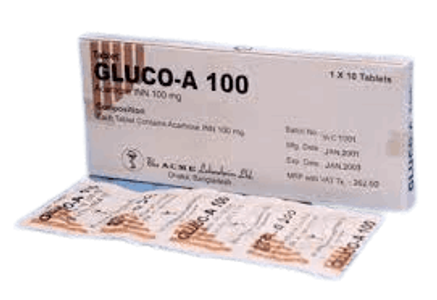
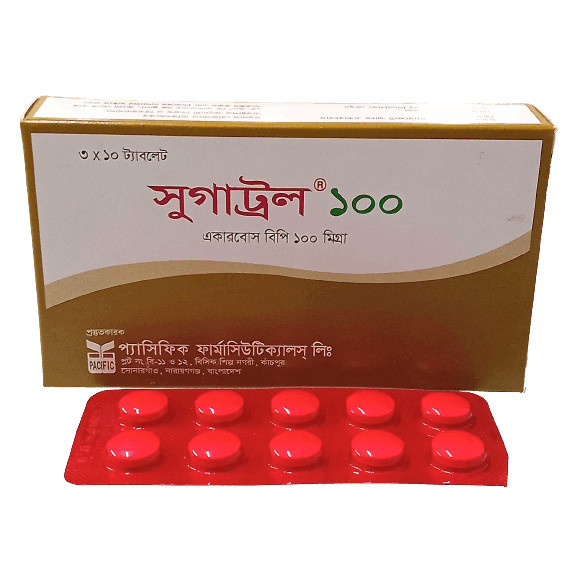
Generic Name Acarbose
Bangla Name অ্যাকারবোয
Available brands 5
Language

Introduction

Acarbose is an alpha-glucosidase inhibitor that lowers post-meal blood sugar and insulin spikes in Type 2 Diabetes by blocking intestinal enzymes (such as alpha-amylase and sucrase) from breaking down complex carbohydrates into absorbable simple sugars. It is used alongside diet, exercise, and other medications. However, it is rarely prescribed today due to its limited impact on long-term blood sugar levels ($A1c$), cumbersome thrice-daily dosing requirement, and significant gastrointestinal side effects.

Uses

Acarbose is an alpha-glucosidase inhibitor used in adjunctly with diet and exercise for the management of glycemic control in patients with type 2 diabetes mellitus.

Acarbose is indicated as an adjunct to diet and exercise to improve glycemic control in adults with type 2 diabetes mellitus.

Associated Conditions

  • Type 2 Diabetes Mellitus

Pharmacodynamics

Acarbose is a complex oligosaccharide that competitively inhibits the ability of brush-border alpha-glucosidase enzymes to break down ingested carbohydrates into absorbable monosaccharides, reducing carbohydrate absorption and subsequent postprandial insulin levels. Acarbose requires the co-administration of carbohydrates in order to exert its therapeutic effect, and as such should be taken with the first bite of a meal three times daily.

Given its mechanism of action, acarbose in isolation poses little risk of contributing to hypoglycemia - this risk is more pronounced, however, when acarbose is used in conjunction with other antidiabetic therapies (e.g. sulfonylureas, insulin). Patients maintained on acarbose in addition to other antidiabetic agents should be aware of the symptoms and risks of hypoglycemia and how to treat hypoglycemic episodes. There have been rare post-marketing reports of the development of pneumatosis cystoides intestinalis following treatment with alpha-glucosidase inhibitors - patients experiencing significant diarrhea/constipation, mucus discharge, and/or rectal bleeding should be investigated and, if pneumatosis cystoides intestinalis is suspected, should discontinue therapy.

Mechanism of Action

Alpha-glucosidase enzymes are located in the brush-border of the intestinal mucosa and serve to metabolize oligo-, tri-, and disaccharides (e.g. sucrose) into smaller monosaccharides (e.g. glucose, fructose) which are more readily absorbed. These work in conjunction with pancreatic alpha-amylase, an enzyme found in the intestinal lumen that hydrolyzes complex starches to oligosaccharides.

Acarbose is a complex oligosaccharide that competitively and reversibly inhibits both pancreatic alpha-amylase and membrane-bound alpha-glucosidases - of the alpha-glucosidases, inhibitory potency appears to follow a rank order of glucoamylase > sucrase > maltase > isomaltase. By preventing the metabolism and subsequent absorption of dietary carbohydrates, acarbose reduces postprandial blood glucose and insulin levels.

Absorption

The oral bioavailability of acarbose is extremely minimal, with less than 1-2% of orally administered parent drug reaching the systemic circulation. Despite this, approximately 35% of the total radioactivity from a radiolabeled and orally administered dose of acarbose reaches the systemic circulation, with peak plasma radioactivity occurring 14-24 hours after dosing - this delay is likely reflective of metabolite absorption rather than absorption of the parent drug. As acarbose is intended to work within the gut, its minimal degree of oral bioavailability is therapeutically desirable.

Protein Binding

As only 1-2% of an orally administered dose is absorbed into the circulation, acarbose is unlikely to be subject to clinically relevant protein binding.

Route of Elimination

Roughly half of an orally administered dose is excreted in the feces within 96 hours of administration. What little drug material is absorbed into the systemic circulation (approximately 34% of an orally administered dose) is excreted primarily by the kidneys, suggesting renal excretion would be a significant route of elimination if the parent drug was more readily absorbed - this is further supported by data in which approximately 89% of an intravenously administered dose of acarbose was excreted in the urine as active drug (in comparison to 7

Half Life

In healthy volunteers, the plasma elimination half-life of acarbose is approximately 2 hours.

Toxicity

The symptoms of acarbose overdose are likely to be consistent with its adverse effect profile and may therefore include significant gastrointestinal (GI) symptoms (flatulence, distension, etc), although an overdose on an empty stomach (i.e. when not co-administered with food) is less likely to result in these GI symptoms. In the event of an overdose, patients should be instructed to avoid carbohydrate-containing foods for 4-6 hours following administration as these can precipitate the aforementioned GI symptoms.

Food Interactions

  • Take with food. Each dose should be taken with the first bite of a main meal.

Dosage

The recommended starting dosage of Acarbose is 25 mg given orally three times daily at the start (with the first bite) of each main meal. However, some patients may benefit from more gradual dose titration to minimize gastrointestinal side effects. This may be achieved by initiating treatment at 25 mg once per day and subsequently increasing the frequency of administration to achieve 25 mg t.i.d. Maintenance Dosage Once a 25 mg t.i.d. dosage regimen is reached, dosage of Acarbose should be adjusted at 4–8 week intervals based on one-hour postprandial glucose or glycosylated hemoglobin levels, and on tolerance. The dosage can be increased from 25 mg t.i.d. to 50 mg t.i.d. Some patients may benefit from further increasing the dosage to 100 mg t.i.d. The maintenance dose ranges from 50 mg t.i.d. to 100 mg t.i.d.

Frequently Asked Questions About Acarbose

1. What is Acarbose?

Acarbose is an oral medication used to manage type 2 diabetes by slowing carbohydrate digestion and absorption.

2. What is Acarbose used for?

Acarbose is used to control blood sugar levels in patients with type 2 diabetes, usually along with diet and exercise.

3. How does Acarbose work?

It inhibits enzymes that break down carbohydrates in the intestines, reducing glucose absorption and preventing spikes in blood sugar after meals.

4. Is Acarbose an insulin?

No, Acarbose is not insulin; it is an alpha-glucosidase inhibitor that helps regulate blood sugar levels.

5. How should Acarbose be taken?

Acarbose should be taken with the first bite of each main meal.

6. Can Acarbose be used alone?

Yes, but it is often combined with other diabetes medications like metformin or insulin for better blood sugar control.

7. What are the side effects of Acarbose?

Common side effects include:

  • Flatulence (gas)
  • Diarrhea
  • Abdominal pain
  • Bloating

8. Does Acarbose cause hypoglycemia?

No, Acarbose alone does not cause low blood sugar, but it may increase the risk when combined with insulin or sulfonylureas.

9. Can Acarbose be taken on an empty stomach?

No, it should be taken with food to be effective.

10. How long does Acarbose take to work?

It starts working immediately after a meal, reducing post-meal blood sugar spikes.

11. Can children take Acarbose?

Acarbose is usually not recommended for children.

12. Can pregnant women take Acarbose?

Acarbose should be used in pregnancy only if prescribed by a doctor.

13. Can Acarbose be used for type 1 diabetes?

No, it is not commonly used for type 1 diabetes.

14. Can Acarbose cause weight loss?

Some people experience mild weight loss due to reduced calorie absorption.

15. Can Acarbose cause weight gain?

No, it does not typically cause weight gain.

16. What should I do if I miss a dose?

If you miss a dose, skip it and take the next dose with your next meal. Do not double the dose.

17. Can Acarbose be taken with metformin?

Yes, it is commonly prescribed with metformin for better blood sugar control.

18. Can Acarbose be taken with insulin?

Yes, but monitor blood sugar closely to avoid hypoglycemia.

19. Can Acarbose cause diarrhea?

Yes, diarrhea is a common side effect, especially when starting treatment.

20. Can Acarbose cause bloating?

Yes, bloating and gas are common side effects due to fermentation of undigested carbohydrates.

21. Can I drink alcohol while taking Acarbose?

Alcohol should be consumed in moderation as it may affect blood sugar levels.

22. Does Acarbose interact with other medications?

Yes, it may interact with:

  • Digoxin
  • Intestinal adsorbents
  • Enzymes like pancreatin

23. Can Acarbose cause liver damage?

Rarely, Acarbose can cause elevated liver enzymes. Regular liver function tests are recommended.

24. Can Acarbose be crushed?

No, Acarbose tablets should be swallowed whole.

25. How should Acarbose be stored?

Store at room temperature, away from moisture and heat.

26. Is Acarbose a prescription medication?

Yes, Acarbose requires a doctor's prescription.

27. Can Acarbose be taken with herbal supplements?

Some herbal supplements may interact with Acarbose. Consult your doctor before use.

28. Can Acarbose be used in elderly patients?

Yes, but with caution, as elderly patients may be more sensitive to gastrointestinal side effects.

29. Can Acarbose cause pancreatitis?

No, Acarbose is not known to cause pancreatitis.

30. Can Acarbose affect kidney function?

Patients with kidney disease should use Acarbose cautiously.

31. Can Acarbose be used in prediabetes?

Yes, it may be used to prevent the progression of prediabetes to type 2 diabetes.

32. Is Acarbose available as a generic drug?

Yes, generic versions of Acarbose are available.

33. Can Acarbose cause constipation?

Constipation is not a common side effect.

34. Can Acarbose be used for gestational diabetes?

It is not commonly recommended for gestational diabetes.

35. Can Acarbose be used in combination with sulfonylureas?

Yes, but the risk of hypoglycemia may increase.

36. Can Acarbose be stopped suddenly?

Yes, but stopping it may lead to increased blood sugar levels.

37. Can Acarbose cause dizziness?

Dizziness is not a common side effect.

38. Is Acarbose safe for long-term use?

Yes, if monitored regularly by a doctor.

39. Can Acarbose cause nausea?

Yes, but it is usually mild.

40. Can Acarbose be taken with probiotics?

Probiotics may help reduce digestive side effects of Acarbose.

41. Can Acarbose be used for weight loss?

It is not a weight loss medication, but it may help with weight control in diabetes.

42. Can Acarbose be taken with aspirin?

Acarbose can generally be taken with aspirin, but consult your doctor.

43. Can Acarbose be used in non-diabetic patients?

It is not commonly prescribed for non-diabetic patients.

44. Can Acarbose be used in combination with SGLT2 inhibitors?

Yes, but consult your doctor for the best combination therapy.

45. Can Acarbose be taken after meals?

No, it should be taken with the first bite of food.

46. Can Acarbose cause allergic reactions?

Yes, though rare, allergic reactions like rash or swelling may occur.

47. Does Acarbose affect cholesterol levels?

It may have a mild beneficial effect on cholesterol levels.

48. Can Acarbose be taken with thyroid medications?

Yes, but take them at different times to avoid interaction.

49. Can Acarbose cause changes in appetite?

No significant effects on appetite have been reported.

50. Can Acarbose cause fatigue?

Fatigue is not a common side effect.

Medical review

Last reviewed: 24 Jul 2026

Medically reviewed by:

This is general information, not personal medical advice. Consult a doctor before taking any medicine.

Taking medicines without doctor's advice can cause long-term problems.
Brand medicines containing Acarbose