Introduction
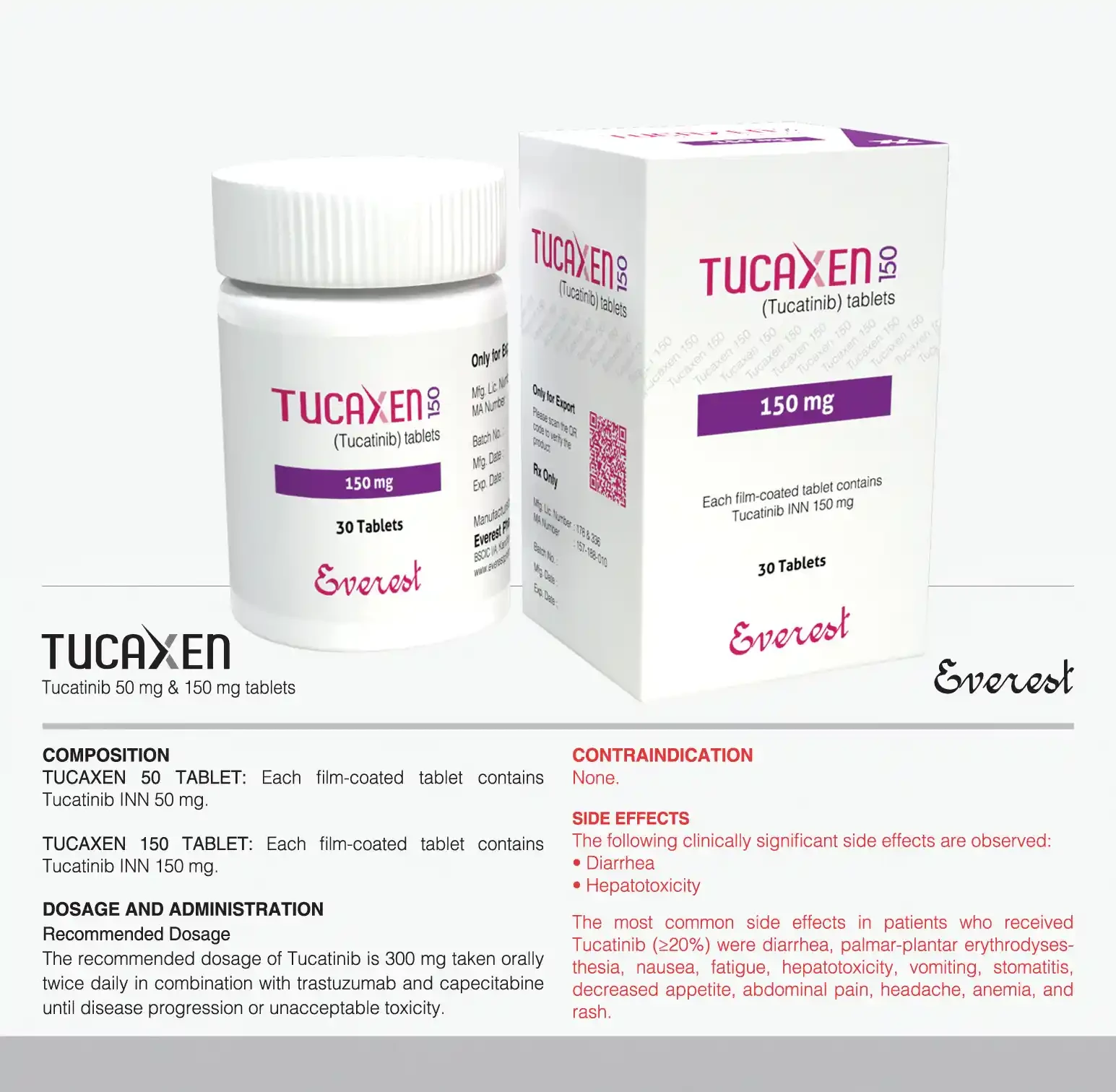
Tucatinbib is a kinase inhibitor drug used with trastuzumab and capecitabine in the treatment of unresectable or metastatic HER-2 positive breast cancer. It was developed by Seattle Genetics and approved by the FDA on April 17, 2020. Tucaxen Tablet 150 mg is a promising new treatment for patients with metastatic breast cancer who have not responded adequately to other chemotherapy regimens.
Uses
Tucaxen Tablet 150 mg is a kinase inhibitor used to treat certain types of unresectable/metastatic HER-2 positive breast cancer.
Tucaxen Tablet 150 mg is indicated with trastuzumab and capecitabine for treatment of adults diagnosed with advanced unresectable or metastatic HER2-positive breast cancer. This includes patients with brain metastases and those who have received one or more prior anti-HER2-based regimens in the metastatic setting.
Associated Conditions
Pharmacodynamics
By inhibiting tyrosine kinase, tucatinib exerts anti-tumor activity, reducing the size of HER-2 positive breast cancer tumors. In clinical trials, the regimen of tucatinib and trastuzumab showed enhanced activity both in vitro and in vivo when compared to either drug administered by itself.
Mechanism of Action
Mutations in the HER-2 gene are observed in some types of breast carcinoma. Tucaxen Tablet 150 mg inhibits the tyrosine kinase enzyme of the HER-2 gene. Mutations of tyrosine kinase in the HER-2 gene lead to cascade effects of increased cell signaling and proliferation, resulting in malignancy. Results of in vitro studies show that tucatinib inhibits the phosphorylation of both HER-2 and HER-3, leading to downstream changes in MAPK and AKT signaling and cell proliferation. Anti-tumor activity occured in the cells that expressed HER-2. In vivo, tucatinib has been shown to inhibit HER-2 expressing tumors, likely by the same mechanism.
Absorption
The Tmax for tucatinib ranges from 1 to 4 hours. One pharmacokinetic study revealed a Cmax of 1120 ng/mL after a dose of 350 mg twice daily with a Tmax ranging from 1 to 3 hours. The AUCtau was reported to be about 7120 hours×ng/mL.
Volume of Distribution
The volume of distribution of tucatinib is about 1670 L. This drug penetrates the blood-brain barrier.
Protein Binding
Tucaxen Tablet 150 mg is about 97% bound to plasma proteins.
Route of Elimination
In a study of radiolabled tucatinib, about 86% of the total dose was excreted in the feces and 4.1% was found in the urine. About 16% of the tucatinib dose recovered in the feces was identified as unchanged tucatinib.
Half Life
A pharmacokinetic study revealed a half-life of approximately 5.38 hours. Prescribing information mentions a geometric mean half-life of about 8.21 hours.
Clearance
The apparent clearance is 148 L/h.
Toxicity
LD50 information and overdose information for tucatinib are not readily available in the literature. In the case of an overdose with this drug, increased adverse effects, such as diarrhea, nausea, abdominal pain, vomiting fatigue, hepatotoxicity, vomiting, decreased appetite, anemia, headache, and rash are expected.
Food Interactions
- Take with or without food. There is no meaningful clinical effect of food on this drug.
Dosage
Dosage Modifications for Severe Hepatic Impairment: For patients with severe hepatic impairment (Child-Pugh C), reduce the recommended dosage to 200 mg orally twice daily.
Dosage Modifications for Concomitant Use with Strong CYP2C8 Inhibitors: Avoid concomitant use of strong CYP2C8 inhibitors with Tucaxen Tablet 150 mg. If concomitant use with a strong CYP2C8 inhibitor cannot be avoided, reduce the recommended dosage to 100 mg orally twice daily. After discontinuation of the strong CYP2C8 inhibitor for 3 elimination half-lives, resume the Tucaxen Tablet 150 mg dose that was taken prior to initiating the inhibitor.