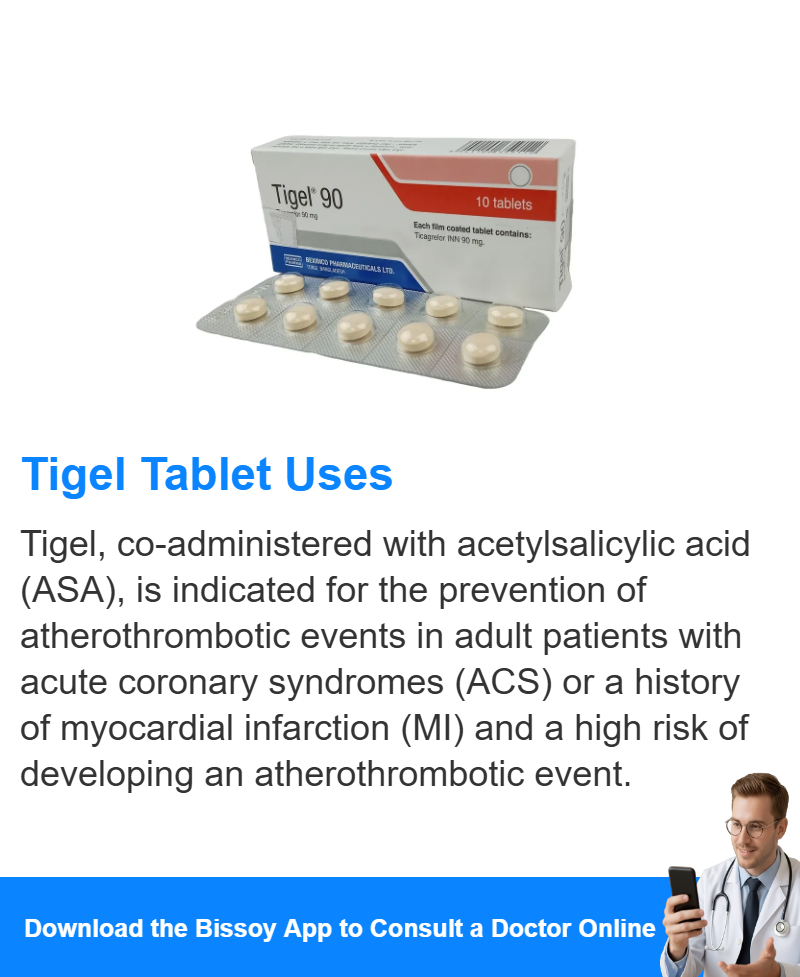
Introduction
Tigel Tablet 90 mg, or AZD6140, was first described in the literature in 2003. Tigel Tablet 90 mg is an ADP derivative developed for its P2Y12 receptor antagonism. Unlike clopidogrel, ticagrelor is not a prodrug.
Uses
Tigel Tablet 90 mg is a P2Y12 platelet inhibitor used in patients with a history of myocardial infarction or with acute coronary syndrome (ACS) to prevent future myocardial infarction, stroke and cardiovascular death.
Tigel Tablet 90 mg is indicated to reduce the risk of cardiovascular death, myocardial infarction, and stroke in patients with acute coronary syndrome or a history of myocardial infarction. Tigel Tablet 90 mg is also indicated to reduce the risk of a first myocardial infarction or stroke in high risk patients with coronary artery disease.
Associated Conditions
Pharmacodynamics
Tigel Tablet 90 mg is a P2Y12 receptor antagonist that inhibits the formation of thromboses to reduce the risk of myocardial infarction and ischemic stroke. It has a moderate duration of action as it is given twice daily, and a wide therapeutic index as high single doses are well tolerated. Patients should be counselled regarding the risk of bleeding, dyspnea, and bradyarrhythmias.
Mechanism of Action
Tigel Tablet 90 mg is a P2Y12 receptor antagonist.
The P2Y12 receptor couples with Gαi2 and other Gi proteins which inhibit adenylyl cyclase. Gi mediated signalling also activates PI3K, Akt, Rap1b, and potassium channels. The downstream effects of these activities mediate hemostasis and lead to platelet aggregation.
Antagonism of the P2Y12 receptor reduces development of occlusive thromboses, which can reduce the risk of myocardial infarction and ischemic stroke.
Absorption
Tigel Tablet 90 mg is 36% orally bioavailable. A single 200mg oral dose of ticagrelor reaches a Cmax of 923ng/mL, with a Tmax of 1.5 hours and an AUC of 6675ng*h/mL. The active metabolite of ticagrelor reaches a Cmax of 264ng/mL, with a Tmax of 3.0 hours and an AUC of 2538ng*h/mL.
Volume of Distribution
The steady state volume of distribution of ticagrelor is 88 L.
Protein Binding
Tigel Tablet 90 mg and its active metabolite ate >99% protein bound in plasma, particularly albumin.
Route of Elimination
A radiolabelled dose of ticagrelor is 57.8% recovered in feces and 26.5% recovered in urine. Less than 1% of the dose is recovered as the unmetabolized parent drug. The active metabolite AC-C124910XX makes up 21.7% of the recovery in the feces. The metabolite AR-C133913XX makes up 9.2% of the recovery in the urine and 2.7% of the recovery in the feces. Other minor metabolites are predominantly recovered in the urine.
Half Life
Tigel Tablet 90 mg has a plasma half life of approximately 8 hours, while the active metabolite has a plasma half life of approximately 12 hours.
Clearance
The renal clearance of ticagrelor is 0.00584L/h.
Toxicity
Patients experiencing an overdose may present with bleeding, nausea, vomiting, diarrhea, and ventricular pauses. Overdose can be managed through symptomatic and supportive treatment, including ECG monitoring. Dialysis is not expected to remove ticagrelor from the blood due to it being highly protein bound.
Food Interactions
- Avoid grapefruit products. Grapefruit inhibits the CYP3A4 metabolism of ticagrelor, which may increase its serum concentration.
- Avoid herbs and supplements with anticoagulant/antiplatelet activity. Herbs with antiplatelet activity may increase the risk of bleeding. Examples include garlic, ginger, bilberry, danshen, piracetam, and ginkgo biloba.
- Avoid St. John's Wort. This herb induces the CYP3A4 metabolism of ticagrelor and may reduce its serum concentration.
- Take with or without food.
Dosage
Acute coronary syndromes: Tigel Tablet 90 mg treatment should be initiated with a single 180 mg loading dose (two tablets of 90 mg) and then continued at 90 mg twice daily. Treatment with Tigel Tablet 90 mg twice daily is recommended for 12 months in ACS patients unless discontinuation is clinically indicated.
History of myocardial infarction: Tigel Tablet 90 mg 60 mg twice daily is the recommended dose when an extended treatment is required for patients with a history of MI of at least one year and a high risk of an atherothrombotic event. Treatment may be started without interruption as continuation therapy after the initial one-year treatment with ticagrelor or another adenosine diphosphate (ADP) receptor inhibitor therapy in ACS patients with a high risk of an atherothrombotic event. Treatment can also be initiated up to 2 years from the MI, or within one year after stopping previous ADP receptor inhibitor treatment. There are limited data on the efficacy and safety of ticagrelor beyond 3 years of extended treatment.
Switch therapy: If a switch is needed, the first dose of ticagrelor should be administered 24 hours following the last dose of the other antiplatelet medication.
Missed dose: A patient who misses a dose of ticagrelor should take only one tablet (their next dose) at its scheduled time.
Elderly: No dose adjustment is required in the elderly.
Renal impairment: No dose adjustment is necessary for patients with renal impairment. No information is available concerning the treatment of patients on renal dialysis and therefore ticagrelor is not recommended in these patients.
Hepatic impairment: Tigel Tablet 90 mg has not been studied in patients with severe hepatic impairment and its use in these patients is therefore contraindicated. Only limited information is available in patients with moderate hepatic impairment. Dose adjustment is not recommended, but ticagrelor should be used with caution. No dose adjustment is necessary for patients with mild hepatic impairment.
Pediatric population: The safety and efficacy of ticagrelor in hildren below the age of 18 years have not been established. No data are available. Tigel Tablet 90 mg can be administered with or without food. Contra-indications, warnings etc.