Plarit Tablet 90 mg Introduction

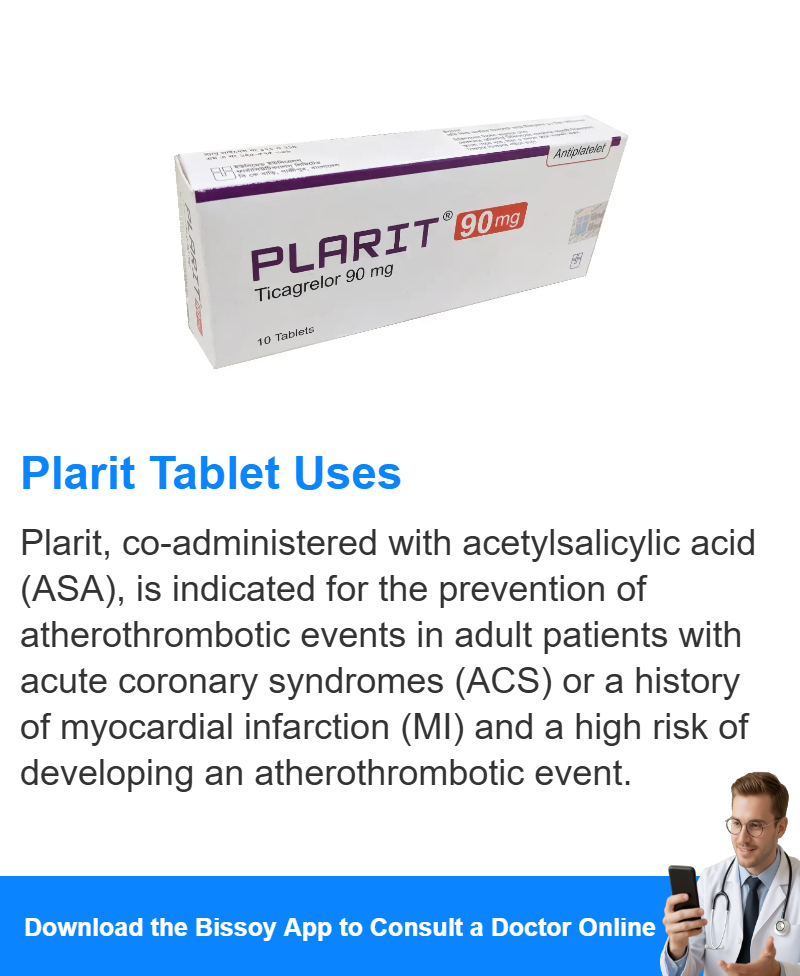
Plarit Tablet 90 mg is an antiplatelet medication that is used to reduce the rate of cardiovascular events, including death. It belongs to a class of drugs called cyclooxygenase (COX)-2 inhibitors. It works by reducing the production of thromboxane A2 (TXA2), a platelet-activating molecule that can lead to clot formation. Plarit Tablet 90 mg is used in most countries to reduce the risk of stroke and heart attack in people with established or at high risk of cardiovascular disease.

Uses for Plarit Tablet 90 mg

Plarit Tablet 90 mg is used to reduce the risk of death or stroke in patients with acute coronary syndrome (ACS). It is also recommended for those with acute ischemic stroke in some countries, and for reducing the risk of peripheral arterial disease in patients with coronary artery disease. It is also sometimes used to reduce angina in some patients.

Brand Name Plarit
Type Tablet
Weight 90 mg
Generic Ticagrelor
Manufacturer UniMed UniHealth
Available in English বাংলা

Mechanism of Action

Plarit Tablet 90 mg works by blocking the action of the enzyme cyclooxygenase-2 (COX-2), which is responsible for the production of thromboxane A2 (TXA2), a platelet-activating molecule. By blocking TXA2, ticagrelor reduces the chances of clot formation. It also helps to keep platelets from sticking to each other, which prevents them from clumping together and creating clots. This helps to reduce the risk of stroke and heart attack.

How Long Does it Take to Work?

Plarit Tablet 90 mg generally takes effect within 10 minutes after it is taken. The effects lasts for about a day, until the body has processed and eliminated the medication.

Absorption

Plarit Tablet 90 mg is rapidly and almost completely absorbed after oral administration. The maximum concentration is usually reached within 1–2 hours.

Route of Elimination

Plarit Tablet 90 mg is mainly eliminated through the kidneys. It is excreted in the urine as unchanged drug and metabolites.

Dosage

Patients taking Ticagrelor should also take a daily low maintenance dose of acetylsalicylic acid (ASA) 75-150 mg unless specifically contraindicated.

Acute coronary syndromes: Ticagrelor treatment should be initiated with a single 180 mg loading dose (two tablets of 90 mg) and then continued at 90 mg twice daily. Treatment with Ticagrelor twice daily is recommended for 12 months in ACS patients unless discontinuation is clinically indicated.

History of myocardial infarction: Ticagrelor 60 mg twice daily is the recommended dose when an extended treatment is required for patients with a history of MI of at least one year and a high risk of an atherothrombotic event. Treatment may be started without interruption as continuation therapy after the initial one-year treatment with ticagrelor or another adenosine diphosphate (ADP) receptor inhibitor therapy in ACS patients with a high risk of an atherothrombotic event. Treatment can also be initiated up to 2 years from the MI, or within one year after stopping previous ADP receptor inhibitor treatment. There are limited data on the efficacy and safety of ticagrelor beyond 3 years of extended treatment.

Switch therapy: If a switch is needed, the first dose of ticagrelor should be administered 24 hours following the last dose of the other antiplatelet medication.

Missed dose: A patient who misses a dose of ticagrelor should take only one tablet (their next dose) at its scheduled time.

Elderly: No dose adjustment is required in the elderly.

Renal impairment: No dose adjustment is necessary for patients with renal impairment. No information is available concerning the treatment of patients on renal dialysis and therefore ticagrelor is not recommended in these patients.

Hepatic impairment: Ticagrelor has not been studied in patients with severe hepatic impairment and its use in these patients is therefore contraindicated. Only limited information is available in patients with moderate hepatic impairment. Dose adjustment is not recommended, but ticagrelor should be used with caution. No dose adjustment is necessary for patients with mild hepatic impairment.

Pediatric population: The safety and efficacy of ticagrelor in hildren below the age of 18 years have not been established. No data are available. Ticagrelor can be administered with or without food. Contra-indications, warnings etc.
The recommended adult dosage for ticagrelor is 60 mg twice daily. It should be taken with food to reduce the risk of stomach and intestine irritation. It is not recommended for patients with severe renal impairment.

Administration

Plarit Tablet 90 mg is usually taken by mouth, as a tablet or an oral suspension. It is recommended to be taken with food. It should be taken exactly as prescribed by the doctor.

Side Effects

Common side effects of ticagrelor include headache, indigestion, nausea, vomiting, diarrhea, dizziness, fatigue, and rash. Rare side effects can include bleeding complications, hypotension, and liver problems.

Toxicity

Plarit Tablet 90 mg is safe when used as recommended. The most serious effect of overdose is bleeding. Seek medical attention immediately if you suspect an overdose.

Precaution

Plarit Tablet 90 mg should be used with caution in patients with a history of bleeding disorders or who take other medications that increase the risk of bleeding. It is also not recommended for pregnant women and those who are breastfeeding.

Interaction

Plarit Tablet 90 mg may interact with certain drugs, including anticoagulants, antiplatelet drugs, and nonsteroidal anti-inflammatory drugs (NSAIDs). It is important to tell your doctor about all medications and supplements, including vitamins and herbal products, you are taking before taking ticagrelor.

Disease Interaction

Plarit Tablet 90 mg may interact with diseases such as liver disease, kidney disease, and bleeding disorders. Tell your doctor about any medical conditions you may have before taking ticagrelor.

Drug Interaction

Plarit Tablet 90 mg may interact with other medications, including anticoagulants, antiplatelet drugs, and nonsteroidal anti-inflammatory drugs (NSAIDs). Tell your doctor about all medications and supplements, including vitamins and herbal products, you are taking before taking ticagrelor.

Food Interaction

Food does not significantly affect the absorption of ticagrelor, but it is recommended to take the medication with food to reduce the risk of stomach and intestine irritation.

Pregnancy Use

Plarit Tablet 90 mg is not recommended for use during pregnancy. It has the potential to cause serious harm to a developing fetus.

Lactation Use

Plarit Tablet 90 mg is excreted in breast milk and is not recommended for use while breastfeeding. It may cause serious harm to a nursing baby.

Acute Overdose

If an overdose is suspected, seek medical attention immediately. The most serious effect of overdose is bleeding.

Contraindication

Plarit Tablet 90 mg is contraindicated in patients with a history of severe renal impairment, a history of bleeding disorders, during pregnancy and breastfeeding, and in patients taking other medications that increase the risk of bleeding.

Use Direction

Plarit Tablet 90 mg should be taken exactly as prescribed by the doctor. It is usually taken orally, as a tablet or an oral suspension with food. It is not recommended for use in patients with severe renal impairment.

Storage Condition

Plarit Tablet 90 mg should be stored at room temperature away from direct sunlight and heat. Keep it in a dry place and out of reach of children.

Volume of Distribution

The volume of distribution of ticagrelor in humans is approximately 176 L, indicating widespread distribution of the drug throughout the body.

Half Life

The half-life of ticagrelor is approximately 8 hours. After 24 hours, the drug has been largely eliminated from the body.

Clearance

The clearance of ticagrelor is approximately 21 L/h, indicating that it is quickly cleared from the body. It is mainly eliminated through the kidneys as unchanged drug and metabolites.

See in details version Plarit Tablet 90 mg also Plarit Tablet 90 mg in bangla

Social card

Uses

Some Frequently Asked Questions About Plarit Tablet 90 mg

1. What is Plarit Tablet 90 mg?

Plarit Tablet 90 mg is an antiplatelet medication used to prevent blood clots in patients with acute coronary syndrome (ACS) or those who have undergone procedures like angioplasty. It reduces the risk of heart attacks and strokes by preventing platelets from sticking together.

2. How does Plarit Tablet 90 mg work?

Plarit Tablet 90 mg works by blocking the P2Y12 receptor on platelets, preventing them from clumping together and forming clots. This reduces the risk of heart attacks, strokes, and other cardiovascular events.

3. What conditions are treated with Plarit Tablet 90 mg?

Plarit Tablet 90 mg is mainly used to treat:

  • Acute coronary syndrome (ACS)
  • Heart attack (myocardial infarction)
  • Unstable angina
  • Patients undergoing stent placement or coronary artery bypass grafting (CABG)

4. Is Plarit Tablet 90 mg a blood thinner?

Yes, Plarit Tablet 90 mg is classified as an antiplatelet drug, which acts as a blood thinner to prevent clot formation. However, it works differently from anticoagulants like warfarin or heparin.

5. How should Plarit Tablet 90 mg be taken?

Plarit Tablet 90 mg is usually taken orally, twice a day, with or without food. It is often prescribed alongside low-dose aspirin (75-100 mg daily) for maximum effectiveness.

6. What is the usual dose of Plarit Tablet 90 mg?

The standard dose of Plarit Tablet 90 mg is a 180 mg loading dose, followed by 90 mg twice daily for the first 12 months. After 12 months, the dose may be reduced to 60 mg twice daily.

7. Can Plarit Tablet 90 mg be taken with aspirin?

Yes, Plarit Tablet 90 mg is usually prescribed with a low dose of aspirin. However, high-dose aspirin (greater than 100 mg daily) may reduce the effectiveness of Plarit Tablet 90 mg.

8. What are the possible side effects of Plarit Tablet 90 mg?

Common side effects include:

  • Shortness of breath (dyspnea)
  • Bleeding
  • Dizziness
  • Nausea
  • Headache
Serious side effects may include severe bleeding or irregular heartbeat.

9. Can Plarit Tablet 90 mg cause bleeding?

Yes, since Plarit Tablet 90 mg prevents blood clotting, it increases the risk of bleeding. Patients may experience bruising, nosebleeds, or prolonged bleeding from minor cuts.

10. What should I do if I miss a dose of Plarit Tablet 90 mg?

If you miss a dose, take it as soon as you remember. However, if it’s almost time for your next dose, skip the missed dose and return to your regular schedule. Do not double up to make up for a missed dose.

11. Can Plarit Tablet 90 mg be used during pregnancy?

Plarit Tablet 90 mg is generally not recommended during pregnancy unless the potential benefits outweigh the risks. Consult your healthcare provider if you are pregnant or planning to become pregnant.

12. Can Plarit Tablet 90 mg be used while breastfeeding?

It is not known if Plarit Tablet 90 mg passes into breast milk. Breastfeeding mothers should consult a doctor before using this medication.

13. How long should I take Plarit Tablet 90 mg?

Patients are typically advised to take Plarit Tablet 90 mg for at least 12 months after a heart attack or stent placement. In some cases, it may be continued for longer if recommended by a healthcare provider.

14. Can Plarit Tablet 90 mg be taken with other medications?

Plarit Tablet 90 mg may interact with certain medications, including:

  • Anticoagulants (e.g., warfarin)
  • Antifungals
  • Rifampin
  • Seizure medications
  • Strong CYP3A inhibitors or inducers
Inform your doctor about all the medications and supplements you are taking.

15. Can Plarit Tablet 90 mg be taken by elderly patients?

Yes, Plarit Tablet 90 mg is often prescribed to elderly patients. However, they may have an increased risk of bleeding and should be closely monitored during treatment.

16. Is Plarit Tablet 90 mg safe for people with liver disease?

Plarit Tablet 90 mg is not recommended for patients with severe liver disease. Liver function should be assessed before starting the medication.

17. Can Plarit Tablet 90 mg cause shortness of breath?

Yes, some patients experience shortness of breath (dyspnea) while taking Plarit Tablet 90 mg. This side effect is usually mild and temporary, but it should be reported to a doctor if severe.

18. Can Plarit Tablet 90 mg cause allergic reactions?

Although rare, some individuals may experience allergic reactions like rash, itching, or swelling. Seek immediate medical help if you experience signs of a severe allergic reaction.

19. Is Plarit Tablet 90 mg used to prevent stroke?

Yes, Plarit Tablet 90 mg is used to reduce the risk of stroke in patients with a history of heart disease, coronary artery disease (CAD), or previous stroke events.

20. Can Plarit Tablet 90 mg be stopped suddenly?

No, stopping Plarit Tablet 90 mg suddenly without medical advice can increase the risk of heart attack or stroke. Always follow your doctor’s instructions when discontinuing the medication.

21. What should I do in case of a Plarit Tablet 90 mg overdose?

If you suspect a Plarit Tablet 90 mg overdose, seek emergency medical attention. Symptoms may include severe bleeding or difficulty breathing.

22. Can Plarit Tablet 90 mg affect kidney function?

Plarit Tablet 90 mg is generally safe for people with mild or moderate kidney disease. However, kidney function should be monitored, particularly in patients with severe kidney impairment.

23. Does Plarit Tablet 90 mg require regular monitoring?

Routine monitoring is not usually required for Plarit Tablet 90 mg, but doctors may perform periodic blood tests to assess bleeding risk or liver function.

24. Can I have surgery while on Plarit Tablet 90 mg?

If you need surgery, inform your surgeon that you are taking Plarit Tablet 90 mg. It may need to be stopped temporarily before major surgery to reduce bleeding risk.

25. Is Plarit Tablet 90 mg a lifelong medication?

In most cases, Plarit Tablet 90 mg is prescribed for 12 months, but some patients may need to continue it long-term to prevent future cardiovascular events. Your doctor will decide the duration based on your health condition.

*** Taking medicines without doctor's advice can cause long-term problems.
Dr. Md. Talal Mamun

Dr. Md. Talal Mamun

Dental, Oral & Maxillofacial Surgery Specialist

Call Doctor
Dr. Md. Ali Faisal Liton

Dr. Md. Ali Faisal Liton

Orthopedics, Arthroscopy & Arthroplasty Surgeon

Call Doctor
Dr. Md. Manir Hossain Khan

Dr. Md. Manir Hossain Khan

General, Laparoscopic, Hepatobiliary, Colorectal & GI Surgeon

Call Doctor
Related Medicines