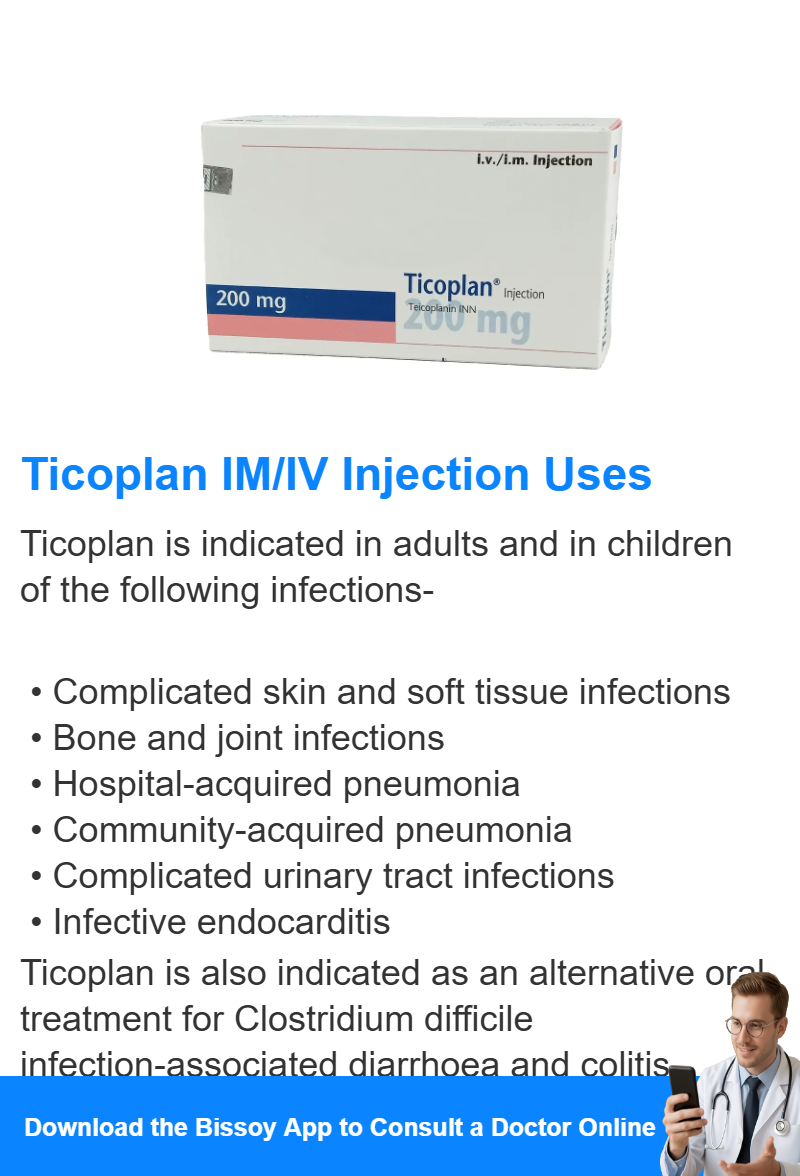
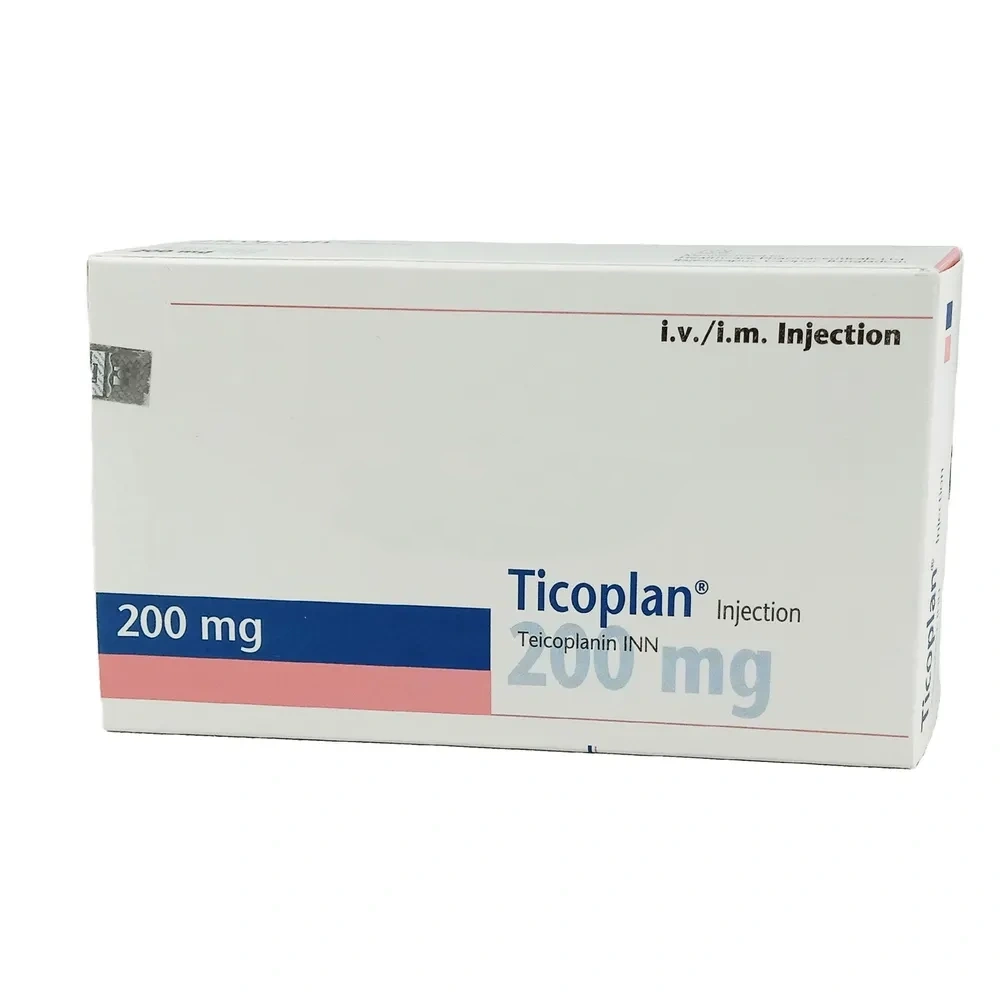
Introduction
Ticoplan IM/IV Injection 200 mg/vial is a glycopeptide antibiotic consisting of a mixture of several compounds, five major (named teicoplanin A2-1 through A2-5) and four minor (named teicoplanin RS-1 through RS-4). All teicoplanins share a same glycopeptide core, teicoplanin A3-1, but differ in the length and conformation of side chains attached to their β-D-glucosamine moiety.
Uses
Ticoplan IM/IV Injection 200 mg/vial is a glycopeptide antibiotic with a similar mechanism of action and spectrum of activity to vancomycin used to treat various infections caused by gram-positive bacteria.
For the treatment of bacterial infections caused by susceptible microorganisms.
Associated Conditions
Pharmacodynamics
It is a glycopeptide antiobiotic extracted from Actinoplanes teichomyceticus, with a similar spectrum of activity to vancomycin. Its mechanism of action is to inhibit bacterial cell wall synthesis. Oral teicoplanin has been demonstrated to be effective in the treatment of pseudomembranous colitis and Clostridium difficile-associated diarrhoea, with comparable efficacy to vancomycin.
Mechanism of Action
Ticoplan IM/IV Injection 200 mg/vial inhibits peptidoglycan polymerization, resulting in inhibition of bacterial cell wall synthesis and cell death.
Absorption
Ticoplan IM/IV Injection 200 mg/vial is poorly absorbed after oral administration but is 90% bioavailable when administered intramuscularly.
Protein Binding
90% to 95%
Half Life
70-100 hours
Dosage
In adults (Normal kidney function):
- On the first day, a dose of 6 mg/kg (generally 400 mg) intravenously is recommended. On the following days, the dose may be 6 mg/kg/day (generally 400 mg) intravenously or 3 mg/kg/day (generally 200 mg) intravenously or intramuscularly as a single daily dose. The highest dose and the intravenous route are recommended for serious infections.
- In potentially fatal infections, treatment should be started with 6 mg/kg (usually 400 mg) twice daily for 1 to 4 days (loading dose) and continued with 6 mg/kg/day intravenously on the following days (maintenance dose).
- In moderate kidney failure (creatinine clearance between 40 and 60 ml/min), the daily dose of Ticoplan IM/IV Injection 200 mg/vial should be halved or given on alternate days.
- In severe kidney failure (creatinine clearance less than 40 ml/min) and in hemodialysis patients, the daily dose of Ticoplan IM/IV Injection 200 mg/vial should be reduced to a third, or given every 3 days.
- If creatinine clearance is equal to or less than 20 ml/min, treatment with Ticoplan IM/IV Injection 200 mg/vial may be given only if monitoring of drug levels in the blood can be guaranteed.
- In Children (2 months to 12 years): Treatment should be started at a dose of 10 mg/kg every 12 hours for a total of 3 doses and then continued at a dose of 6-10 mg/kg/day, the highest dose being used for the most serious infections or for children with neutropenia.
- In neonates (up to 2 months): Treatment should be started at a dose of 16 mg/kg on the first day, followed by maintenance doses of 8 mg/kg/day by slow intravenous infusion (lasting approximately 30 minutes).
Clostridium difficile infection associated diarrhea: The recommended dose is 100-200 mg administered twice a day for 7 to 14 days. Giving Ticoplan IM/IV Injection 200 mg/vial along with another suitable bactericidal antibiotic is recommended for infections requiring maximum bactericidal activity or in situations where the presence of Gram-negative bacteria cannot be ruled out (empirical treatment of fever in patients with neutropenia). In most patients, this medicine can be seen to have an effect 48 to 72 hours after the start of treatment. However, the total duration of treatment is determined based on the type and severity of the infection and the patient’s response to treatment. In endocarditis and osteomyelitis, a period of at least 3 weeks is recommended.