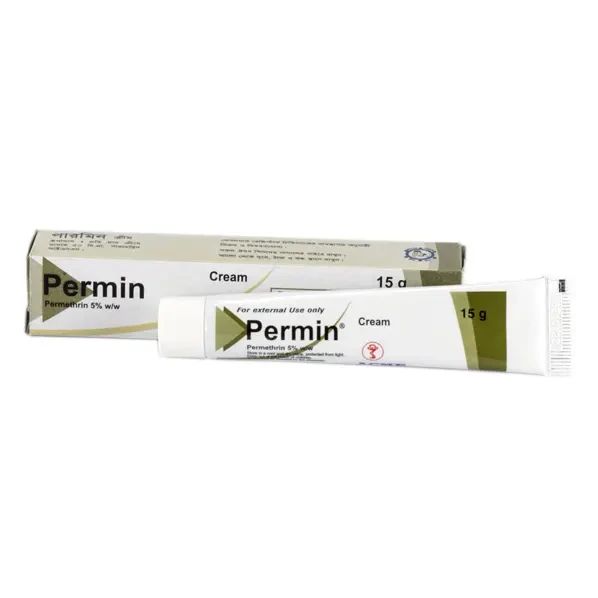
Permin Cream 5% w/w is an insecticide and a synthetic pyrethroid used topically to prevent infestations of lice, mites, ticks, fleas, and mosquitos. It works as a nerve paralyzer for the insect, stopping its life cycle, and is very effective in controlling lice, ticks, fleas, and other insects with a single application.
Permin Cream 5% w/w is used to treat head lice, crab lice, scabies, and other parasites on the skin. It is also used for the prevention of fleas, mosquitoes, and ticks on clothing and camping gear. In veterinary medicine, it is used to treat fleas, mange, and other ectoparasite infestations in dogs and cats.
| Brand Name | Permin |
|---|---|
| Type | Cream |
| Weight | 5% w/w |
| Generic | Permethrin |
| Manufacturer | ACME Laboratories Ltd. |
| Available in | English বাংলা |
Permin Cream 5% w/w works by interfering with the nervous systems of insects, leading to paralysis and death. It binds to sodium channels, which are the channels responsible for the passage of ions across the neuron membrane, interrupting nerve impulses and leading to muscle paralysis.
The effects of permethrin can be observed within several hours of the application. Complete elimination of parasites, such as head lice, can usually be noted within 24 to 48 hours after application.
Permin Cream 5% w/w is rapidly absorbed through the skin and topical application produces only low levels of systemic absorption. The rate of absorption through the skin is relatively low, but it has been shown to be higher in people who are elderly or have skin diseases.
Permin Cream 5% w/w is eliminated primarily via the kidneys. About 70-80% of a single dose is excreted via the urine within 48 hours.
The recommended dosage of permethrin for humans is 5% cream applied to affected areas of skin, usually once, in a single treatment. For topical lice control, permethrin is applied for 10-15 minutes and then washed off. Different concentrations are available for treating different insect infestations.
Permin Cream 5% w/w is applied topically directly to the infested areas of skin. It can also be used to treat clothing and camping gear to prevent infestations of fleas, mosquitos, and ticks. It can also be administered as a bath to treat mange and other ectoparasite infestations in dogs and cats.
Common side effects include skin irritation, contact dermatitis, and an increase in mild skin inflammation. In some cases, more serious side effects can occur such as redness, itching, hives, swelling, or blisters of the skin. It is important to contact a healthcare provider if any of these symptoms occur.
Permin Cream 5% w/w is considered to be of low toxicity to humans. In cases of acute poisoning or overdose, the primary symptom is general malaise, but no long-term effects or serious toxicity have been reported.
Permin Cream 5% w/w should not be used on open wounds or on a child younger than two months old. Do not apply to the eyes, mouth, or other mucous membranes. It is also important to use permethrin as directed and to avoid getting it in the eyes.
Permin Cream 5% w/w is known to interact with certain drugs, including hydroxychloroquine, sulfadoxine/pyrimethamine, and phenytoin. It is important to tell your healthcare provider about any drugs you are taking before using permethrin.
Permin Cream 5% w/w can interact with certain diseases, such as asthma or eczema. People with these conditions should consult a doctor before using permethrin.]
Permin Cream 5% w/w can interact with certain drugs, such as anticonvulsants, phenytoin, immunosuppressants, and some anti-malaria medications. It is important to tell your healthcare provider about any drugs you are taking before using permethrin.
There is limited information available on the interactions between permethrin and food. If you are taking permethrin, it is important to monitor your diet and avoid food interactions that could affect the efficacy of the medication.
Permin Cream 5% w/w is in the pregnancy category B, meaning that it has been tested in pregnant animals and has not shown any adverse effects on the fetus. It should be used with caution in pregnant women and only as directed by a healthcare provider.
There is limited data available on the safety of permethrin during lactation. However, it is believed to be safe to use while nursing. It is important to talk to your healthcare provider before using permethrin while nursing.
There have been no reports of acute overdose from permethrin. In cases of accidental overdose, the primary symptom is general malaise, but no long-term effects or serious toxicity have been reported.
Permin Cream 5% w/w is contraindicated for use in individuals who are hypersensitive to it or any of its ingredients. It should also not be used on open wounds, in the eyes, mouth, or other mucous membranes. Do not apply to a child younger than two months old.
Permin Cream 5% w/w should be used as directed on the label. It is important to follow the instructions carefully, as different concentrations are available for treating different insect infestations. Always wash your hands after using permethrin.
Permin Cream 5% w/w should be stored at room temperature away from heat and moisture. Keep it out of reach of children and pets and away from direct sunlight.
Permin Cream 5% w/w has a volumetric distribution of about 126 L/kg, meaning that about 126 liters of the drug is present in the body per 1 kg of body mass.
The half-life of permethrin is approximately 24 hours. This means that after 24 hours only half of the initial dose that was administered will remain in the body. After 7 days, the drug will have been eliminated from the body completely.
The renal clearance of permethrin is 15 mL/min/kg. This means that 15 mL of the drug are filtered out of the body per minute per 1 kg of body mass.
See in details version Permin Cream 5% w/w also Permin Cream 5% w/w in bangla
Dr. Mst. Parul Akter
Gynecology, Obstetrics Specialist & Laparoscopic Surgeon
Gynecologist in Khulna