Introduction
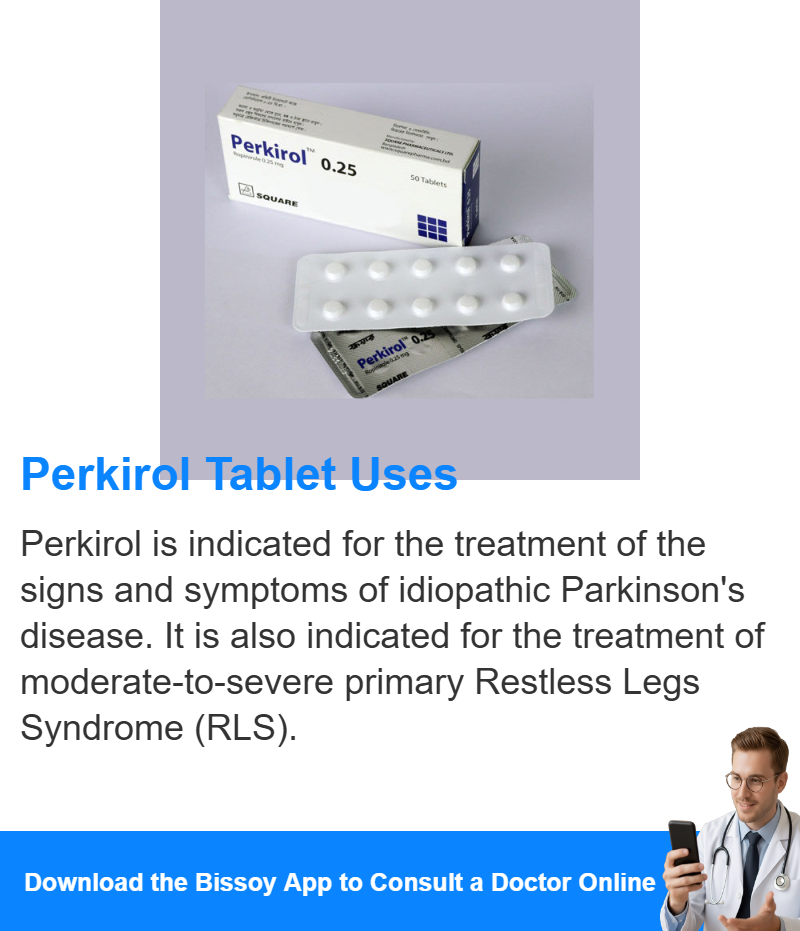
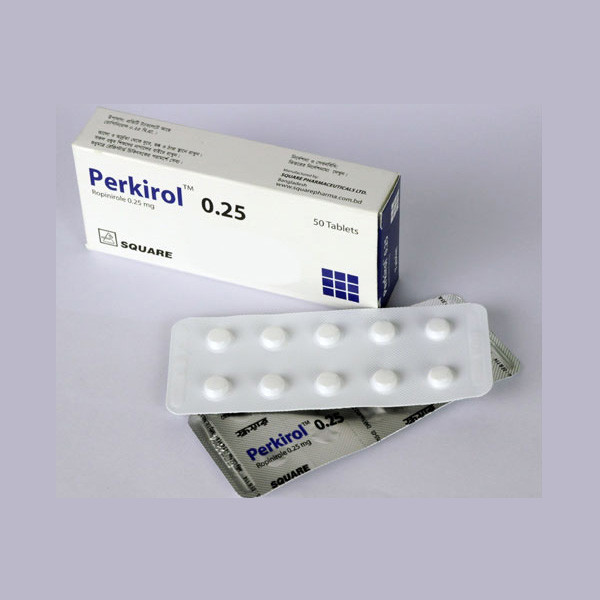
Perkirol Tablet 0.25 mg is a non-ergoline dopamine agonist used in the treatment of Parkinson's disease and moderate to severe restless legs syndrome (RLS). It stimulates dopamine receptors in the brain, helping to improve motor symptoms such as tremor, rigidity, bradykinesia, and the uncomfortable sensations associated with RLS.
Perkirol Tablet 0.25 mg may be used alone or in combination with levodopa in Parkinson's disease. Extended-release formulations allow for once-daily dosing, improving treatment convenience while maintaining efficacy.
Uses
Perkirol Tablet 0.25 mg is a non-ergoline dopamine agonist used to treat the symptoms of Parkinson's disease and Restless Legs Syndrome.
For the treatment of the signs and symptoms of Parkinson's disease and for the treatment of primary moderate-severe restless legs syndrome .
Associated Conditions
Pharmacodynamics
Effects on Parkinson's and restless leg syndrome
This drug promotes the relief or improvement of symptoms of Parkinson's or restless leg syndrome by stimulatory actions on dopamine receptors, which regulate movement.
Effects on blood pressure
Clinical experience with dopamine agonists, including ropinirole, suggests an association with impaired abilities in regulating blood pressure with resulting orthostatic hypotension, especially with patients undergoing dose escalation. In some patients in clinical studies, blood pressure changes were associated with orthostatic symptoms, bradycardia, and, in one case in a healthy volunteer, transient sinus arrest accompanied by syncope . The mechanism of orthostatic hypotension caused by ropinirole is assumed to be due to a D2-mediated blunting of noradrenergic response to a standing position, followed by a decrease in peripheral vascular resistance. Nausea is also a frequent symptom which accompanies orthostatic signs and symptoms .
Effects on prolactin
At oral doses as low as 0.2 mg, ropinirole suppressed serum prolactin concentrations in healthy male volunteers. Perkirol Tablet 0.25 mg had no dose-related effect on ECG wave form and rhythm in young, healthy, male volunteers in the range of 0.01 to 2.5 mg .
Effects on QT interval
Perkirol Tablet 0.25 mg had no dose- or exposure-related effect on average QT intervals in healthy male and female volunteers at doses up to 4 mg/day. The effect of ropinirole on QTc intervals at higher exposures reached either due to drug interactions, hepatic dysfunction, or at higher doses has not been adequately evaluated .
Mechanism of Action
Perkirol Tablet 0.25 mg is a non-ergoline dopamine agonist. Perkirol Tablet 0.25 mg has the highest affinity at the D3 receptors, which are concentrated in the limbic areas of the brain and may be responsible for some of the neuropsychiatric effects . The exact mechanism of action of ropinirole as a treatment for Parkinson’s disease is unknown, however, it is believed to be related to its ability to selectively stimulate dopamine D2 receptors within the caudate-putamen system in the brain. This system affects body movement. Negligible affinity is seen for ropinirole at α2 adrenoreceptors in the periphery and 5HT-1 receptor. Perkirol Tablet 0.25 mg has no affinity at the D1-like receptors, benzodiazepine or GABA receptors .
The precise mechanism of action of ropinirole as a treatment for Restless Legs Syndrome is unknown, however, it is believed to be related to its ability to stimulate dopamine receptors .
Absorption
Perkirol Tablet 0.25 mg is rapidly absorbed after oral administration, reaching peak concentration in approximately 1 to 2 hours , .
Absolute bioavailability was 45% to 55%, suggesting approximately 50% hepatic first-pass effect . The bioavailability of ropinirole prolonged release compared to the immediate release tablets is about 100% .
Ingestion of food does not affect the absorption of ropinirole, although its Tmax was increased by 2.5 hours and its Cmax was reduced by approximately 25% when the drug is taken with a high-fat meal .
Volume of Distribution
Perkirol Tablet 0.25 mg is found to be widely distributed throughout the body, with an apparent volume of distribution of 7.5 L/kg .
Protein Binding
40% bound to plasma proteins with a blood-to-plasma ratio of 1:1 .
Route of Elimination
The majority of the absorbed dose is cleared by the liver .
In clinical trials, more than 88% of a radiolabeled dose was recovered in urine . Less than 10% of the administered dose is excreted as unchanged drug in urine. N-despropyl ropinirole is the major metabolite found in the urine (40%), followed by the carboxylic acid metabolite (10%), and the glucuronide of the hydroxy metabolite (10%) .
Half Life
Approximately 6 hours , .
Clearance
The clearance of ropinirole after oral administration is 47 L/h .
Toxicity
Overdose
Symptoms of overdose include agitation, chest pain, confusion, drowsiness, facial muscle movements, grogginess, increased jerkiness of movement, symptoms of low blood pressure (dizziness, light-headedness)upon standing, nausea, and vomiting .
Carcinogenicity
Two-year carcinogenicity studies of ropinirole were performed on animal models at oral doses of 5, 15, and 50 mg/kg/day and in rats at oral doses of 1.5, 15, and 50 mg/kg/day. There was an increase in testicular Leydig cell adenomas at all doses tested in rats. The hormonal mechanisms thought to be involved in the development of these tumors in rats are not considered relevant to humans. In mice, there was an increase in benign uterine endometrial polyps at a dose of 50 mg/kg/day. The highest dose not associated with this observation (15 mg/kg/day) is three times the maximum recommended human dose on a mg/m2 basis .
Mutagenesis
Perkirol Tablet 0.25 mg was not found to be mutagenic or clastogenic during in vitro assays, or in the in vivo mouse micronucleus test .
Effects on reproduction
When given to female rats prior to and during mating and throughout pregnancy, ropinirole led to disruption of implantation at oral doses of 20 mg/kg/day (8 times the MRHD on a mg/m2 basis) or higher. This effect in rats is believed to be due to the prolactin-lowering effects of ropinirole.
Use in Pregnancy
Pregnancy Category C. There are no sufficient and well-controlled studies done in pregnant women. In animal reproduction studies, ropinirole has demonstrated adverse effects on embryo-fetal development, including teratogenicity .
Food Interactions
- Take with or without food. May take with food to reduce nausea.
Dosage
- Week 1: 0.25 mg 3 times daily. Total Daily Dose 0.75 mg
- Week 2: 0.5 mg 3 times daily. Total Daily Dose 1.50 mg
- Week 3: 0.75 mg 3 times daily. Total Daily Dose 2.25 mg
- Week 4: 1 mg 3 times daily. Total Daily Dose 3 mg
- Days 1 and 2: 0.25 mg, 1 to 3 hours before bedtime, to be taken once daily
- Days 3-7: 0.5 mg, 1 to 3 hours before bedtime, to be taken once daily
- Days 2: 1 mg, 1 to 3 hours before bedtime, to be taken once daily
- Days 3: 1.5 mg, 1 to 3 hours before bedtime, to be taken once daily
- Days 4: 2 mg, 1 to 3 hours before bedtime, to be taken once daily
- Days 5: 2.5 mg, 1 to 3 hours before bedtime, to be taken once daily
- Days 6: 3 mg, 1 to 3 hours before bedtime, to be taken once daily
- Days 7: 4 mg, 1 to 3 hours before bedtime, to be taken once daily