Introduction
An antimetabolite antineoplastic agent with immunosuppressant properties. It interferes with nucleic acid synthesis by inhibiting purine metabolism and is used, usually in combination with other drugs, in the treatment of or in remission maintenance programs for leukemia.
Uses
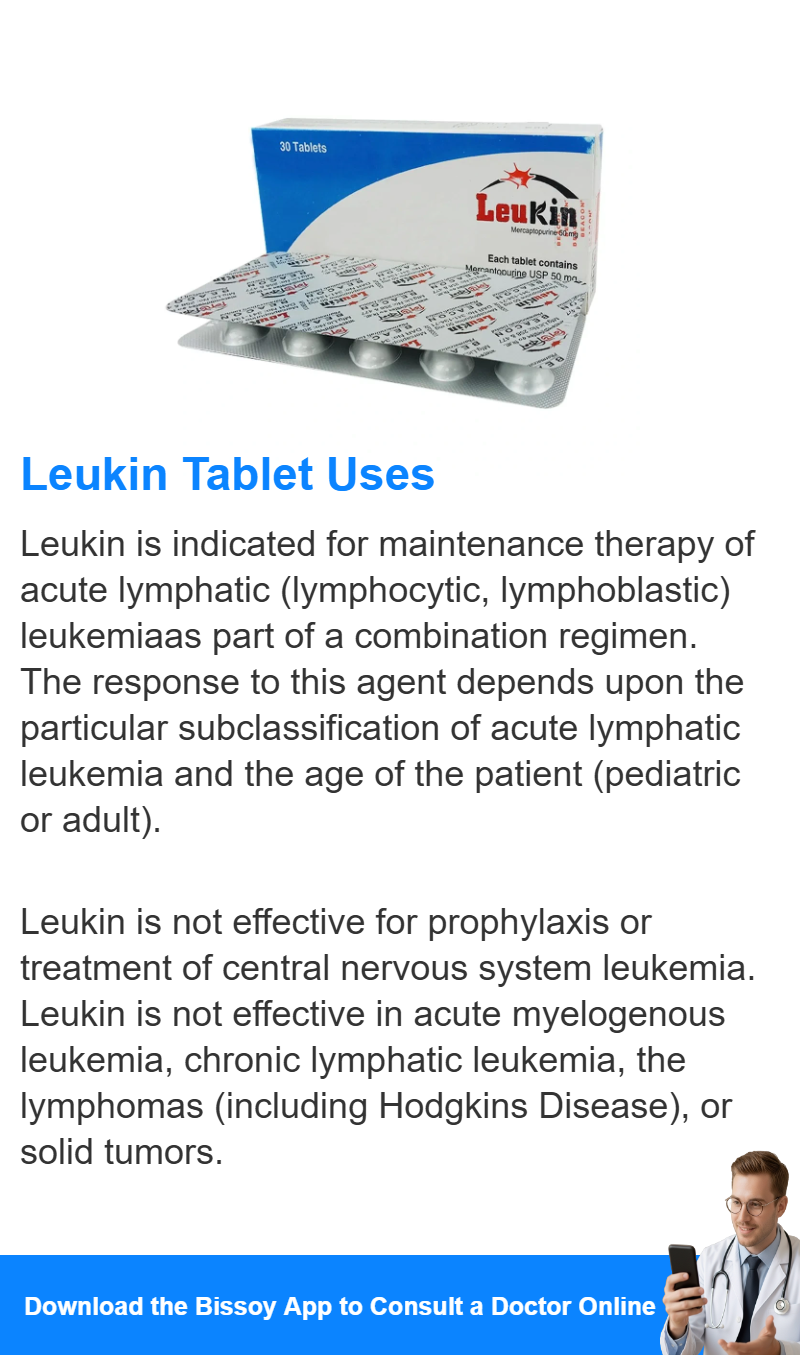
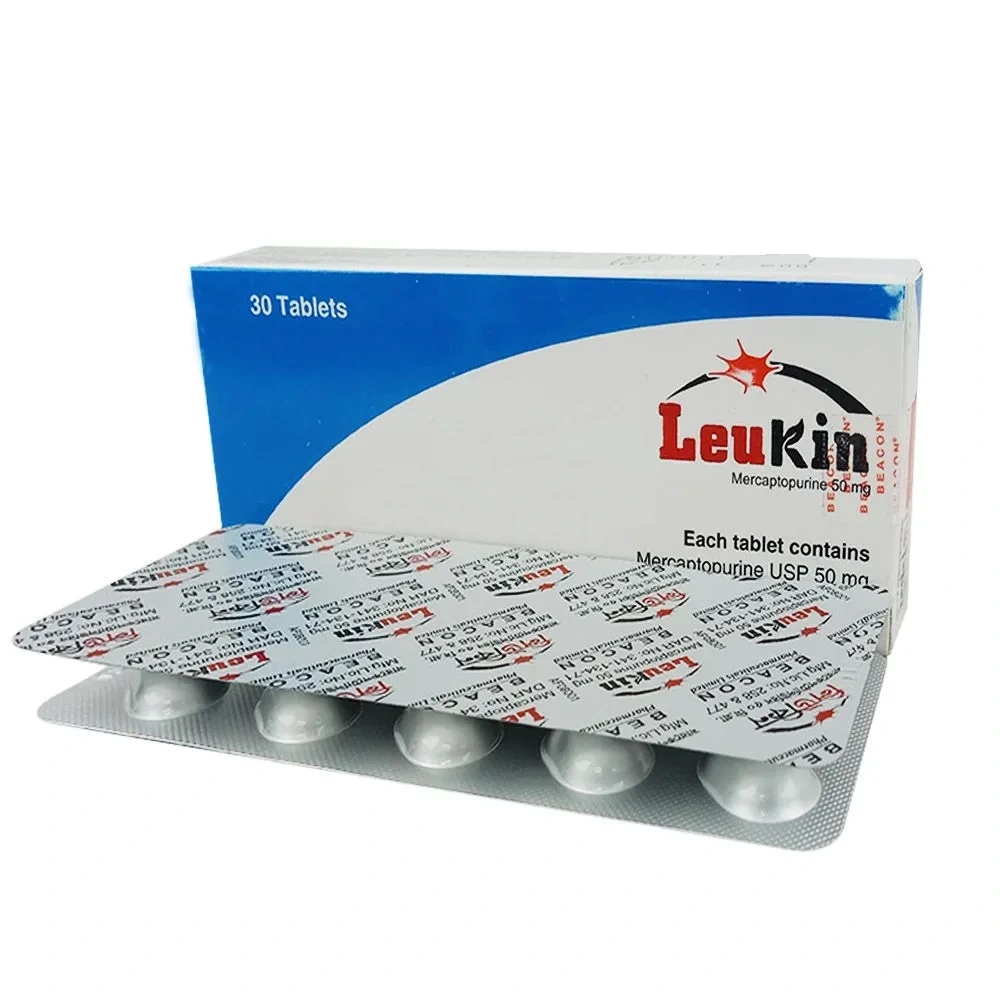
Leukin Tablet 50 mg is an antineoplastic agent used to treat acute lymphocytic leukemia.
For remission induction and maintenance therapy of acute lymphatic leukemia.
Associated Conditions
Pharmacodynamics
Leukin Tablet 50 mg is one of a large series of purine analogues which interfere with nucleic acid biosynthesis and has been found active against human leukemias. It is an analogue of the purine bases adenine and hypoxanthine. It is not known exactly which of any one or more of the biochemical effects of mercaptopurine and its metabolites are directly or predominantly responsible for cell death.
Mechanism of Action
Leukin Tablet 50 mg competes with hypoxanthine and guanine for the enzyme hypoxanthine-guanine phosphoribosyltransferase (HGPRTase) and is itself converted to thioinosinic acid (TIMP). TIMP inhibits several reactions that involve inosinic acid (IMP), such as the conversion of IMP to xanthylic acid (XMP) and the conversion of IMP to adenylic acid (AMP) via adenylosuccinate (SAMP). Upon methylation, TIMP forms 6-methylthioinosinate (MTIMP) which inhibits glutamine-5-phosphoribosylpyrophosphate amidotransferase in addition to TIMP. Glutamine-5-phosphoribosylpyrophosphate amidotransferase is the first enzyme unique to the de novo pathway for purine ribonucleotide synthesis. According to experimental findings using radiolabeled mercaptopurine, mercaptopurine may be recovered from the DNA in the form of deoxythioguanosine. In comparison, some mercaptopurine may be converted to nucleotide derivatives of 6-thioguanine (6-TG) via actions of inosinate (IMP) dehydrogenase and xanthylate (XMP) aminase that convert TIMP to thioguanylic acid (TGMP).
Absorption
Clinical studies have shown that the absorption of an oral dose of mercaptopurine in humans is incomplete and variable, averaging approximately 50% of the administered dose. The factors influencing absorption are unknown.
Volume of Distribution
The volume of distribution exceeded that of the total body water.
Protein Binding
Plasma protein binding averages 19% over the concentration range 10 to 50 µg/mL (a concentration only achieved by intravenous administration of mercaptopurine at doses exceeding 5 to 10 mg/kg).
Half Life
Triphasic: 45 minutes, 2.5 hours, and 10 hours.
Toxicity
Signs and symptoms of overdosage may be immediate such as anorexia, nausea, vomiting, and diarrhea; or delayed such as myelosuppression, liver dysfunction, and gastroenteritis. The oral LD50 of mercaptopurine was determined to be 480 mg/kg in the mouse and 425 mg/kg in the rat.
Food Interactions
- Drink plenty of fluids.
- Take on an empty stomach.
Dosage
- Adult: Initially 1-1.5 mg/kg daily, may increase to 125 mg daily.
- Child: Initially 1-1.5 mg/kg daily increased to a max of 75 mg daily
- Adult: Usual maintenance dose: Initially, 1.5-2.5 mg/kg daily as a single dose, usually used in combination with methotrexate. Dose may vary individually based on response and tolerance. Monitor blood counts at least once wkly. Withdraw treatment immedietely if there is a sharp drop in the white cell count or severe bone-marrow depression. May resume treatment slowly and carefully if white cell count remains constant for 2-3 days or rises. Reduce dose when used with allopurinol.
- Child: Usual maintenance dose: Initially, 1.5-2.5 mg/kg daily as a single dose, usually used in combination with methotrexate. Dose may vary individually based on response and tolerance. Monitor blood counts at least once wkly. Withdraw treatment immedietely if there is a sharp drop in the white cell count or severe bone-marrow depression. May resume treatment slowly and carefully if white cell count remains constant for 2-3 days or rises. Reduce dose when used with allopurinol.