Introduction
Sevelamer is a phosphate binding drug used to prevent hyperphosphataemia in patients with chronic renal failure.
Uses
Sevelamer is a phosphate binder used to treat hyperphosphatemia.
For the control of serum phosphorus in patients with Chronic Kidney Disease (CKD) on hemodialysis.
Associated Conditions
Pharmacodynamics
Patients with end-stage renal disease (ESRD) retain phosphorus and can develop hyperphosphatemia. High serum phosphorus can precipitate serum calcium resulting in ectopic calcification. When the product of serum calcium and phosphorus concentrations (Ca x P) exceeds 55 mg2/dL2, there is an increased risk that ectopic calcification will occur. Hyperphosphatemia plays a role in the development of secondary hyperparathyroidism in renal insufficiency. An increase in parathyroid hormone (PTH) levels is characteristic of patients with chronic renal failure. Increased levels of PTH can lead to osteitis fibrosa, a bone disease. A decrease in serum phosphorus may decrease serum PTH levels. Treatment of hyperphosphatemia includes reduction in dietary intake of phosphate, inhibition of intestinal phosphate absorption with phosphate binders, and removal of phosphate with dialysis. Sevelamer taken with meals has been shown to decrease serum phosphorus concentrations in patients with ESRD who are on hemodialysis. In vitro studies have shown that the capsule and tablet formulations bind phosphate to a similar extent. Sevelamer treatment also results in a lowering of low-density lipoprotein (LDL) and total serum cholesterol levels.
Mechanism of Action
Sevelamer prevents hyperphosphatemia by binding to dietary phosphate in the gut, preventing its absorption and thus decreasing serum parathyroid hormone levels.
Absorption
Not absorbed following oral administration, however no absorption studies have been performed in patients with renal disease. Sevelamer may bind to dietary phosphates and prevent its gastrointestinal absorption when sevelamer is administered in combination with food.
Toxicity
Sevelamer has been given to normal healthy volunteers in doses of up to 14 grams per day for eight days with no adverse effects. Sevelamer has been given in average doses up to 13 grams per day to hemodialysis patients. There are no reported overdosages of sevelamer in patients. Since sevelamer is not absorbed, the risk of systemic toxicity is low.
Food Interactions
- Take with food.
Dosage
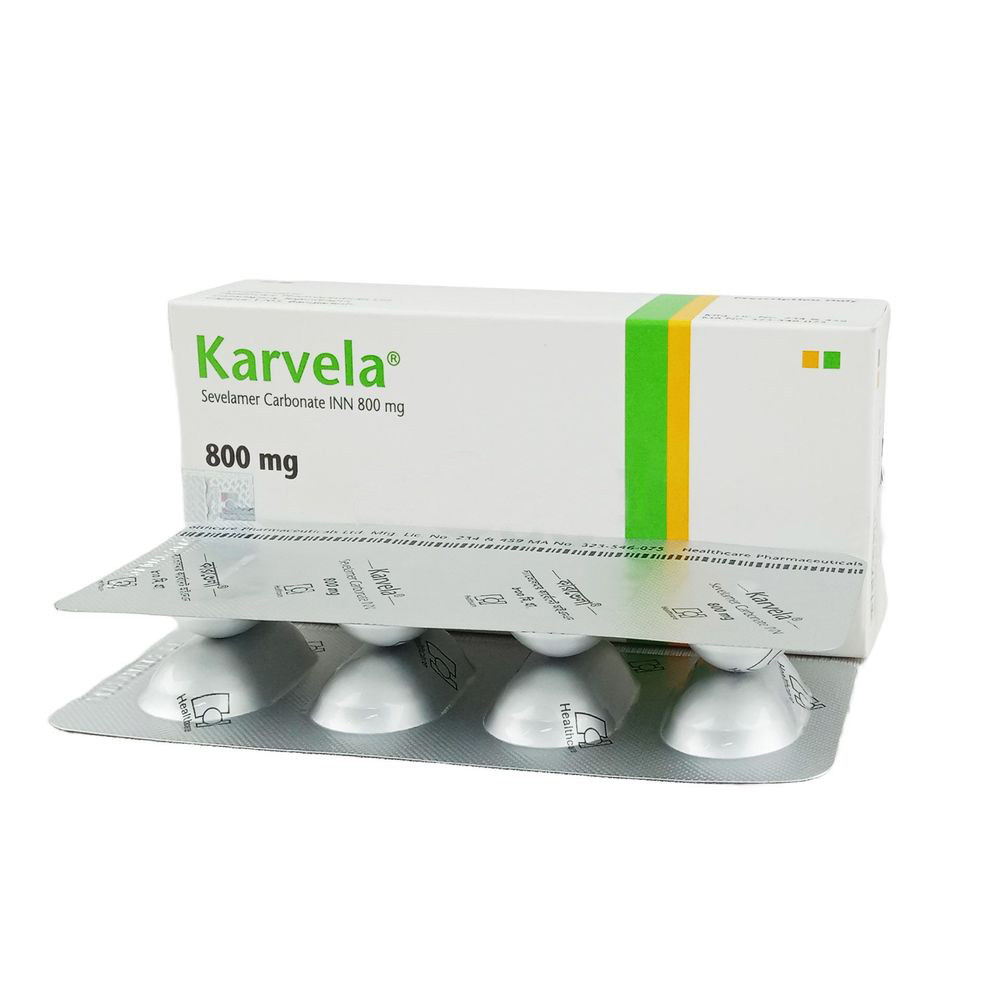
For patients previously on phosphate binders (Sevelamer Hydrochloride or calcium based), Karvela Tablet 800 mg should be given on a gram for gram basis with monitoring of serum phosphorus levels to ensure optimal daily doses.
Titration and Maintenance: Serum phosphorus levels must be monitored and the dose of Karvela Tablet 800 mg titrated every 2-4 weeks until an acceptable serum phosphorus level is reached, with regular monitoring thereafter. Patients taking Karvela Tablet 800 mg should adhere to their prescribed diets. In clinical practice, treatment will be continuous based on the need to control serum phosphorus levels and the daily dose is expected to be an average of approximately 6 g per day.
Paediatric population: The safety and efficacy of Karvela Tablet 800 mg has not been established in children below the age of 18 years. Karvela Tablet 800 mg is not recommended in children below the age of 18 years.