Introduction
A benzimidazole broad-spectrum anthelmintic structurally related to mebendazole that is effective against many diseases. (From Martindale, The Extra Pharmacopoeia, 30th ed, p38)
Uses
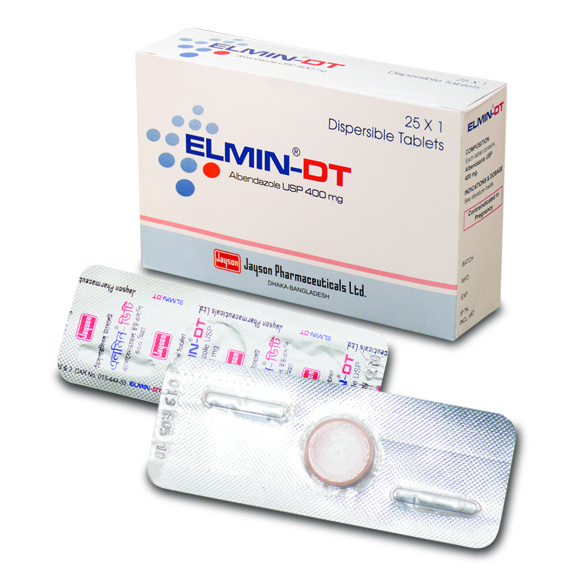
Elmin-DT Dispersible Tablet 400 mg is a benzimidazole anthelmintic used to treat parenchymal neurocysticercosis and other helminth infections.
For the treatment of parenchymal neurocysticercosis due to active lesions caused by larval forms of the pork tapeworm, Taenia solium and for the treatment of cystic hydatid disease of the liver, lung, and peritoneum, caused by the larval form of the dog tapeworm, Echinococcus granulosus.
Associated Conditions
Pharmacodynamics
Elmin-DT Dispersible Tablet 400 mg is a broad-spectrum anthelmintic. The principal mode of action for albendazole is by its inhibitory effect on tubulin polymerization which results in the loss of cytoplasmic microtubules.
Mechanism of Action
Elmin-DT Dispersible Tablet 400 mg causes degenerative alterations in the tegument and intestinal cells of the worm by diminishing its energy production, ultimately leading to immobilization and death of the parasite. It works by binding to the colchicine-sensitive site of tubulin, thus inhibiting its polymerization or assembly into microtubules. As cytoplasmic microtubules are critical in promoting glucose uptake in larval and adult stages of the susceptible parasites, the glycogen stores of the parasites are depleted. Degenerative changes in the endoplasmic reticulum, the mitochondria of the germinal layer, and the subsequent release of lysosomes result in decreased production of adenosine triphosphate (ATP), which is the energy required for the survival of the helminth.
Absorption
Poorly absorbed from the gastrointestinal tract due to its low aqueous solubility. Oral bioavailability appears to be enhanced when coadministered with a fatty meal (estimated fat content 40 g)
Protein Binding
70% bound to plasma protein
Route of Elimination
Elmin-DT Dispersible Tablet 400 mg is rapidly converted in the liver to the primary metabolite, albendazole sulfoxide, which is further metabolized to albendazole sulfone and other primary oxidative metabolites that have been identified in human urine. Urinary excretion of albendazole sulfoxide is a minor elimination pathway with less than 1% of the dose recovered in the urine. Biliary elimination presumably accounts for a portion of the elimination as evidenced by biliary concentrations of albendazole sulfoxide similar to those achieved in plasma.
Half Life
Terminal elimination half-life ranges from 8 to 12 hours (single dose, 400mg).
Toxicity
Symptoms of overdose include elevated liver enzymes, headaches, hair loss, low levels of white blood cells (neutropenia), fever, and itching.
Food Interactions
- Take with a high fat meal. A high fat meal increases solubility and absorption. Take with food when treating systemic infections.
Dosage
- 400 mg (1 tablet or 10 ml suspension) as a single dose in cases of Enterobius vermicularis, Trichuris trichiura, Ascaris lumbricoides, Ancylostoma duodenale and Necator americanus.
- In cases of strongyloidiasis or taeniasis, 400 mg (1 tablet or 10 ml suspension) daily should be given for 3 consecutive days. If the patient is not cured on follow-up after three weeks, a second course of treatment is indicated.
Children under 1 year: Not recommended.
In Hydatid disease (Echinococcosis):
- Elmin-DT Dispersible Tablet 400 mg is given by mouth with meals in a dose of 400 mg twice daily for 28 days for patients weighing over 60 kg.
- A dose of 15 mg/kg body weight daily in two divided doses (to a maximum total daily dose of 800 mg) is used for patients weighing less than 60 kg.
- For cystic echinococcosis, the 28 days course may be repeated after 14 days without treatment, to a total of 3 treatment cycles.
- For alveolar echinococcosis, cycles of 28 days of treatment followed by 14 days without treatment, may need to continue for months or years.
- In giardiasis, 400 mg (1 tablet or 10 ml suspension) once daily for five days is used.