Introduction
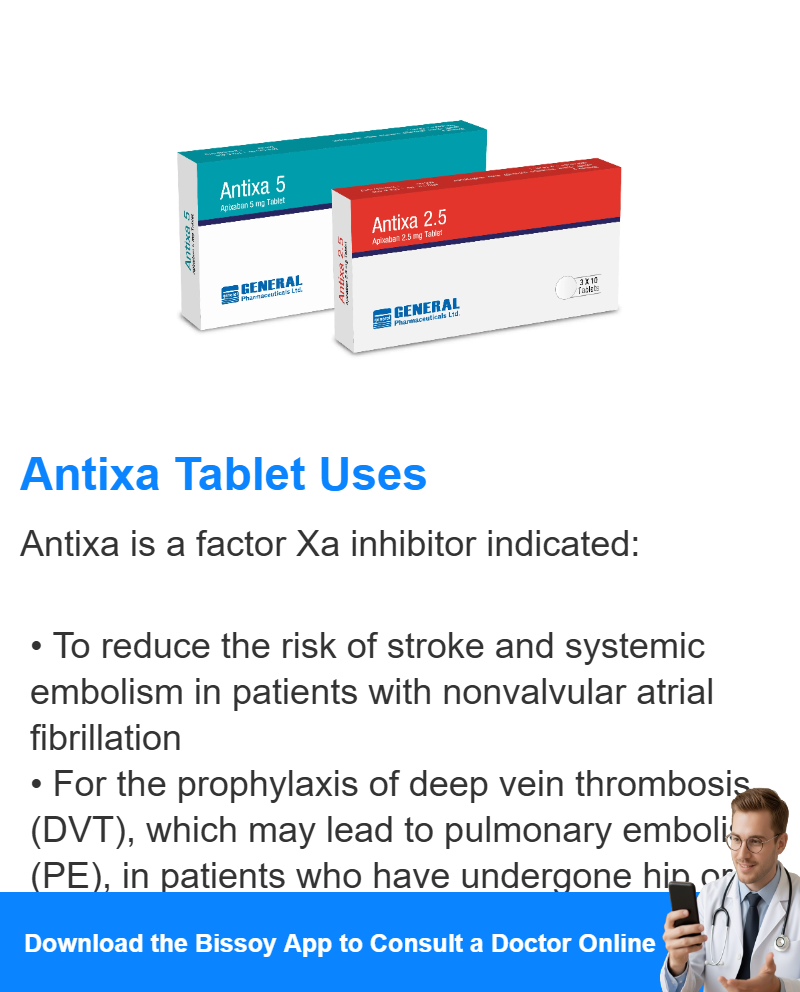
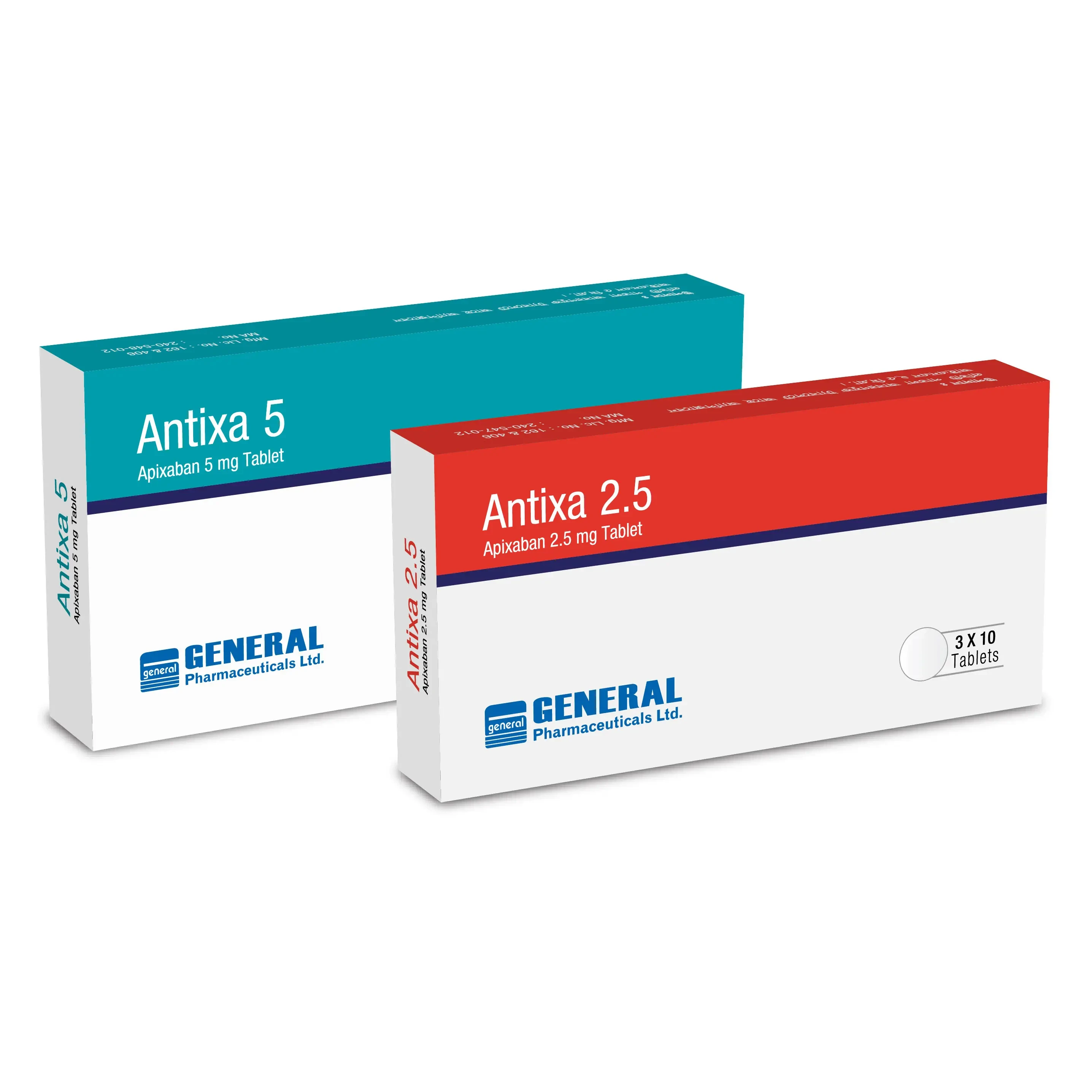
Antixa Tablet 2.5 mg is an oral, direct, and highly selective factor Xa (FXa) inhibitor of both free and bound FXa, as well as prothrombinase, independent of antithrombin III for the prevention and treatment of thromboembolic diseases.
Uses
Antixa Tablet 2.5 mg is an anticoagulant used for the prophylaxis of stroke and systemic embolism in nonvalvular atrial fibrillation, and deep vein thrombosis(DVT) leading to pulmonary embolism(PE), including in patients after a hip or knee replacement surgery.
Antixa Tablet 2.5 mg is indicated for reducing the risk of stroke and systemic embolism in patients who have nonvalvular atrial fibrillation, prophylaxis of deep vein thrombosis(DVT) leading to pulmonary embolism(PE) in patients after a hip or knee replacement surgery, and treatment of DVT and PE to reduce the risk of recurrence.
Associated Conditions
Pharmacodynamics
Antixa Tablet 2.5 mg selectively inhibits factor Xa in its free and bound forms, independant of antithrombin III. Antixa Tablet 2.5 mg also inhibits prothrominase. These effects prevent the formation of a thrombus.
Mechanism of Action
Antixa Tablet 2.5 mg selectively inhibits factor Xa in its free and bound forms, independant of antithrombin III. Antixa Tablet 2.5 mg also inhibits prothrominase. These effects prevent the formation of a thrombus.
Absorption
Antixa Tablet 2.5 mg is approximately 50% bioavailable though other studies report 43-46% oral bioavailability.
Volume of Distribution
Approximately 21L.
Protein Binding
92-94%.
Route of Elimination
56% of an orally administered dose is recovered in the feces and 24.5-28.8% of the dose is recovered in the urine. 83-88% of the dose recovered in the urine was the unchanged parent compound.
Half Life
12.7±8.55h.
Clearance
3.3L/h though other studies report 4876mL/h.
Toxicity
Animal studies have shown an increased risk of maternal bleeding during pregnancy but no increase in fetal malformations or fetal or maternal deaths. It is unknown if this animal data also translates to humans so apixaban should only be used in pregnancy if the benefits outweigh the risks. It is not know whether apixaban is safe and effective in labor and during birth, though animal studies have shown an increased rate of maternal bleeding. Animal studies in rats show apixaban excreted in milk, though it is not know if this also applies to humans. Nursing mothers should either stop breastfeeding or stop taking apixaban depending on the risk and benefit of each option. Studies to determine safety and effectiveness in pediatric patients have yet to be performed. Studies that involved geriatric patients (at least 75 years old) saw no difference in safety or effectiveness compared to younger patients, though geriatric patients at an especially advanced age may be more susceptible to adverse effects. Dosage adjustments for patients with end stage renal disease(ESRD) are based on estimates of pharmacokinetic principles and not clinical study. Patients with ESRD may experience pharmacodynamics similar to those seen in well controlled studies but it may not lead to the same clinical effects. Dosage adjustments are not necessary in mild hepatic impairment. In moderate hepatic impairment patients may already experience abnormalities in coagulation and so no dose recommendations are possible. Antixa Tablet 2.5 mg is not recommended for patients with severe hepatic impairment.
Food Interactions
- Avoid grapefruit products.
- Avoid herbs and supplements with anticoagulant/antiplatelet activity. Examples include garlic, ginger, bilberry, danshen, piracetam, and ginkgo biloba.
- Avoid St. John's Wort. St. John's Wort will decrease levels of this medication.
- Take with or without food.
Dosage
Dosage Adjustments: The recommended dose of Antixa Tablet 2.5 mg is 2.5 mg twice daily in patients with any 2 of the following characteristics: age ≥80 years, body weight ≤60 kg, serum creatinine ≥1.5mg/dl.
CYP3A4 and P-gp inhibitors: When Antixa Tablet 2.5 mg is coadministered with drugs that are strong dual inhibitors of cytochrome P450 3A4 (CYP3A4) and P-glycoprotein (P-gp) (e.g. ketoconazole, itraconazole, ritonavir, clarithromycin) the recommended dose is 2.5 mg twice daily.
Missed Dose: If a dose of Antixa Tablet 2.5 mg is not taken at the scheduled time, the dose should be taken as soon as possible on the same day and twice-daily administration should be resumed. The dose should not be doubled to make up for a missed dose.
Discontinuation for Surgery and Other Interventions: Antixa Tablet 2.5 mg should be discontinued at least 48 hours prior to elective surgery or invasive procedures with a moderate or high risk of unacceptable or clinically significant bleeding. Antixa Tablet 2.5 mg should be discontinued at least 24 hours prior to elective surgery or invasive procedures with a low risk of bleeding or where the bleeding would be non-critical in location and easily controlled.
Switching from or to Antixa Tablet 2.5 mg: Switching from warfarin to Antixa Tablet 2.5 mg: Warfarin should be discontinued and Antixa Tablet 2.5 mg started when the international normalized ratio (INR) is below 2.0.
Switching from Antixa Tablet 2.5 mg to warfarin: Antixa Tablet 2.5 mg affects INR, so that INR measurements during co-administration with warfarin may not be useful for determining the appropriate dose of warfarin. If continuous anticoagulation is necessary, discontinue Antixa Tablet 2.5 mg and begin both a parenteral anticoagulant and warfarin at the time the next dose of Antixa Tablet 2.5 mg would have been taken, discontinuing the parenteral anticoagulant when INR reaches an acceptable range.
Switching between Antixa Tablet 2.5 mg and anticoagulants other than warfarin: Discontinue one being taken and begin the other at the next scheduled dose.