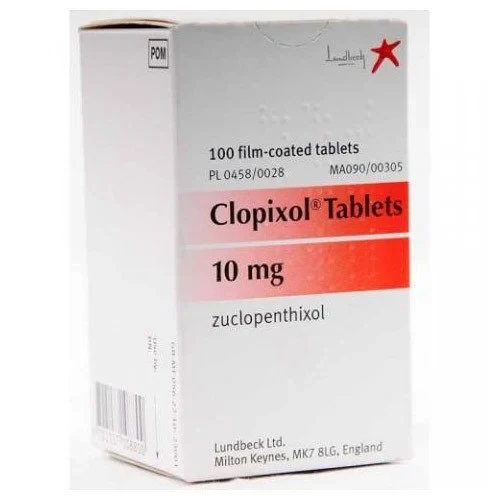
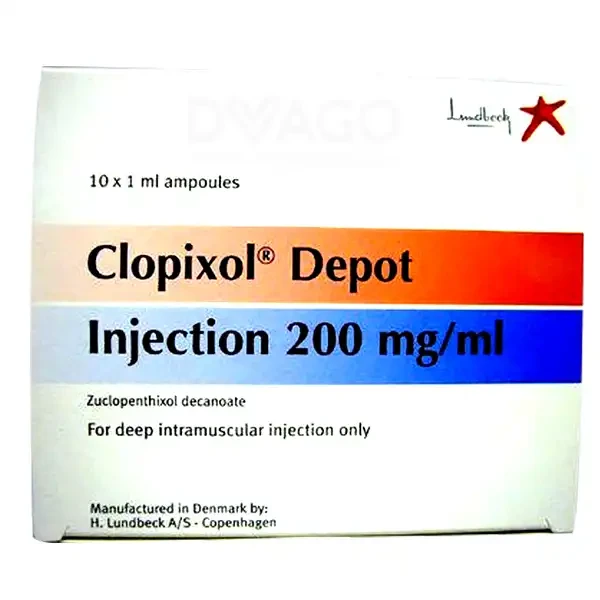
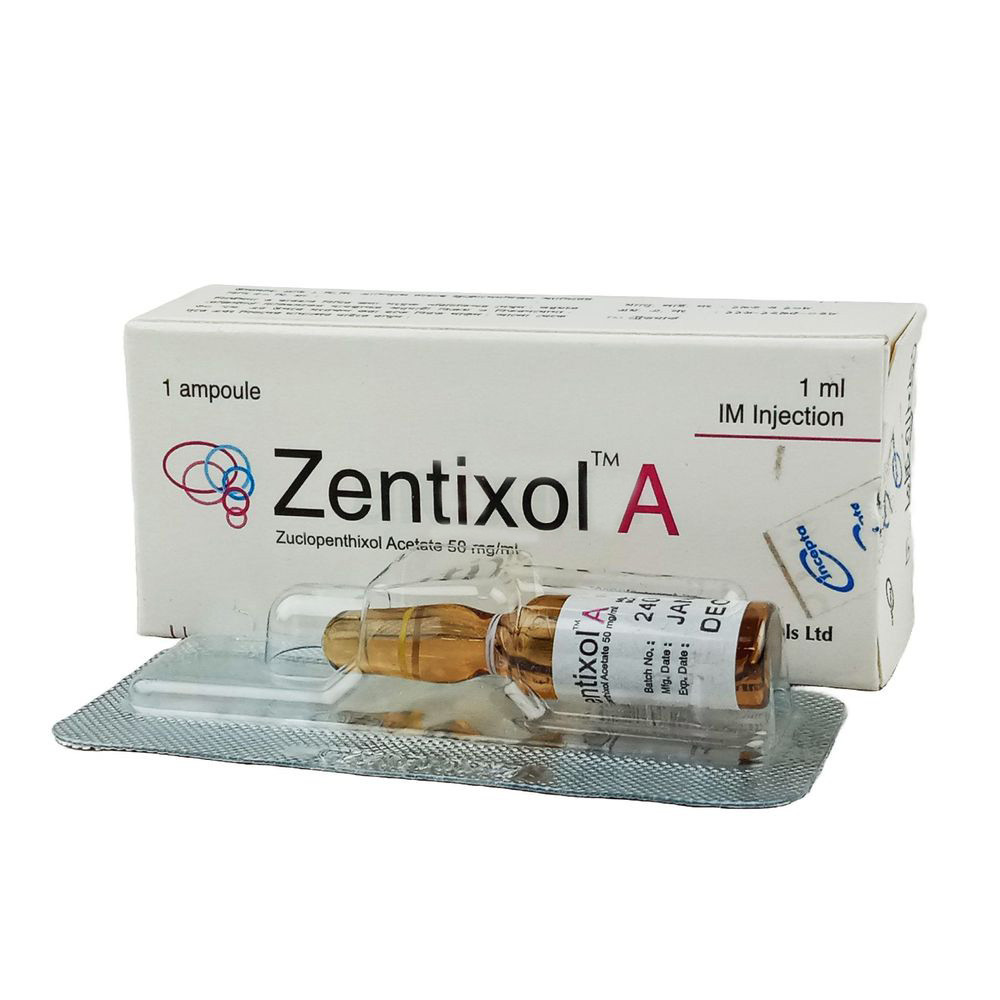
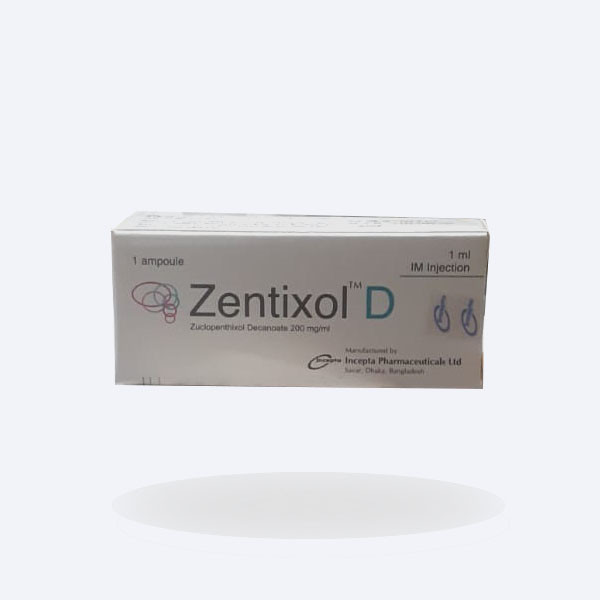
Introduction
Zuclopenthixol is a liquid, thioxanthene-based antipsychotic that functions primarily as a $D_1$ and $D_2$ dopamine receptor antagonist, with additional binding activity at $5\text{-HT}_{2\text{A}}$ serotonin and $\alpha_{1\text{A}}$-adrenergic receptors. Similar in therapeutic action to phenothiazine neuroleptics, it is metabolized by the CYP2D6 enzyme system to manage psychotic disorders.
Uses
Zuclopenthixol is an antipsychotic indicated for the management of schizophrenia. The acuphase formulation is indicated for initial treatment of acute psychosis or exacerbation of psychosis, while the depot formulation is best for maintenance.
Used in the management of acute psychoses such as mania or schizophrenia. However, the use of zuclopenthixol acetate in psychiatric emergencies as an alternative to standard treatments (haloperidol, clotiapine, etc.) should be cautioned, since well executed and documented trials of zuclopenthixol acetate for this use have yet to be conducted. Zuclopenthixol acetate is not intended for long-term use.
Associated Conditions
Pharmacodynamics
Zuclopenthixol is a thioxanthene with therapeutic actions similar to the phenothiazine antipsychotics. It is an antagonist at D1 and D2 dopamine receptors.
Mechanism of Action
Zuclopenthixol is a typical antipsychotic neuroleptic drug of the thioxanthene class. It mainly acts by antagonism of D1 and D2 dopamine receptors. Zuclopenthixol also has high affinity for alpha1-adrenergic and 5-HT2 receptors. It has weaker histamine H1 receptor blocking activity, and even lower affinity for muscarinic cholinergic and alpha2-adrenergic receptors.
Absorption
Upon reaching the body water phase, the decanoate ester is slowly released from the oil depot, which is resultantly hydrolyzed to the active substance, zuclopenthixol. The decanoate ester provides a means of slow release since zuclopenthixol itself is a short-acting drug.
Volume of Distribution
20 L/kg.
Protein Binding
98-99%
Route of Elimination
Primarily in the feces with approximately 10% in the urine.
Half Life
20 hours (range 12-28 hours) for the tablet form, 19 days for the depot form.
Clearance
approximately 0.9 L/min.
Toxicity
Although there have not been any cases of overdosage reported, the symptoms are likely to be somnolence, coma, extrapyramidal symptoms, convulsions, hypotension, shock, or hyper- or hypothermia.
Neuroleptic malignant syndrome may occur. Zuclopenthixol may potentiate anticholinergic effects of concurrent medications. Zuclopenthixol has a demonstrated antiemetic effect in animals, and may mask signs of toxicity due to other drug overdoses, or may mask symptoms of disease.
Food Interactions
- Avoid alcohol. Acute alcohol intoxication is a contraindication for zuclopenthixol therapy.
- Take with or without food.
Dosage
Zuclopenthixol Acuphase: Dosage should be individually adjusted according to the patient’s condition. The usual dose is 50-150 mg (1-3 ml) administered intramuscularly and repeated if necessary, at intervals of 2-3 days. Some patients may need an additional injection 1 or 2 days after the first injection.
Zuclopenthixol Depot: Close supervision is required during the period following initiation of Zuclopenthixol Depot treatment, in order to minimize the risk of over-medication or insufficient suppression of psychotic symptoms. Supplemental oral antipsychotic medication may be required in diminishing dosage during this period. The usual maintenance dose is 150-300 mg intramuscularly, every 2-4 weeks. Some patients may require higher or lower doses, or shorter intervals between doses.