Introduction
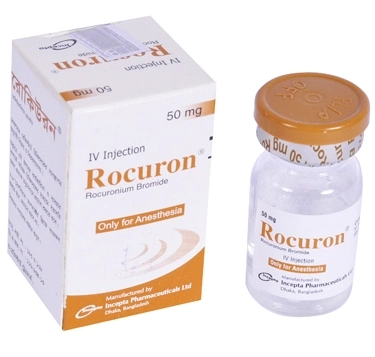
Rocuronium is an aminosteroid non-depolarizing neuromuscular blocking agent used during general anesthesia to facilitate endotracheal intubation and provide skeletal muscle relaxation during surgery or mechanical ventilation. It has a rapid onset and intermediate duration of action, making it suitable for a wide range of anesthetic procedures. Rocuronium may cause allergic reactions in susceptible individuals, although the risk is comparable to that of other non-depolarizing neuromuscular blockers. Its neuromuscular blocking effects can be rapidly reversed with sugammadex, a selective reversal agent.
Uses
Rocuronium is a vecuronium analog used to facilitate tracheal intubation and to relax skeletal muscles during surgery.
For inpatients and outpatients as an adjunct to general anesthesia to facilitate both rapid sequence and routine tracheal intubation, and to provide skeletal muscle relaxation during surgery or mechanical ventilation.
Associated Conditions
Pharmacodynamics
Neuromuscular blocking agents are drugs that cause skeletal muscle relaxation primarily by causing a decreased response to the neurotransmitter acetylcholine (ACh) at the myoneural (neuromuscular) junction of skeletal muscle. At that site, ACh normally produces electrical depolarization of the postjunctional membrane of motor end-plate, which leads to conduction of muscle action potential and subsequently induces skeletal muscle contraction. Neuromuscular agents are classified as depolarizing or nondepolarizing. Rocuronium is a nondepolarizing neuromuscular blocking agent with a rapid to intermediate onset depending on dose and intermediate duration. Rocuronium, like vecuronium is longer acting in infants than in children. However, unlike vecuronium, rocuronium retains the characteristics of an intermediate-acting NMBD in infants.
Mechanism of Action
Rocuronium acts by competing for cholinergic receptors at the motor end-plate. This action is antagonized by acetylcholinesterase inhibitors, such as neostigmine and edrophonium. Rocuronium acts by competitively binding to nicotinic cholinergic receptors. The binding of vecuronium decreases the opportunity for acetylcholine to bind to the nicotinic receptor at the postjunctional membrane of the myoneural junction. As a result, depolarization is prevented, calcium ions are not released and muscle contraction does not occur. Evidence also suggests that nondepolarizing agents can affect ACh release. It has been hypothesized that nondepolarzing agents bind to postjunctional ("curare") receptors and may therefore interfere with the sodium and potassium flux, which is responsible for depolarization and repolarization of the membranes involved in muscle contraction.
Absorption
Poorly absorbed from the GI tract.
Volume of Distribution
- 0.3 L/kg [3 to <12 mos]
- 0.26 L/kg [1 to <3 yrs]
- 0.21 L/kg [3 to <8 yrs]
Protein Binding
Approximately 30% bound to human plasma proteins.
Route of Elimination
Studies of distribution, metabolism, and excretion in cats and dogs indicate that rocuronium is eliminated primarily by the liver.
Half Life
The rapid distribution half-life is 1-2 minutes and the slower distribution half-life is 14-18 minutes. Renal impairment has no net effect on half-life, however, half-life is almost doubled in patients with impaired liver function.
Clearance
- 0.25 L/kg/hr [Adults (Ages 27 to 58 years)]
- 0.21 L/kg/hr [Geriatrics (>=65 yrs)]
- 0.16 L/kg/hr [Normal ewnal and hepatice function]
- 0.13 L/kg/hr [Renal transplant patients]
- 0.13 L/kg/hr [Hepatic dysfunction patients]
- 0.35 +/- 0.08 L/kg/hr [Pediatric Patients 3 to <12 mos]
- 0.32 +/- 0.07 L/kg/hr [Pediatric Patients 1 to 3 yrs]
- 0.44 +/- 0.16 L/kg/hr [Pediatric Patients 3 to 8 yrs]
Toxicity
No cases of significant accidental or intentional overdose have been reported. Overdosage with neuromuscular blocking agents may result in neuromuscular block beyond the time needed for surgery and anesthesia.
Food Interactions
No interactions found.
Dosage
Surgical Procedures: Tracheal Intubation: The standard intubating dose during routine anesthesia is 0.6mg Rocuronium Bromide per kg body weight, after which adequate intubation conditions are established within 60 seconds in nearly all patients. A dose of 1.0mg Rocuronium Bromide per kg body weight is recommended for facilitating tracheal intubation conditions during rapid sequence induction of anesthesia, after which adequate intubation conditions are also established within 60 seconds in nearly all patients. If a dose of 0.6mg Rocuronium Bromide per kg body weight is used for rapid sequence induction of anesthesia, it is recommended to intubate the patient 90 seconds after administration of Rocuronium Bromide. In patients undergoing Caesarean section it is recommended to only use a dose of 0.6mg Rocuronium Bromide per kg body weight, since a 1.0mg/kg dose has not been investigated in this patient group.
Maintenance Dosing: The recommended maintenance dose is 0.15mg Rocuronium Bromide per kg body weight; in the case of long-term inhalational anesthesia this should be reduced to 0.075-0.1mg Rocuronium Bromide per kg body weight. The maintenance doses should best be given when twitch height has recovered to 25% of control twitch height, or when 2-3 responses to train of four stimulation are present.
Continuous Infusion: If Rocuronium Bromide is administered by continuous infusion, it is recommended to give a loading dose of 0.6mg Rocuronium Bromide per kg body weight and, when neuromuscular block starts to recover, to start administration by infusion. The infusion rate should be adjusted to maintain twitch response at 10% of control twitch height, or to maintain 1 to 2 responses to train of four stimulation. In adults under intravenous anesthesia, the infusion rate required to maintain neuromuscular block at this level ranges from 0.3-0.6mg/kg/hr and under inhalational anesthesia the infusion rate ranges from 0.3-0.4mg/kg/hr. Continuous monitoring of neuromuscular block is recommended since infusion rate requirements vary from patient to patient and with the anaesthetic method used.
Dosing in Paediatric Patients: Children (1-14 years) and infants (1-12 months) under halothane anesthesia manifest similar sensitivity to Rocuronium Bromide as adults. Onset of action is faster in infants and children than in adults. Clinical duration is shorter in children than in adults. For continuous infusion in paediatrics, the infusion rates, with exception of children, are the same as for adults. For children higher infusion rates might be necessary. For children the same initial infusion rates as for adults are recommended and this should be adjusted to maintain twitch response at 10% of control twitch height or to maintain 1 or 2 responses to train of four stimulation during the procedure. There are insufficient data to support dose recommendations for the use of Rocuronium Bromide in neonates (0-1 month). The experience with Rocuronium Bromide in rapid sequence induction in paediatric patients is limited. Rocuronium Bromide is therefore not recommended for facilitating tracheal intubation conditions during rapid sequence induction in paediatric patients.
Dosing in Geriatric patients and patients with Hepatic and/or Biliary tract disease and/or Renal Failure: The standard intubation dose for geriatric patients and patients with hepatic and/or biliary tract disease and/or renal failure during routine anesthesia is 0.6mg Rocuronium Bromide per kg body weight. A dose of 0.6mg per kg body weight should be considered for rapid sequence induction of anesthesia in patients in which a prolonged duration of action is expected. Regardless of the anesthetic technique used, the recommended maintenance dose for these patients is 0.075-0.1mg Rocuronium Bromide per kg body weight, and the recommended infusion rate is 0.3-0.4mg/kg/hr.
Dosing in Overweight and Obese Patients: When used in overweight or obese patients (defined as patients with a body weight of 30% or more above ideal body weight) doses should be reduced taking into account ideal body weight.
Intensive Care Procedures (Tracheal Intubation): For tracheal intubation, the same doses should be used as described above under surgical procedures.
Maintenance Dosing: The use of an initial loading dose of 0.6mg Rocuronium Bromide per kg body weight is recommended, followed by a continuous infusion as soon as twitch height recovers to 10% or upon reappearance of 1 to 2 twitches to train of four stimulation. Dosage should always be titrated to effect in the individual patient. The recommended initial infusion rate for the maintenance of a neuromuscular block of 80-90% (1 to 2 twitches to TOF stimulation) in adult patients is 0.3-0.6mg/kg/hr during the first hour of administration, which will need to be decreased during the following 6-12 hours, according to the individual response. Thereafter, individual dose requirements remain relatively constant. A large between patient variability in hourly infusion rates has been found in controlled clinical studies, with mean hourly infusion rates ranging from 0.2-0.5mg/kg/hr depending on nature and extent of organ failure(s), concomitant medication and individual patient characteristics. To provide optimal individual patient control, monitoring of neuromuscular transmission is strongly recommended. Administration up to 7 days has been investigated.
Special Populations: Rocuronium Bromide is not recommended for the facilitation of mechanical ventilation in the intensive care in paediatric and geriatric patients due to a lack of data on safety and efficacy.