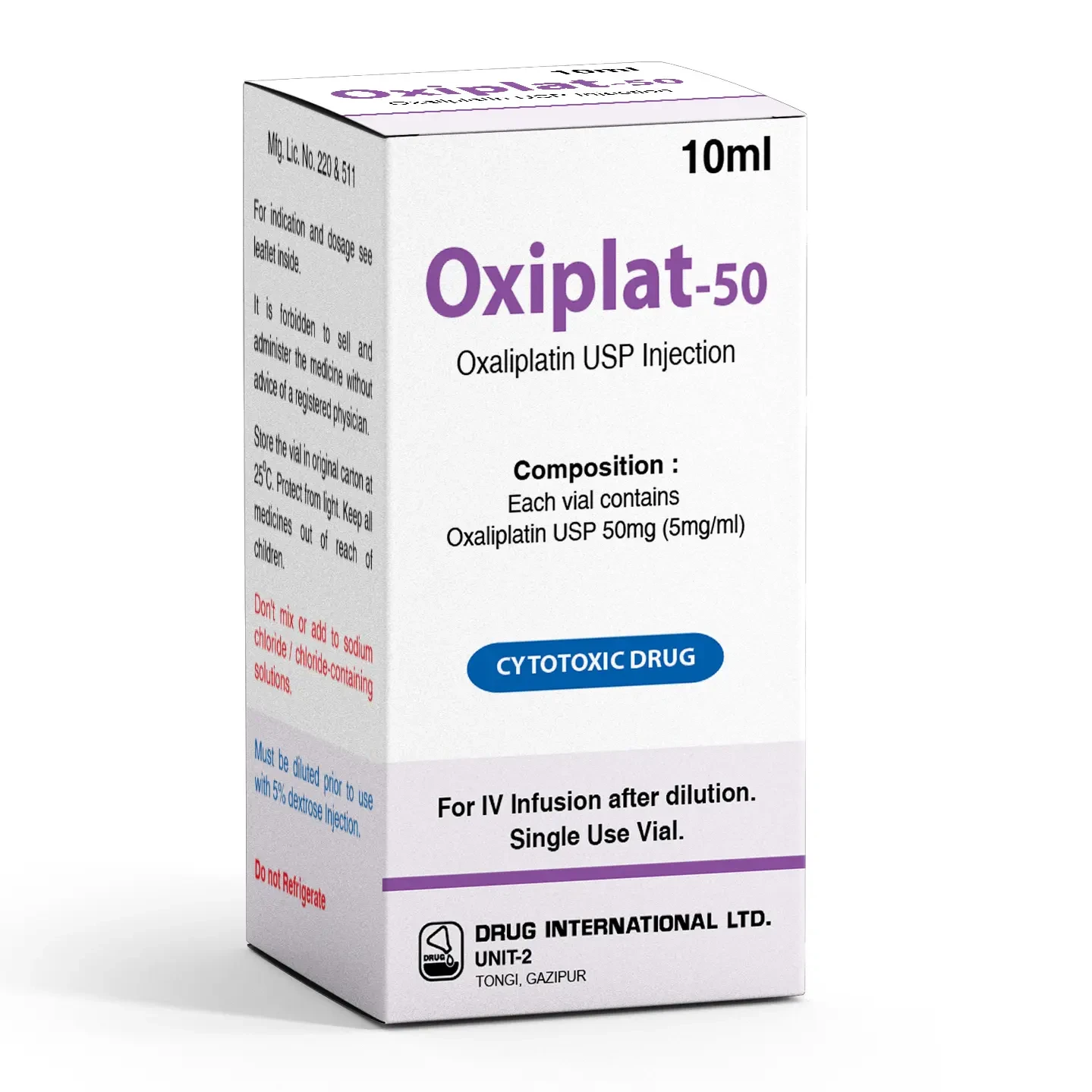
Introduction
Oxaliplatin is a platinum-based chemotherapy drug in the same family as cisplatin and carboplatin. It is typically administered in combination with fluorouracil and leucovorin in a combination known as Folfox for the treatment of colorectal cancer. Compared to cisplatin the two amine groups are replaced by cyclohexyldiamine for improved antitumour activity. The chlorine ligands are replaced by the oxalato bidentate derived from oxalic acid in order to improve water solubility.
Uses
Oxaliplatin is a platinum based chemotherapy agent used to treat carcinoma of the colon or rectum or stage III colon cancer.
Used in combination with infusional 5-FU/LV, is indicated for the treatment of advanced carcinoma of the colon or rectum and for adjuvant treatment of stage III colon cancer patients who have undergone complete resection of the primary tumor.
Associated Conditions
Pharmacodynamics
Oxaliplatin selectively inhibits the synthesis of deoxyribonucleic acid (DNA). The guanine and cytosine content correlates with the degree of Oxaliplatin-induced cross-linking. At high concentrations of the drug, cellular RNA and protein synthesis are also suppressed.
Mechanism of Action
Oxaliplatin undergoes nonenzymatic conversion to active derivatives via displacement of the labile oxalate ligand. Several transient reactive species are formed, including monoaquo and diaquo DACH platinum, which covalently bind with macromolecules. After activation, oxaliplatin binds preferentially to the guanine and cytosine moieties of DNA, leading to cross-linking of DNA, thus inhibiting DNA synthesis and transcription. Cytotoxicity is cell-cycle nonspecific.
Absorption
Bioavailability is complete following intravenous administration. When a single 2-hour intravenous infusion of oxaliplatin at a dose of 85 mg/m^2 is given, the peak serum concentration was 0.814 mcg/mL.
Volume of Distribution
- 440 L [single 2-hour IV infusion at dose of 85 mg/m^2] At the end of a 2-hour infusion of oxaliplatin, approximately 15% of the administered platinum is present in the systemic circulation. The remaining 85% is rapidly distributed into tissues or eliminated in the urine.
Protein Binding
Plasma protein binding of platinum (active metabolite) is irreversible and is greater than 90%, primarily to albumin and gamma-globulins. It is also irreversibly binds to erythrocytes.
Route of Elimination
The major route of platinum elimination is renal excretion. At five days after a single 2-hour infusion of oxaliplatin, urinary elimination accounted for about 54% of the platinum eliminated, with fecal excretion accounting for only about 2%.
Half Life
The decline of ultrafilterable platinum levels following oxaliplatin administartion is triphasic, with two distribution phases: t1/2α; 0.43 hours and t1/2β; 16.8 hours. This is followed by a long terminal elimination phase that lasts 391 hours (t1/2γ).
Clearance
- 10 - 17 L/h [renal clearance]
Toxicity
There have been five cases of oxaliplatin overdose reported. One patient received two 130 mg/m2 doses of oxaliplatin (cumulative dose of 260 mg/m2) within a 24-hour period. The patient experienced Grade 4 thrombocytopenia (3) without any bleeding, which resolved. Two other patients were mistakenly administered oxaliplatin instead of carboplatin. One patient received a total oxaliplatin dose of 500 mg and the other received 650 mg. The first patient experienced dyspnea, wheezing, paresthesia, profuse vomiting and chest pain on the day of administration. She developed respiratory failure and severe bradycardia, and subsequently did not respond to resuscitation efforts. The other patient also experienced dyspnea, wheezing, paresthesia, and vomiting. Most common adverse reactions (incidence ≥ 40%) were peripheral sensory neuropathy, neutropenia, thrombocytopenia, anemia, nausea, increase in transaminases and alkaline phosphatase, diarrhea, emesis, fatigue and stomatitis.
Food Interactions
No interactions found.
Dosage
Day 1: Oxaliplatin 85 mg/m² intravenous infusion in 250-500 mL 5% Dextrose injection, USP and folinic acid 200 mg/m² intravenous infusion in 5% Dextrose Injection, USP both given over 120 minutes at the same time in separate bags using a Y-line, followed by 5-fluorouracil 400 mg/m² intravenous bolus given over 2-4 minutes, followed by 5-fluorouracil 600 mg/m² intravenous infusion in 500 mL 5% Dextrose Injection, USP (recommended) as a 22-hour continuous infusion.
Day 2: Folinic acid 200 mg/m² intravenous infusion over 120 minutes, followed by 5-fluorouracil 400 mg/m² intravenous bolus given over 2-4 minutes, followed by 5-fluorouracil 600 mg/m² intravenous infusion in 500 mL 5% Dextrose Injection, USP (recommended) as a 22-hour continuous infusion.