Introduction
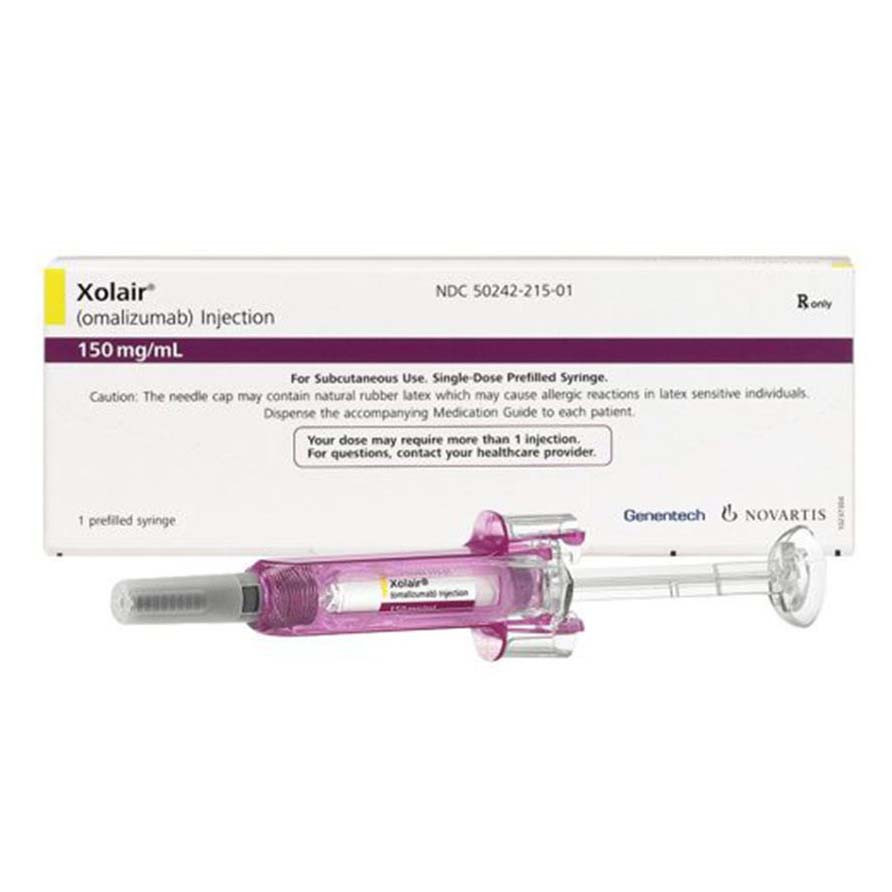
Omalizumab, manufactured by Genentech, was first FDA approved in 2003 to treat adults and children 12 years of age and older with moderate to severe persistent allergic asthma which is not controlled by inhaled steroids . Since its U.S. approval, more than 200,000 patients older than 12 with allergic asthma have been treated . In September 2018, a new prefilled syringe formulation of this drug was approved by the FDA .
Uses
Omalizumab is a monoclonal anti-immunoglobulin E antibody used in the treatment of severe asthma and chronic idiopathic urticaria.
This drug is an anti-IgE antibody indicated for:
Moderate to severe persistent asthma in patients 6 years of age and older with a positive skin test or in vitro reactivity to a perennial aeroallergen and symptoms that are inadequately controlled with inhaled corticosteroids
Chronic idiopathic urticaria in adults and adolescents 12 years of age and older who remain symptomatic despite H1 antihistamine treatment
Associated Conditions
Pharmacodynamics
Omalizumab is a recombinant, humanized, monoclonal antibody against human immunoglobulin E (IgE) which treats the symptoms of asthma and chronic idiopathic urticaria by limiting the allergic response , . It inhibits the binding of IgE to receptors on mast cells and basophils, blocking the IgE-mediated secretion of inflammatory mediators from these cells .
Mast cell activation and the release of mediators, in response to allergen exposure and IgE, results in a cascade of events. This cascade culminates in the activation of B-lymphocytes, T-lymphocytes, eosinophils, fibroblasts, smooth muscle cells, and the endothelium. This cellular interaction, as well as the release of cytokines, chemokines and growth factors and inflammatory remodeling of the airway results in chronic asthma .
After 4 weeks of use of this medication in patients with chronic urticaria, it was found that rescue medication use was reduced significantly and quality of life improved .
Mechanism of Action
When an environmental allergen first enters the body, is taken up by antigen-presenting cells (APCs). It is then processed, and presented to T and B immune cells. This is followed by the activation of B-lymphocyte and production of allergen-specific IgE. This IgE is then released by plasma cells (converted B lymphocytes) and is therefore available to bind to IgE receptors on several other cells .
IgE binds to high-affinity (Fc€RI) and low-affinity (Fc€RII) receptors on multiple cells of the immune system. Following subsequent antigen exposure, cross-linking of the antigen occurs by several Fc€RI-bound IgE molecules on the surface of both basophils and mast cells. This leads to the activation of mast cells and histamine release, producing a wheal and other symptoms of urticaria .
The following are explanations of the mechanism of action for both indications of this drug:
Asthma
Omalizumab inhibits the binding of IgE to the high-affinity IgE receptor (FcεRI) on the surface of both mast cells and basophils. The reduction in surface-bound IgE on FcεRI-bearing cells limits the degree of release of mediators of the typical allergic response. Treatment with omalizumab also reduces the number of FcεRI receptors on basophils in atopic patients .
Omalizumab binds to free IgE with a higher affinity than IgE itself binds to the high-affinity Fc€RI receptors found on basophils. Therefore, it decreases the availability of free IgE for binding . Omalizumab by itself does not bind to the Fc€RI receptors, nor does the drug bind to receptor-bound IgE. These binding characteristics allow omalizumab to neutralize the typical IgE-mediated responses without causing the degranulation of basophils or cross-linking with basophil-bound IgE .
Chronic Idiopathic Urticaria Omalizumab binds to IgE and decreases free IgE levels. Subsequently, IgE receptors (FcεRI) on cells are down-regulated. The mechanism by which these effects of omalizumab result in an improvement of CIU symptoms is unclear.
Absorption
After subcutaneous administration in pharmacokinetic studies, omalizumab was absorbed with a mean absolute bioavailability of 62% . After the administration of a single subcutanous dose in adult and adolescent patients with asthma, omalizumab was absorbed slowly. The peak serum concentrations peaked after an average of 7-8 days. In patients with CIU, the peak serum concentration was reached at a similar time after a single SC dose. The pharmacokinetics of omalizumab was linear at doses which were higher than 0.5 mg/kg. In patients with asthma, after several doses of omalizumab, areas under the serum concentration-time curve from Day 0 to Day 14 at steady state were up to 6-fold of those after one dose. In patients with CIU, omalizumab showed linear pharmacokinetics in the dose range of 75 mg to 600 mg administered as a single subcutaneous dose. After repeated dosing from 75mg-300 mg every 4 weeks, trough serum concentrations of omalizumab increased proportionally with the dose .
Volume of Distribution
The apparent volume of distribution of omalizumab in patients with asthma after subcutaneous administration was 78 ± 32 mL/kg. In patients with CIU, the distribution of omalizumab was similar to that in asthmatic patients .
Protein Binding
Monoclonal antibodies are usually not required to have protein binding studies.
Route of Elimination
Liver elimination of IgG includes degradation in the liver reticuloendothelial system (RES) and endothelial cells. Intact IgG was also shown to be excreted in bile, in pharmacokinetic studies .
Half Life
In chronic idiopathic urticaria (CIU) patients, at steady state, based on population pharmacokinetics, omalizumab serum elimination half-life averaged 24 days .
In asthmatic patients omalizumab serum elimination half-life averaged 26 days .
Clearance
In pharmacokinetic studies, the clearance of omalizumab involved IgG clearance as well as clearance by specific binding and complex formation with its target ligand, IgE , .
The apparent clearance averaging 2.4 ± 1.1 mL/kg/day was measured in asthmatic patients .
In chronic idiopathic urticaria (CIU) patients, at steady state, based on population pharmacokinetics, omalizumab apparent clearance averaged 240 mL/day (corresponding to 3.0 mL/kg/day for an 80 kg patient).
Toxicity
Anaphylaxis
Anaphylaxis may occur rarely with this agent, either after the first dose or multiple doses , . Anaphylaxis presenting clinically as bronchospasm, hypotension, syncope, urticaria, and/or angioedema of the throat or tongue, has been reported during and after this use of this drug. Therefore, close clinical monitoring should be performed during and shortly after administration .
Maximum Dosage
The maximum tolerated dosage of omalizumab has not yet been determined. Single intravenous (IV) doses of up to 4000 mg have been administered to patients without evidence of dose-limiting toxicity. The highest cumulative dose administered to patients was 44,000 mg over a 20 week time period, which was not associated with any toxicities .
The use in Pregnancy
The data with omalizumab use in pregnant women are insufficient to inform on drug-associated risk. Monoclonal antibodies, such as omalizumab, are transported across the placenta in a linear fashion as a pregnancy progresses; therefore, potential effects on a fetus are likely to be greater in frequency during the second and third trimesters .
In women with inadequately or moderately controlled asthma, the current evidence suggests that there is an increased risk of preeclampsia in the mother and prematurity, low birth weight, and small fetal size .
The use During Breastfeeding
There is no information regarding the presence of omalizumab in human milk, the effects on the breastfed infant, or the effects on milk production . The developmental and health benefits of breastfeeding should be considered along with the mother’s clinical need for omalizumab and any potential adverse effects on the breastfed child from omalizumab or from the underlying maternal condition .
Food Interactions
No interactions found.
Dosage
Asthma: omalizumab 75 to 375 mg SC every 2 or 4 weeks. Determine dose (mg) and dosing frequency by serum total IgE level (IU/mL), measured before the start of treatment, and body weight (kg). See the dose determination charts.
Nasal Polyps: omalizumab 75 to 600 mg SC every 2 or 4 weeks. Determine dose (mg) and dosing frequency by serum total IgE level (IU/mL), measured before the start of treatment, and body weight (kg). See the dose determination charts.
Chronic Spontaneous Urticaria: omalizumab 150 or 300 mg SC every 4 weeks. Dosing in CSU is not dependent on serum IgE level or body weight.