Introduction
Leuprolide is a synthetic 9-residue peptide analogue of gonadotropin-releasing hormone (GnRH). Unlike the endogenous decapeptide GnRH, leuprolide contains a single D-amino acid (D-leucyl) residue, which helps to increase its circulating half-life from three to four minutes to approximately three hours. As a GnRH mimic, leuprolide is capable of binding to the GnRH receptor (GnRHR) and inducing downstream modulation of both gonadotropin hormone and sex steroid levels. Prolonged activation of GnRHR results in significant downregulation of sex steroid levels, which is primarily responsible for the clinical efficacy of leuprolide in diverse conditions, including advanced prostate cancer, endometriosis, and central precocious puberty.
Leuprolide was first approved in 1985 as a daily subcutaneous injection under the tradename Lupron™ by Abbvie Endocrine Inc. Since this initial approval, various long-acting intramuscular and subcutaneous products have been developed such that patients can be dosed once every six months. Leuprolide remains frontline therapy in all conditions for which it is indicated for use.
Uses
Leuprolide is a peptide-based GnRH receptor superagonist used for the palliative treatment of prostate cancer, uterine leiomyomata, endometriosis, and central precocious puberty.
Leuprolide is indicated for the palliative treatment of advanced prostate cancer as well as for the treatment of pediatric patients with central precocious puberty (CPP). Leuprolide mesylate, as an injectable emulsion, is indicated for the treatment of adult patients with advanced prostate cancer. In combination with oral norethisterone (also known as norethindrone), leuprolide is also indicated for the initial treatment of the symptoms of endometriosis. Finally, in combination with iron supplementation, leuprolide is indicated for the preoperative hematological improvement of anemic patients with uterine leiomyomata (uterine fibroids).
Associated Conditions
Pharmacodynamics
Leuprolide is a gonadotropin-releasing hormone (GnRH) analogue that functions as a GnRH receptor superagonist. After an initial spike in GnRH-mediated steroidal production, including testosterone and estradiol, prolonged use results in a significant drop in circulating steroid levels, in line with those produced through other forms of androgen-deprivation therapy (ADT). The corresponding hormonal/steroidal changes produce specific adverse effects in different patient populations.
In women undergoing treatment for endometriosis or uterine leiomyomata, careful consideration regarding pregnancy status is advised. The initial increase in estradiol levels may worsen symptoms such as pain and bleeding. Long-term use of leuprolide is associated with loss of bone mineral density. Patients co-administered with norethisterone may experience sudden vision loss, proptosis, diplopia, migraine, thrombophlebitis, and pulmonary embolism and may also be at higher risk of cardiovascular disease. Patients with a history of depression may experience severe recurrence of depressive symptoms.
In men undergoing palliative treatment for advanced/metastatic prostate cancer, short-term spikes in testosterone levels may cause tumour flare and associated symptoms such as bone pain, hematuria, neuropathy, bladder and/or ureteral obstruction, and spinal cord compression. In addition, patients are at increased risk of developing hyperglycemia, diabetes, and cardiovascular disease, which may manifest through myocardial infarction, stroke, cardiac death, or prolonged QT/QTc interval. In addition, Leuprolide may cause convulsions and embryo-fetal toxicity.
In pediatric patients undergoing treatment for central precocious puberty (CPP), the initial steroidal spike may be associated with increased clinical signs of puberty within 2-4 weeks of treatment initiation. In addition, leuprolide may cause convulsions and psychiatric symptoms, including irritability, impatience, aggression, anger, and crying.
Mechanism of Action
Gonadotropin-releasing hormone (GnRH) is a naturally occurring decapeptide that modulates the hypothalamic-pituitary-gonadal (HPG) axis. GnRH binds to corresponding receptors (GnRHRs) on the anterior pituitary gonadotropes, which in turn release luteinizing hormone (LH) and follicle-stimulating hormone (FSH); these, in turn, affect the downstream synthesis and release of the sex hormones testosterone, dihydrotestosterone, estrone, and estradiol.
Despite the variety of conditions indicated for treatment with leuprolide, the mechanism of action underlying efficacy is the same in all cases. As a GnRHR agonist, leuprolide binds to and initially activates downstream LH and FSH release; this initial spike in gonadotropin levels is responsible for some of the adverse effects associated with treatment. After 2-4 weeks of treatment, continuous stimulation of GnRHR results in feedback inhibition and significant downregulation of LH, FSH, and their corresponding downstream effects, producing a therapeutic benefit. These effects are reversible upon treatment discontinuation.
Absorption
Leuprolide is typically administered as a single-dose long-acting formulation employing either microsphere or biodegradable solid depot technologies. Regardless of the exact formulation and initial dose strength, the Cmax is typically achieved by 4-5 hours post-injection and displays large variability in the range of 4.6 - 212 ng/mL. Eventual steady-state kinetics are typically achieved by four weeks, with a narrower range of 0.1 - 2 ng/mL. No studies on the effects of food on absorption have been carried out.
Volume of Distribution
Leuprolide has an apparent steady-state volume of distribution of 27 L following intravenous bolus administration to healthy males. The volume of distribution for indicated routes of subcutaneous or intramuscular injection has not been reported.
Protein Binding
Leuprolide displays in vitro binding to human plasma proteins between 43% and 49%.
Route of Elimination
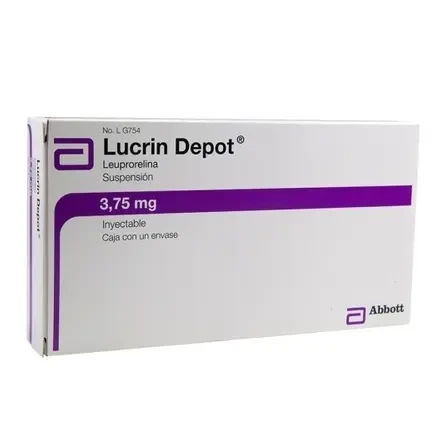
Following administration of 3.75 mg leuprolide depot suspension to three patients, less than 5% of the initial dose was recovered as unchanged or pentapeptide metabolite in the urine.
Half Life
Leuprolide has a terminal elimination half-life of approximately three hours.
Clearance
Leuprolide administered as a 1 mg intravenous bolus in healthy males has a mean systemic clearance between 7.6 and 8.3 L/h.
Toxicity
Leuprolide is considered extremely safe, with low dose-related toxicity and comparatively mild adverse effects. Prostate cancer patients treated with leuprolide at doses as high as 20 mg/day for two years showed no additional adverse effects compared to those receiving 1 mg/day.
Food Interactions
No interactions found.
Dosage
Endometriosis: As depot preparations: 3.75 mg every mth given as a single IM/SC inj or 11.25 mg every 3 mth as IM depot Inj. Initiate treatment during the 1st 5 days of menstrual cycle up to 6 mth. May be used with norethindrone acetate 5 mg daily for initial management of endometriosis and for management of recurrence symptoms. Duration of retreatment: Should not exceed one additional 6 mth course.
Uterine fibroids: As depot preparations: In combination with iron therapy for women with anaemia due to uterine fibroids, 3.75 mg every mth given as a single IM/SC inj or 11.25 mg every 3 mth as IM Inj. Treatment duration: Usually up to 3 mth.
Preparation for intrauterine surgery: Endometrial preparation prior to intrauterine surgery: As depot preparations: 3.75 mg as a single inj via IM/SC given 5-6 wk before the procedure; therapy should be initiated during days 3-5 of the menstrual cycle.
Child: Precocious puberty: As aqueous soln inj: Initial: 50 mcg/kg daily by SC inj, may be titrated upwards by 10 mcg/kg/day if total down-regulation is not achieved. As depot preparations: Initial: 0.3 mg/kg/dose (minimum dose: 7.5 mg) given every 4 wk via IM inj; which equates to children ≤25 kg: 7.5 mg; >25-37.5 kg: 11.25 mg and >37.5 kg: 15 mg given every 4 wk. Maintenance: May titrate dose upwards in steps of 3.75 mg every 4 wk if down-regulation is not achieved. Consider discontinuing therapy before age 11 (females) and age 12 (males).