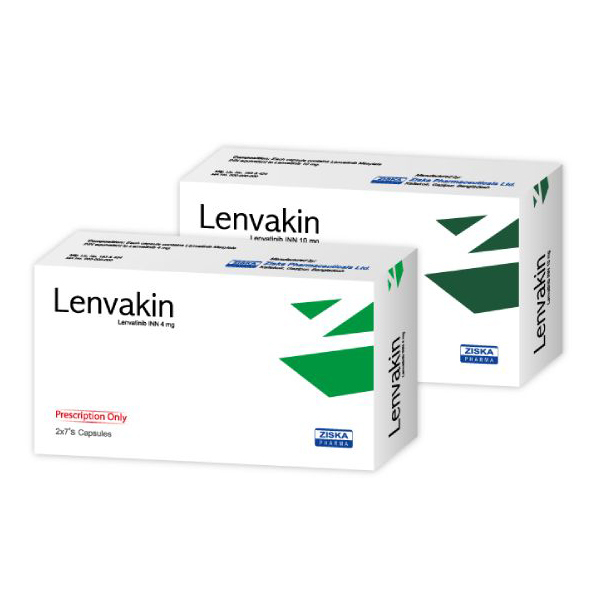
Introduction
Lenvatinib is a receptor tyrosine kinase (RTK) inhibitor that inhibits the kinase activities of vascular endothelial growth factor (VEGF) receptors VEGFR1 (FLT1), VEGFR2 (KDR), and VEGFR3 (FLT4). Lenvatinib also inhibits other RTKs that have been implicated in pathogenic angiogenesis, tumor growth, and cancer progression in addition to their normal cellular functions, including fibroblast growth factor (FGF) receptors FGFR1, 2, 3, and 4; the platelet derived growth factor receptor alpha (PDGFRα), KIT, and RET. These receptor tyrosine kinases (RTKs) located in the cell membrane play a central role in the activation of signal transduction pathways involved in the normal regulation of cellular processes, such as cell proliferation, migration, apoptosis and differentiation, and in pathogenic angiogenesis, lymphogenesis, tumour growth and cancer progression. In particular, VEGF has been identified as a crucial regulator of both physiologic and pathologic angiogenesis and increased expression of VEGF is associated with a poor prognosis in many types of cancers.
Lenvatinib is indicated for the treatment of patients with locally recurrent or metastatic, progressive, radioactive iodine (RAI)-refractory differentiated thyroid cancer. Most patients with thyroid cancer have a very good prognosis with treatment (98% 5 year survival rate) involving surgery and hormone therapy. However, for patients with RAI-refractory thyroid cancer, treatment options are limited and the prognosis is poor, leading to a push for the development of more targeted therapies such as lenvatinib.
Uses
Lenvatinib is a receptor tyrosine kinase inhibitor used for the treatment of metastatic thyroid cancer, advanced renal cell carcinoma in combination with everolimus, and unresectable hepatocellular carcinoma.
Lenvatinib is indicated for the treatment of following conditions.
Treatment of locally recurrent or metastatic, progressive, radioactive iodine-refractory differentiated thyroid cancer.
Treatment of advanced renal cell carcinoma (RCC) in combination with everolimus following one prior antiangiogenic therapy.
First-line treatment of unresectable hepatocellular carcinoma (HCC).
Associated Conditions
Pharmacodynamics
Based on x-ray crystallography and kinetic interaction studies, lenvatinib binds to the adenosine 5'-triphosphate binding site of VEGFR2 and to a neighbouring region via a cyclopropane ring and thereby inhibits tyrosine kinase activity and associated signalling pathways.
Mechanism of Action
Lenvatinib is a receptor tyrosine kinase (RTK) inhibitor that inhibits the kinase activities of vascular endothelial growth factor (VEGF) receptors VEGFR1 (FLT1), VEGFR2 (KDR), and VEGFR3 (FLT4). Lenvatinib also inhibits other RTKs that have been implicated in pathogenic angiogenesis, tumor growth, and cancer progression in addition to their normal cellular functions, including fibroblast growth factor (FGF) receptors FGFR1, 2, 3, and 4; the platelet derived growth factor receptor alpha (PDGFRα), KIT, and RET.
Absorption
Time to peak plasma concentration occurred from 1 to 4 hours postdose. Administration with food did not affect the extent of absorption, but decreased the rate of absorption and delayed the median Tmax from 2 hours to 4 hours.
Protein Binding
In vitro binding of lenvatinib to human plasma proteins ranged from 98% to 99%.
Route of Elimination
Following administration of a radiolabeled dose, approximately 64% and 25% of the radiolabel were eliminated in the feces and urine, respectively.
Half Life
The terminal elimination halflife of lenvatinib is approximately 28 hours.
Toxicity
The most common adverse events that occurred in lenvatinib recipients were hypertension (67.8 vs. 9.2 % in the placebo group), diarrhea (59.4 vs. 8.4 %), fatigue or asthenia (59.0 vs. 27.5 %), decreased appetite (50.2 vs. 11.5 %), decreased bodyweight (46.4 vs. 9.2 %), nausea (41.0 vs. 13.7 %), stomatitis (35.6 vs. 3.8 %), palmar-plantar erythrodysethesia syndrome (31.8 vs. 8.0 %) and proteinuria (31.0 vs. 1.5 %). Adverse events that occurred in clinical trials and for which there is a warning/precaution in US manufacturer’s pre- scribing information were hypertension, cardiac dysfunction (decreased left or right ventricular function, cardiac failure or pulmonary edema), arterial thromboembolic events, hepatotoxicity, proteinuria, renal failure and impairment, gastrointestinal perforation and fistula formation, QT interval prolongation, hypocalcaemia, reversible posterior leucoencephalopathy syndrome, haemorrhagic events, and impairment of thyroid stimulating hormone (TSH) suppression. Based on the mechanism of action of lenvatinib and results from animal reproduction studies, which showed embryotoxicity, foetotoxicity and teratogenicity at lenvatinib doses below the recommended dose in humans, females of reproductive potential should be advised to use effective contraception during treatment and for at least 2 weeks following completion of therapy.
Food Interactions
- Avoid hypertensive herbs (e.g. bayberry, blue cohosh, cayenne, ephedra, and licorice). Lenvatinib may cause hypertension as an adverse effect; therefore, there may be additive blood pressure elevation when using hypertensive herbs.
- Take at the same time every day.
- Take with or without food.
Dosage
Recommended Dosage for Differentiated Thyroid Cancer (DTC): The recommended dosage of Lenvatinib is 24 mg orally once daily until disease progression or until unacceptable toxicity.
Recommended Dosage for Renal Cell Carcinoma (RCC): The recommended dosage of Lenvatinib is 18 mg in combination with 5 mg Everolimus orally once daily until disease progression or until unacceptable toxicity.
Recommended Dosage for Hepatocellular Carcinoma (HCC): The recommended dosage of Lenvatinib is based on actual body weight: 12 mg for patients greater than or equal to 60 kg or 8 mg for patients less than 60 kg. Lenvatinib should be taken orally once daily until disease progression or until unacceptable toxicity.
Recommended Dosage for Endometrial Carcinoma: The recommended dosage of Lenvatinib is 20 mg orally once daily, in combination with Pembrolizumab 200 mg administered as an intravenous infusion over 30 minutes every 3 weeks, until unacceptable toxicity or disease progression.