Introduction
Infliximab is a tumor necrosis factor (TNF-alpha or TNF-α) blocker and a chimeric monoclonal IgG1 antibody composed of human constant (75%) and murine variable (25%) regions . Infliximab is produced by a recombinant cell line cultured by continuous perfusion. Tumor necrosis factor-alpha (TNF-α) is a key proinflammatory cytokine involved in chronic inflammatory diseases . Its hyperactivity and enhanced signalling pathways can be observed in inflammatory diseases where it activates further pro-inflammatory cascades. By binding to both the soluble subunit and the membrane-bound precursor of TNF-α , infliximab disrupts the interaction of TNF-α with its receptors and may also cause lysis of cells that produce TNF-α .
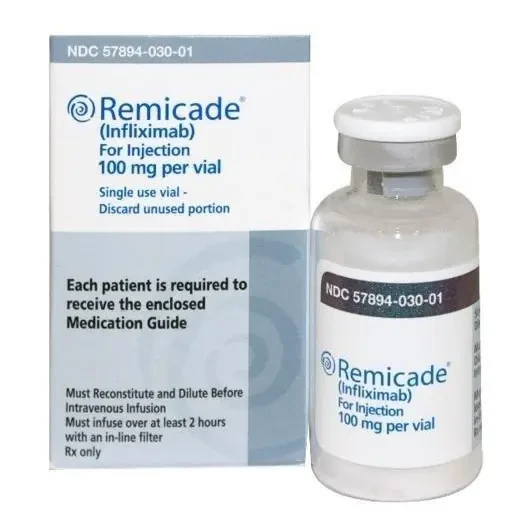
Infliximab was first approved by the FDA in 1998 under the market name Remicade as an intravenous injection. It is indicated for the treatment of various inflammatory disorders such as adult or pediatric Chron's disease, adult or pediatric ulcerative colitis, rheumatoid arthritis in combination with methotrexate, ankylosing spondyliti, psoriatic arthritis, and plaque psoriasis . In clinical trials, multiple infusions of infliximab displayed in a reduction of signs and symptoms of inflammatory diseases and induction of remission in patients who have had an inadequate response to alternative first-line therapies for that disorder .
There are currently two biosilimars of infliximab available in the US market that demonstrate a high degree of similarity to the reference product, Remicade. They are approved for all eligible indications of the reference product.
Uses
Infliximab is a monoclonal anti tumor necrosis factor alpha antibody used in the treatment of a wide variety of inflammatory conditions such as rheumatoid arthritis, Crohn's disease, and ankylosing spondylitis.
- Indicated for reducing signs and symptoms and inducing and maintaining clinical remission in adult or pediatric (≥ 6 years of age) patients with moderately to severely active Crohn’s disease who have had an inadequate response to conventional therapy
- Indicated for reducing the number of draining enterocutaneous and rectovaginal fistulas and maintaining fistula closure in adult patients with fistulizing Crohn’s disease.
- Indicated for reducing signs and symptoms, inducing and maintaining clinical remission and mucosal healing, and eliminating corticosteroid use in adult or pediatric (≥ 6 years of age) patients with moderately to severely active ulcerative colitis who have had an inadequate response to conventional therapy.
- Indicated for, in combination with methotrexate, reducing signs and symptoms, inhibiting the progression of structural damage, and improving physical function in patients with moderately to severely active rheumatoid arthritis.
- Indicated for reducing signs and symptoms in patients with active ankylosing spondylitis.
- Indicated for reducing signs and symptoms of active arthritis, inhibiting the progression of structural damage, and improving physical function in patients with psoriatic arthritis.
- Indicated for the treatment of adult patients with chronic severe (i.e., extensive and/or disabling) plaque psoriasis who are candidates for systemic therapy and when other systemic therapies are medically less appropriate.
Associated Conditions
Pharmacodynamics
Infliximab disrupts the activation of pro-inflammaory cascade signalling. Infliximab has shown to reduce infiltration of inflammatory cells into sites of inflammation. It also attenautes the expression of molecules mediating cellular adhesion {including E-selectin, intercellular adhesion molecule-1 (ICAM-1) and vascular cell adhesion molecule-1 (VCAM-1)}, chemoattraction {[IL-8 and monocyte chemotactic protein (MCP-1)} and tissue degradation {matrix metalloproteinase (MMP) 1 and 3} .
Mechanism of Action
Infliximab is a IgG1κ monoclonal antibody that binds to soluble and transmembrane forms of TNF-α with high affinity to disrupt the pro-inflammatory cascade signalling. Binding of the antibody to TNF-α prevents TNF-α from interacting with its receptors. Infliximab does not neutralize TNF-β (lymphotoxin-α), a related cytokine that utilizes the same receptors as TNF-α . Blocked actions of TNF-α further leads to downregulation of local and systemic pro-inflammatory cytokines (i.e. IL-1, IL-6), reduction of lymphocyte and leukocyte migration to sites of inflammation, induction of apoptosis of TNF-producing cells (i.e. activated monocytes and T lymphocytes), increased levels of nuclear factor-κB inhibitor, and reduction of reduction of endothelial adhesion molecules and acute phase proteins . Its inhibitory actions on TNF-α was demonstrated in human fibroblasts, endothelial cells, neutrophils, B and Tlymphocytes and epithelial cells . Infliximab also atteunates the production of tissue degrading enzymes synthesized by synoviocytes and/or chondrocytes. According to a transgenic mice study that developed polyarthritis due to consitutive levels of human TNF-α, infliximab decreased synovitis and joint erosions in collagen-induced arthritis and allows eroded joints to heal .
Absorption
Following a single intravenous infusion, infliximab absorption displays a linear relationship between the dose administered and the maximum serum concentration .
In patients with Crohn's disease, the maximum plasma concentration (Cmax) of infliximab following single doses of 5 mg/kg and 10 mg/kg was 75 µg/mL and 181 µg/mL, respectively. In a maintenance therapy study, multiple infusions of infliximab (at week 0, 2 and 6) at the same dose of 5 mg/kg and 10 mg/kg resulted in Cmax of 120 µg/mL and 189 µg/mL , respectively .
In patients with rheumatoid arthritis, the Cmax of infliximab following a single dose infusion of 5 mg/kg, 10 mg/kg and 20 mg/kg were 192±51 µg/mL, 427±106 µg/mL, and 907±183 µg/mL, respectively .
Volume of Distribution
Based on a pharmacokinetic study of adult patients, the distribution at steady state was independent of dose and indicated that infliximab was distributed primarily within the vascular compartment .
In patients with Crohn's disease, the apparent volume of distribution at steady state (Vss) of infliximab following single doses of 5 mg/kg and 10 mg/kg was 80 mL/kg and 65 mL/kg, respectively. In a maintenance therapy study, multiple infusions of infliximab (at week 0, 2 and 6) at the same dose of 5 mg/kg and 10 mg/kg resulted in Vss of 70 mL/kg and 81 mL/kg , respectively .
In patients with rheumatoid arthritis, the Vss of infliximab following a single dose infusion of 5 mg/kg, 10 mg/kg and 20 mg/kg were 4.3±2.5 L, 3.2±0.7 L, and 3.1±0.6 L, respectively .
Route of Elimination
Therapeutic monoclonal antibodies including infliximab are predicted to be nonspecifically metabolized to peptides and amino acids that can be re-used in the body for de novo synthesis of proteins or arc excreted by the kidney . The reticuloendothelial system (RES) are phagocytic cells of the immune system such as macrophages and monocytes that play a role in the elimination of endogenous IgG antibodies. Although administered infliximab accounts for a small fraction of total endogenous IgG and this route is not likely saturated by therapeutic mAbs, infliximab may be removed by opsonization via RES following binding of the Fc part of the antibody to Fcy-receptors expressed on the RES .
Half Life
The median terminal half-life of infliximab is 7.7 to 9.5 days. The data is based on a pharmacokinetic study in patients with Crohn's disease, plaque psoriasis and rheumatoid arthritis receiving a single dose of infliximab .
Clearance
In patients with Crohn's disease, the total body clearance (CL) of infliximab following single doses of 5 mg/kg and 10 mg/kg was 18.4 mL/h and 14.3 mL/h, respectively. In a maintenance therapy study, multiple infusions of infliximab (at week 0, 2 and 6) at the same dose of 5 mg/kg and 10 mg/kg resulted in CL of 15.2 mL/h and 15.2 mL/h, respectively .
In patients with rheumatoid arthritis, the CL of infliximab following a single dose infusion of 5 mg/kg, 10 mg/kg and 20 mg/kg were 11±7.5 mL/h, 11.4±5 mL/h, and 11±8.9 mL/h, respectively .
Development of antibodies to infliximab increased infliximab clearance .
Toxicity
In an acute toxicity animal study, the NOAEL of intravenous infliximab in rats was 50 mg/kg. In a repeated dose animal study, the NOAEL values of intravenous infliximab was 50 mg/kg in rats at 2 weeks following 3 doses and 40 mg/kg/day in mice at 6 months .
The toxicological potential of infliximab in humans has not yet been fully established. According to an analogous antibody study, infliximab is not predicted to induce tumorigenic, clastogenic or mutagenic effects. No impairment of fertility was observed in a fertility and general reproduction toxicity study with the analogous mouse antibody used in the 6-month chronic toxicity study .
Food Interactions
No interactions found.
Dosage
Pediatric Crohn’s Disease: 5 mg/kg at 0, 2 and 6 weeks, then every 8 weeks.
Ulcerative Colitis: 5 mg/kg at 0, 2 and 6 weeks, then every 8 weeks.
Pediatric Ulcerative Colitis: 5 mg/kg at 0, 2 and 6 weeks, then every 8 weeks.
Rheumatoid Arthritis: In conjunction with methotrexate, 3 mg/kg at 0, 2 and 6 weeks, then every 8 weeks. Some patients may benefit from increasing the dose up to 10
mg/kg or treating as often as every 4 weeks.
Ankylosing Spondylitis: 5 mg/kg at 0, 2 and 6 weeks, then every 6 weeks.
Psoriatic Arthritis and Plaque Psoriasis: 5 mg/kg at 0, 2 and 6 weeks, then every 8 weeks.