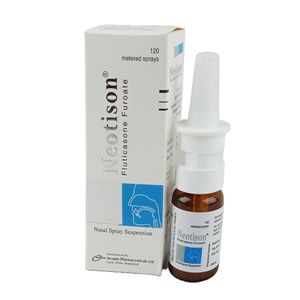
Introduction
Fluticasone furoate is a synthetic glucocorticoid available as an inhaler and nasal spray for various inflammatory indications. Fluticasone furoate was first approved in 2007.
Uses
Fluticasone furoate is an inhaled corticosteroid that can be used as maintenance treatment of asthma and/or chronic obstructive pulmonary disease (COPD) depending on the product. Also available as a nasal spray to manage symptoms of allergic rhinitis.
Fluticasone furoate is indicated as an inhaler for the treatment and management of asthma by prophylaxis. The fluticasone furoate nasal spray is indicated for treating season and perennial allergic rhinitis.
Associated Conditions
Pharmacodynamics
Systemically, in vitro experiments show fluticasone furoate activates glucocorticoid receptors, inhibits nuclear factor kappa b, and inhibits lung eosinophilia in rats.
Mechanism of Action
Fluticasone furoate works through an unknown mechanism to affect the action of various cell types and mediators of inflammation. In vitro experiments show fluticasone furoate activating glucocorticoid receptors, inhibiting nuclear factor kappa b, and inhibiting lung eosinophilia in rats.
Absorption
Intranasal exposure of fluticasone furoate results in patients swallowing a larger portion of the dose. However, absorption is poor and metabolism is high, therefore there is negligible systemic exposure with a nasal bioavailability of 0.50% and oral bioavialability of 1.26%. Inhaled bioavailability is 13.9%. A study of 24 healthy Caucasian males showed an inhaled bioavailability of 6.3-18.4%.
Volume of Distribution
608L at steady state for intravenous administration of fluticasone furoate. Other reports suggest the mean volume of distribution at steady state is 661L. A study of 24 healthy Caucasian males showed a volume of distribution at steady state of 704L following intravenous administration.
Protein Binding
Fluticasone furoate is >99% protein bound in serum and may be as high as 99.6%.
Route of Elimination
Fluticasone furoate is eliminated ≥90% in the feces and 1-2% in the urine.
Half Life
15.1 hours for intranasal fluticasone furoate and 24 hours for the inhaled formulation. A study of 24 healthy Caucasian males showed a half life of 13.6 hours following intravenous administration and 17.3-23.9 hours followed inhalation.
Clearance
57.8L/h for fluticasone furoate. A study of 24 healthy Caucasian males showed a clearance of 71.8L/h following intravenous administration.
Toxicity
Fluticasone furoate administered nasally may be associated with adrenal suppression or an increase in QTc interval though the association has not been well demonstrated in studies. Fluticasone furoate requires no dosage adjustment in renal impairment but must be used in caution in hepatic impairment due to the elimination mechanisms. Fluticasone furoate is not associated with carcinogenicity, mutagenicity, or impairment of fertility. There are no well controlled studies in pregnancy or lactation though animal studies have shown teratogenicity and hypoadrenalism in the offspring of treated mothers and other corticosteroids are known to be excreted in breast milk. Generally, there are no reported adverse effects with fluticasone in pregnancy. Pediatric patients should be given the lowest possible dose and monitored for reduction in growth velocity. There is insufficient evidence to determine whether geriatric patients respond differently to other patients. Systemic exposure may be 27-49% higher in Japanese, Korean, and Chinese patients compared to Caucasian patients. Caution should be exercised in these patients and the benefit and risk should be assessed before deciding on a treatment.
Food Interactions
No interactions found.
Dosage
- Adults & Children over 12 years: 2 sprays in each nostril once a day. In some cases 2 sprays into each nostril twice daily, not exceeding 4 sprays.
- Children under 12 years (2-11 Years): 1 spray in each nostril once a day. Patients should use Fluticasone Furoate nasal spray at regular intervals as directed since its effectiveness depends on its regular use.
- Children (under 2 years of age): There are no data to recommend use of Fluticasone Furoate Nasal Spray for the treatment of seasonal or perennial allergic rhinitis in children under 2 years of age.
- Adults and Adolescents Aged 12 Years and Older: The starting dosage for Fluticasone Furoate should be based upon patients' asthma severity.
- The usual recommended starting dose for adults and adolescents aged 12 years and older not on an inhaled corticosteroid (ICS) is 100 mcg.
- For other adults and adolescents aged 12 years and older, the starting dose should be based on previous asthma drug therapy and disease severity.
- For adults and adolescents aged 12 years and older who do not respond to Fluticasone Furoate 100 mcg after 2 weeks of therapy, replacement with Fluticasone Furoate 200 mcg may provide additional asthma control.
The highest recommended daily dose in adults and adolescents aged 12 years and older is 200 mcg. After asthma stability has been achieved, it is desirable to titrate to the lowest effective dosage to help reduce the possibility of side effects.
Pediatric Patients Aged 5 to 11 Years: The recommended dosage for children aged 5 to 11 years is 50 mcg administered once daily