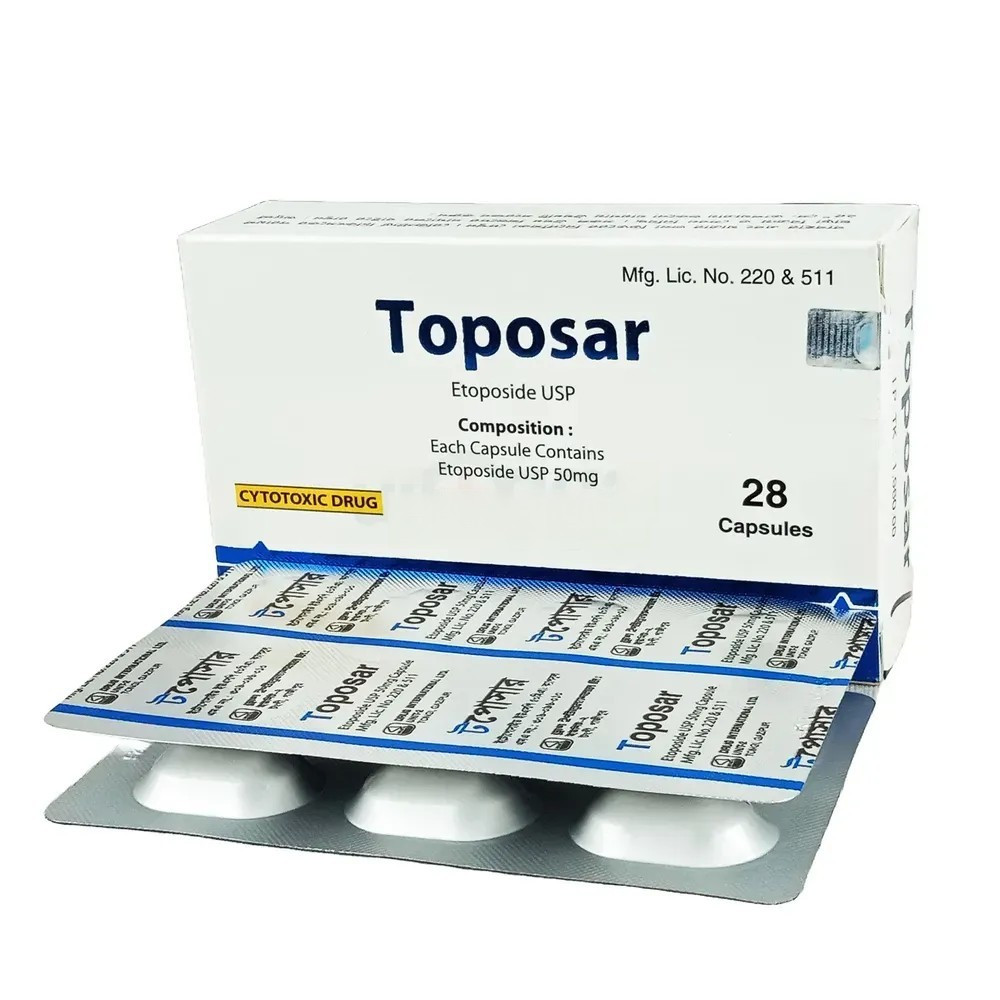
Introduction
A semisynthetic derivative of podophyllotoxin that exhibits antitumor activity. Etoposide inhibits DNA synthesis by forming a complex with topoisomerase II and DNA. This complex induces breaks in double stranded DNA and prevents repair by topoisomerase II binding. Accumulated breaks in DNA prevent entry into the mitotic phase of cell division, and lead to cell death. Etoposide acts primarily in the G2 and S phases of the cell cycle.
Uses
Etoposide is a podophyllotoxin derivative used to treat testicular and small cell lung tumors.
For use in combination with other chemotherapeutic agents in the treatment of refractory testicular tumors and as first line treatment in patients with small cell lung cancer. Also used to treat other malignancies such as lymphoma, non-lymphocytic leukemia, and glioblastoma multiforme.
Associated Conditions
Pharmacodynamics
Etoposide is an antineoplastic agent and an epipodophyllotoxin (a semisynthetic derivative of the podophyllotoxins). It inhibits DNA topoisomerase II, thereby ultimately inhibiting DNA synthesis. Etoposide is cell cycle dependent and phase specific, affecting mainly the S and G2 phases. Two different dose-dependent responses are seen. At high concentrations (10 µg/mL or more), lysis of cells entering mitosis is observed. At low concentrations (0.3 to 10 µg/mL), cells are inhibited from entering prophase. It does not interfere with microtubular assembly. The predominant macromolecular effect of etoposide appears to be the induction of DNA strand breaks by an interaction with DNA-topoisomerase II or the formation of free radicals.
Mechanism of Action
Etoposide inhibits DNA topoisomerase II, thereby inhibiting DNA re-ligation. This causes critical errors in DNA synthesis at the premitotic stage of cell division and can lead to apoptosis of the cancer cell. Etoposide is cell cycle dependent and phase specific, affecting mainly the S and G2 phases of cell division. Inhibition of the topoisomerase II alpha isoform results in the anti-tumour activity of etoposide. The drug is also capable of inhibiting the beta isoform but inhibition of this target is not associated with the anti-tumour activity. It is instead associated with the carcinogenic effect.
Absorption
Absorbed well, time to peak plasma concentration is 1-1.5 hrs. Mean bioavailability is 50% (range of 25% - 75%). Cmax and AUC values for orally administered etoposide capsules display intra- and inter-subject variability. There is no evidence of first-pass effect for etoposide.
Volume of Distribution
The disposition of etoposide is a biphasic process with a distribution half-life of 1.5 hours. It does not cross into cerebrospinal fluid well. Volume of distribution, steady state = 18 - 29 L.
Protein Binding
97% protein bound.
Route of Elimination
Etoposide is cleared by both renal and nonrenal processes, i.e., metabolism and biliary excretion. Glucuronide and/or sulfate conjugates of etoposide are also excreted in human urine. Biliary excretion of unchanged drug and/or metabolites is an important route of etoposide elimination as fecal recovery of radioactivity is 44% of the intravenous dose. 56% of the dose was in the urine, 45% of which was excreted as etoposide.
Half Life
4-11 hours
Clearance
- Total body clearance = 33 - 48 mL/min [IV administration, adults]
- Mean renal clearance = 7 - 10 mL/min/m^2
Toxicity
Side effects include alopecia, constipation, diarrhea, nausea and vomiting and secondary malignancies (leukemia).
Food Interactions
- Avoid grapefruit products. Grapefruit inhibits CYP3A4 metabolism, which may increase the serum concentration of etoposide.
- Exercise caution with St. John's Wort. This herb induces CYP3A4 metabolism, which may reduce serum levels of etoposide.
Dosage
In patients with impaired renal function: The initial dose modification should be considered based on measured creatinine clearance: >50 mL/min: 100% of dose; 15-50 mL/min: 75% of dose. Subsequent Etoposide dosing should be based on patient tolerance and clinical effect. Data are not available in patients with creatinine clearances <15 ml/min and further dose reduction should be considered in these patients.