Introduction
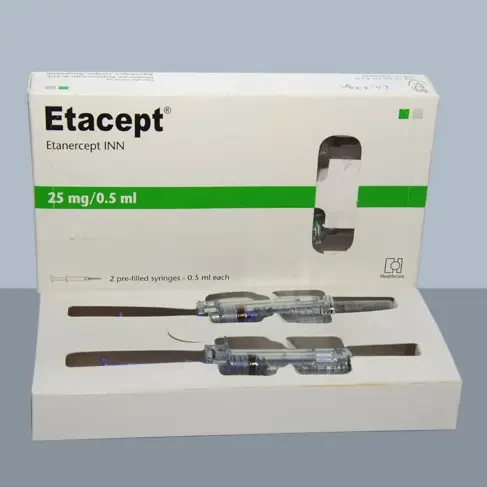
Dimeric fusion protein consisting of the extracellular ligand-binding portion of the human 75 kilodalton (p75) tumor necrosis factor receptor (TNFR) linked to the Fc portion of human IgG1. The Fc component of etanercept contains the CH2 domain, the CH3 domain and hinge region, but not the CH1 domain of IgG1. Etanercept is produced by recombinant DNA technology in a Chinese hamster ovary (CHO) mammalian cell expression system. It consists of 934 amino acids. It is used to treat or manage a variety of inflammatory conditions including rheumatoid arthritis (RA), ankylosing spondylitis (AS), and juvenile idiopathic poly-articular arthritis (JIA).
Uses
Etanercept is a protein therapy based on the binding fragment of the tumour necrosis factor alpha receptor used to treat severe rheumatoid arthritis and moderate to severe plaque psoriasis.
Etanercept is indicated for the treatment of moderately to severely active rheumatoid arthritis in adults and in chronic moderate to severe plaque psoriasis in patients 4 years of age and older. It is also used to manage signs and symptoms of polyarticular idiopathic arthritis in those aged 2 years and older. Etanercept is also used to manage the symptoms of psoriatic arthritis and ankylosing spondylitis.
Associated Conditions
Pharmacodynamics
Etanercept binds specifically to tumor necrosis factor (TNF) and thereby modulates biological processes that are induced or regulated by TNF. Such processes or molecules affected include the level of adhesion molecules expressed, as well as serum levels of cytokines and matrix metalloproteinases.
Mechanism of Action
There are two distinct receptors for TNF (TNFRs), a 55 kilodalton protein (p55) and a 75 kilodalton protein (p75). The biological activity of TNF is dependent upon binding to either cell surface receptor (p75 or p55). Etanercept is a dimeric soluble form of the p75 TNF receptor that can bind to two TNF molecules, thereby effectively removing them from circulation. Notably, etancerpt is only capable of binding to the active trimeric form of TNF as its binding site is located in the cleft between subunits.TNF is a naturally occurring cytokine that is involved in normal inflammatory and immune responses. Increased levels of TNF are found in tissues and fluids of those with rheumatoid arthritis, psoriatic arthritis, ankylosing spondylitis, and plaque psoriasis.
Absorption
Population pharmacokinetic modeling in adults with RA, AS, or who were healthy showed a subcutaneous bioavailability of 56.9% with a Ka of 0.0223/h. Another model in pediatric JIA patients showed an increased Ka of 0.05/h with a high mean interindividual variability of 215%. Cmax after a single 25 mg subcutaneous dose of Enbrel is reported as 1.1 mcg/L with a Tmax of 69 h. Cmax after repeated dosing is reported as 2.4 mcg/L in adult RA patients with a dosage of 25 mg twice weekly and 2.1 mcg in pediatric JIA patients with a dosage of 0.4 mg/kg twice weekly.
Volume of Distribution
Population pharmacokinetic modeling predicts a total Vd of 5.49 L with a peripheral compartment of 1.24 L in adults with RA and an apparent Vd with subcutaneous administration in pediatric JIA patients of 7.88 L.
Protein Binding
No significant protein binding has been identified.
Half Life
Etanercept has a mean half-life of elimination of 102 hours in RA patients. Population models have shown a mean half-life of 68 hours in healthy adults and 70.7-94.8 hours in pediatric JIA patients. Etanercept has a mean apparent clearance of 160 mL/h in RA patients. Population models predict a mean apparent clearance of 132 mL/h in healthy adults and 0.0576 L/h in pediatric JIA patients.
This is general information, not personal medical advice. Consult a doctor before taking any medicine.
Clearance
Dosage
Plaque psoriasis: The dose of etanercept is 50 mg syringe once weekly (as one subcutaneous injection using a 50 mg syringe or as two 25 mg injections given at approximately the same time) or 25 mg twice weekly (72 to 96 hours apart) as a subcutaneous injection. Higher responses may be achieved from initial treatment with a dose of 50 mg twice weekly for up to 12 weeks, followed, if necessary, by a dose of 50 mg once weekly or 25 mg twice weekly.
Adult patients may be treated intermittent or continuously based on physician judgment and individual patient needs. Treatment should be discontinued in patients who show no response after 12 weeks. With intermittent use, treatment cycles subsequent to the initial cycle should use a dose of 50 mg once weekly. No dose adjustment is required for elderly and or patient with renal and hepatic impairment. Patient weighs less than 62.5kg should be accurately dosed on an mg/kg basis. Patients weighing 62.5 kg or more may be fixed-dose prefilled syringe.
Juvenile idiopathic arthritis: Children (⩾2 to <18 years): 0.4mg/kg (up to maximum of 25 mg per dose) twice weekly (72 to 96 hours apart). Glucocoticoids, nonsteroidal anti-inflammatory drugs (NSAIDs), or analgesics may be continued during treatment with etanercept in children. Etanercept has not been studied in children <2 years of age.
Pediatric plaque psoriasis: Children (⩾6 to <18 years): 0.8mg/kg (up to a maximum of 50 mg per dose) once weekly for up to 24 weeks. Treatment should be discontinued in patients who show no response after 12 weeks. If retreatment of etanercept is indicated, the above guidance on treatment duration should be followed. The dose should be 0.8 mg/kg (up to maximum of 50 mg per dose) once weekly.Medical review