Introduction
Degarelix is used for the treatment of advanced prostate cancer. Degarelix is a synthetic peptide derivative drug which binds to gonadotropin-releasing hormone (GnRH) receptors in the pituitary gland and blocks interaction with GnRH. This antagonism reduces luteinising hormone (LH) and follicle-stimulating hormone (FSH) which ultimately causes testosterone suppression. Reduction in testosterone is important in treating men with advanced prostate cancer.
Uses
Degarelix is a GnRH receptor antagonist used in the management of advanced prostate cancer.
Degaralix is used for the management of advanced prostate cancer.
Associated Conditions
Pharmacodynamics
Degarelix is a synthetic derivative of GnRH decapeptide, the ligand of the GnRH receptor. Gonadotropin and androgen production result from the binding of endogenous GnRH to the GnRH receptor. Degarelix antagonizes the GnRH receptor which in turn blocks the release of LH and FSH from the pituitary. LF and FSH decreases in a concentration-dependent manner. The reduction in LH leads to a decrease in testosterone release from the testes.
Mechanism of Action
Degarelix competitively inhibits GnRH receptors in the pituitary gland, preventing the release of luteinizing hormone (LH) and follicle stimulating hormone. Reduced LH suppresses testosterone release, which slows the growth and reduces the size of prostate cancers.
Absorption
Degarelix forms a depot at the site of injection after subcutaneous administration from which the drug slowly released into circulation. After a single bolus dose of 2mg/kg, peak plasma concentrations of degarelix occured within 6 hours at a concentration of 330 ng/mL. Ki = 0.082 ng/mL and 93% of receptors were fully suppressed; MRT = 4.5 days.
Volume of Distribution
Central compartment: 8.88 - 11.4 L; Peripheral compartment: 40.9 L
Protein Binding
90% of the drug is bound to plasma proteins.
Route of Elimination
Fecal (70% to 80%) and renal (20%-30% of unchanged drug)
Half Life
Terminal half-life: 41.5 - 70.2 days; Absorption half-life: 32.9 hours; Half-life from injection site: 1.17 days.
Clearance
Following subcutaneous administration of degarelix to prostate cancer patients the clearance is approximately 9 L/hr.
Toxicity
The most commonly observed adverse reactions (> 10%) during degarelix therapy included injection site reactions (e.g., pain, erythema, swelling, or induration), hot flashes, increased weight, and increases in serum levels of transaminases and gamma-glutamyltransferase (GGT).
Food Interactions
No interactions found.
Dosage
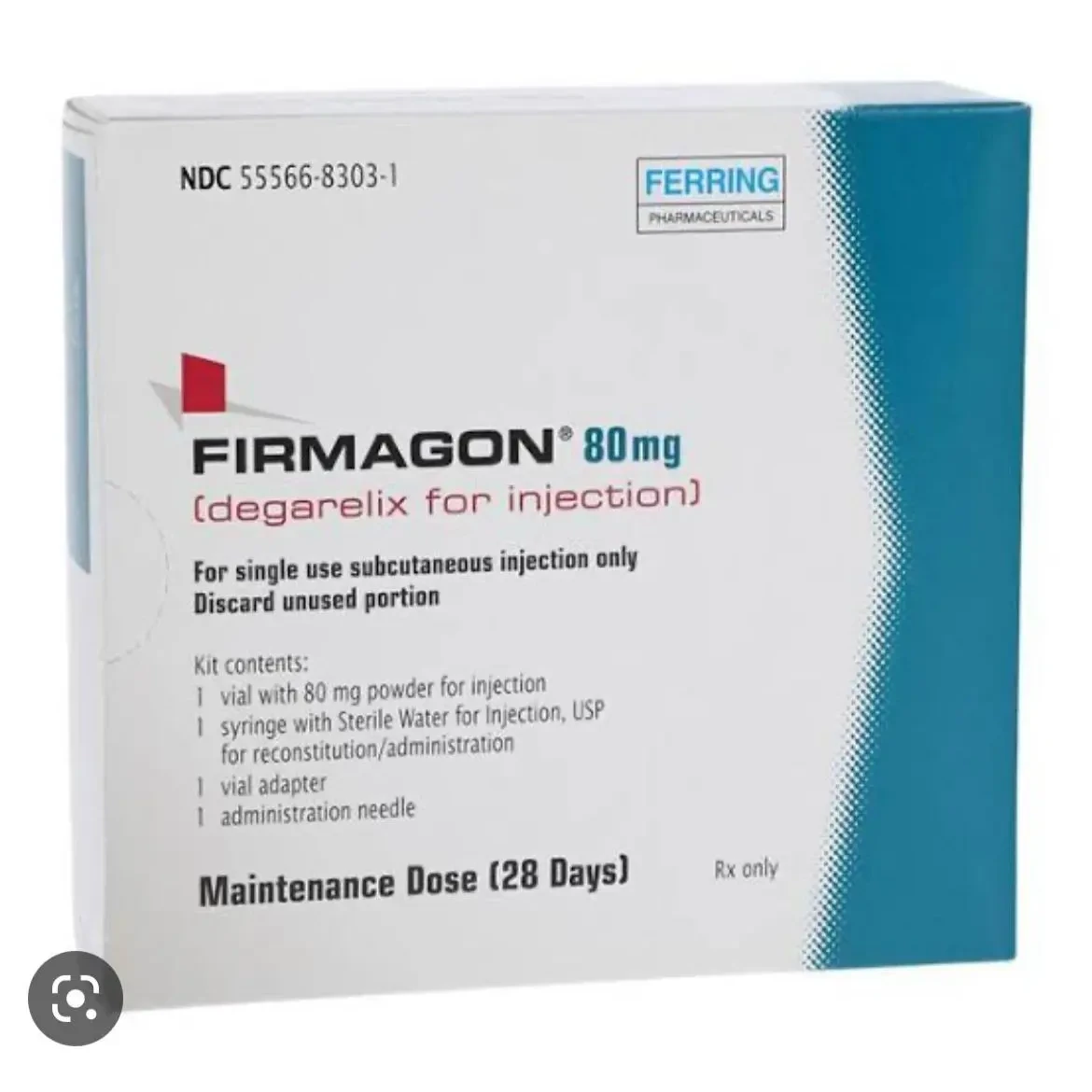
Maintenance dose (monthly administration): 80 mg administered as one subcutaneous injection.
The first maintenance dose should be given one month after the starting dose.
The therapeutic effect of degarelix should be monitored by clinical parameters and prostate specific antigen (PSA) serum levels. Clinical studies have shown that testosterone (T) suppression occurs immediately after administration of the starting dose with 96% of the patients having serum testosterone levels corresponding to medical castration (T≤0.5 ng/ml) after three days and 100% after one month. Long term treatment with the maintenance dose up to 1 year shows that 97% of the patients have sustained suppressed testosterone levels (T≤0.5 ng/ml).
In case the patient's clinical response appears to be sub-optimal, it should be confirmed that serum testosterone levels are remaining sufficiently suppressed.
Since degarelix does not induce a testosterone surge it is not necessary to add an anti androgen as surge protection at initiation of therapy.