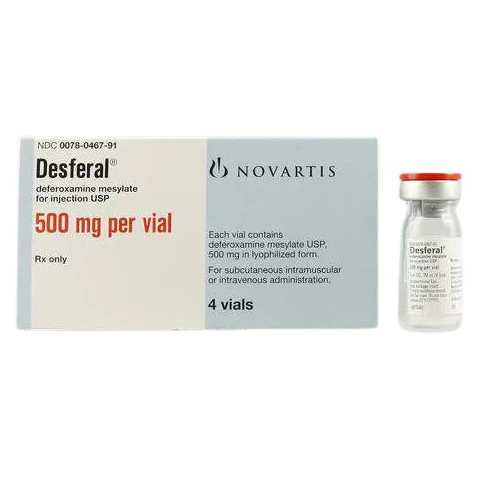
Introduction
Natural product isolated from Streptomyces pilosus. It forms iron complexes and is used as a chelating agent, particularly in the mesylate form.
Uses
Deferoxamine is a chelating agent used to treat iron or aluminum toxicity and some blood transfusion dependent anemias.
Used to treat acute iron or aluminum toxicity (an excess of aluminum in the body) in certain patients. Also used in certain patients with anemia who must receive many blood transfusions.
Associated Conditions
Pharmacodynamics
Deferoxamine, otherwise known as desferrioxamine or desferal, is a chelating agent used to remove excess iron or aluminum from the body. It acts by binding free iron or aluminum in the bloodstream and enhancing its elimination in the urine. By removing excess iron or aluminum, the agent reduces the damage done to various organs and tissues, such as the liver.
Mechanism of Action
Deferoxamine works in treating iron toxicity by binding trivalent (ferric) iron (for which it has a strong affinity), forming ferrioxamine, a stable complex which is eliminated via the kidneys. 100 mg of deferoxamine is capable of binding approximately 8.5 mg of trivalent (ferric) iron. Deferoxamine works in treating aluminum toxicity by binding to tissue-bound aluminum to form aluminoxamine, a stable, water-soluble complex. The formation of aluminoxamine increases blood concentrations of aluminum, resulting in an increased concentration gradient between the blood and dialysate, boosting the removal of aluminum during dialysis. 100 mg of deferoxamine is capable of binding approximately 4.1 mg of aluminum.
Absorption
Deferoxamine is rapidly absorbed after intramuscular or subcutaneous administration, but only poorly absorbed from the gastrointestinal tract in the presence of intact mucosa.
Protein Binding
Less than 10% bound to serum proteins in vitro.
Route of Elimination
Deferoxamine mesylate is metabolized principally by plasma enzymes, but the pathways have not yet been defined. Some is also excreted in the feces via the bile.
Half Life
Biphasic elimination pattern in healthy volunteers with a first rapid phase half life of 1 hour and a second slow phase half-life of 6 hours.
Toxicity
Intravenous LD50 in mouse, rat, and rabbit is 340 mg/kg, 520 mg/kg, and 600 mg/kg, respectively. Subcutaneous LD50 in mouse and rat is 1600 mg/kg and >1000 mg/kg, respectively. Oral LD50 in mouse and rat is >3000 mg/kg and >1000 mg/kg, respectively. Nephrotoxicity, ototoxicity and retinal toxicity have been reported following long-term administration for chronic iron overload.
Food Interactions
No interactions found.
Dosage
Rapid intravenous injection of Deferoxamine exceeding 15 mg/kg/h has produced flushing of the skin, urticaria, hypotension and shock