Introduction
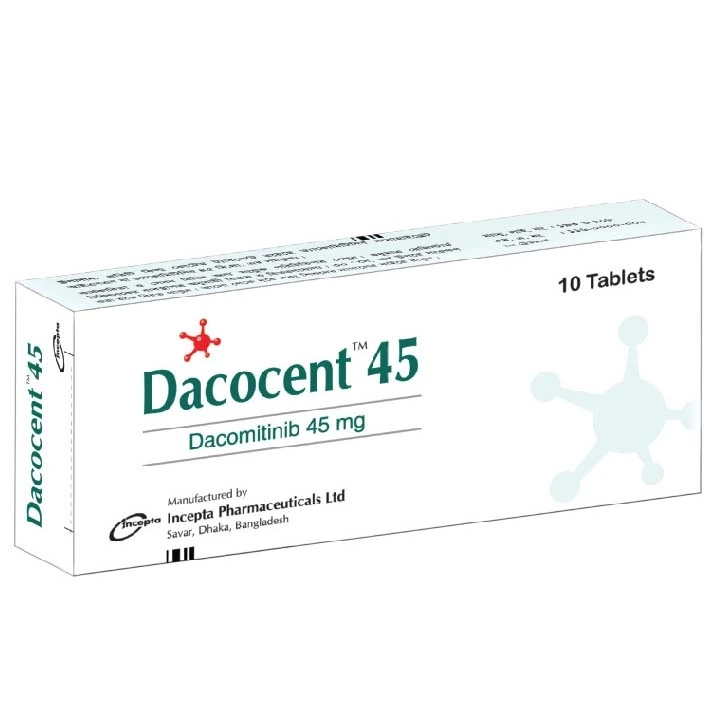
Dacomitinib is an oral highly selective quinazalone part of the second-generation tyrosine kinase inhibitors which are characterized by the irreversible binding at the ATP domain of the epidermal growth factor receptor family kinase domains.
Some evidence in the literature suggests the therapeutic potential of dacomitinib in the epithelial ovarian cancer model, although further investigations are needed.
Uses
Dacomitinib is a medication used to treat non small cell lung cancer with EGFR exon 19 deletion of exon 21 L858R substitution.
Dacomitinib is indicated as the first-line treatment of patients with metastatic non-small cell lung cancer (NSCLC) with epidermal growth factor receptor (EGFR) exon 19 deletion or exon 21 L858R substitution mutations as verified by an FDA-approved test.
Lung cancer is the leading cause of cancer death and NSCLC accounts for 85% of lung cancer cases. From the cases of NSCLC, approximately 75% of the patients present a late diagnosis with metastatic and advanced disease which produces a survival rate of 5%. The presence of a mutation in EGFR accounts for more than the 60% of the NSCLC cases and the overexpression of EGFR is associated with frequent lymph node metastasis and poor chemosensitivity.
Associated Conditions
Pharmacodynamics
Preclinical data suggested that dacomitinib increases the inhibition of the epidermal growth factor receptor kinase domain as well as the activity in cell lines harboring resistance mutations such as T790M. This activity further produced a significant reduction of EGFR phosphorylation and cell viability. In these studies, non-small cell lymphoma cancer cell lines with L858R/T790M mutations where used and an IC50 of about 280 nmol/L was observed.
In clinical trials with patients with advanced non-small cell lung carcinoma who progressed after chemotherapy, there was an objective response rate of 5% with a progression-free survival of 2.8 months and an overall survival of 9.5 months. As well, phase I/II studies showed positive dacomitinib activity despite prior failure with tyrosine kinase inhibitors.
Phase III clinical trials (ARCHER 1050), done in patients suffering from advanced or metastatic non-small cell lung carcinoma with EGFR-activating mutations, reported a significant improvement in progression-free survival when compared with gefitinib.
Mechanism of Action
Dacomitinib is an irreversible small molecule inhibitor of the activity of the human epidermal growth factor receptor (EGFR) family (EGFR/HER1, HER2, and HER4) tyrosine kinases. It achieves irreversible inhibition via covalent bonding to the cysteine residues in the catalytic domains of the HER receptors. The affinity of dacomitinib has been shown to have an IC50 of 6 nmol/L.
The ErbB or epidermal growth factor (EGF) family plays a role in tumor growth, metastasis, and treatment resistance by activating downstream signal transduction pathways such as such as Ras-Raf-MAPK, PLCgamma-PKC-NFkB and PI3K/AKT through the tyrosine kinase-driven phosphorylation at the carboxy-terminus. Around 40% of cases show amplification of EGFR gene and 50% of the cases present the EGFRvIII mutation which represents a deletion that produces a continuous activation of the tyrosine kinase domain of the receptor.
Absorption
Dacomitinib has shown a linear kinetics after single and multiple dose range studies. The absorption and distribution do not seem to be affected by food or the consumption of antacids. The peak plasma concentration after a dosage of 45 mg for 4 days is of 104 ng/ml. The reported AUC0-24h and tmax are of 2213 ng.h/mL and 6 hours, respectively. As well, following oral administration, the absolute oral bioavailability is 80% .
Volume of Distribution
The volume of distribution of dacomitinib was reported to be of 2415 L.
Protein Binding
Dacomitinib is known to present a protein binding of 98%.
Route of Elimination
From the administered dose, 79% is recovered in feces, from which 20% represents the unmodified form of dacomitinib, and 3% is recovered in urine, from which 12
Half Life
Dacomitinib is reported to have a very large half-life of 70 hours.
Clearance
The geometric apparent clearance of dacomitinib is 27.06 L/h.
Toxicity
The maximum asymptomatic dose in rats was 50 mg/kg . In animal studies, dacomitinib was shown to induce embryo-fetal toxicity, as demonstrated by an increased incidence of a post-implantation loss and reduced fetal body weight at doses resulting in exposures near the exposure at the 45mg human dose following administration in rats during the period of organogenesis. On the other hand, dacomitinib was showed to lack a mutagenic potential in a bacterial reverse mutation assay, in human lymphocyte chromosome aberration assay and in clastogenic or aneugenic in vivo rat bone marrow micronucleus assay.
The dose-limiting and overdose toxicities include stomatitis, rash, palmar-plantar erythrodysesthesia syndrome, dehydration, paronychia, and diarrhea. From these findings, the maximum tolerated dose (defined by the dose in which the dose-limiting toxicities did not exceed 33%) is 45 mg.
Food Interactions
- Avoid grapefruit products. Grapefruit inhibits CYP3A4 metabolism, which may increase the serum concentration of dacomitinib.
- Exercise caution with St. John's Wort. This herb induces CYP3A4 metabolism, which may reduce serum levels of dacomitinib.
- Take at the same time every day.
- Take separate from antacids. Take dacomitinib at least 6 hours before or 10 hours after administering antacids.
- Take with or without food.