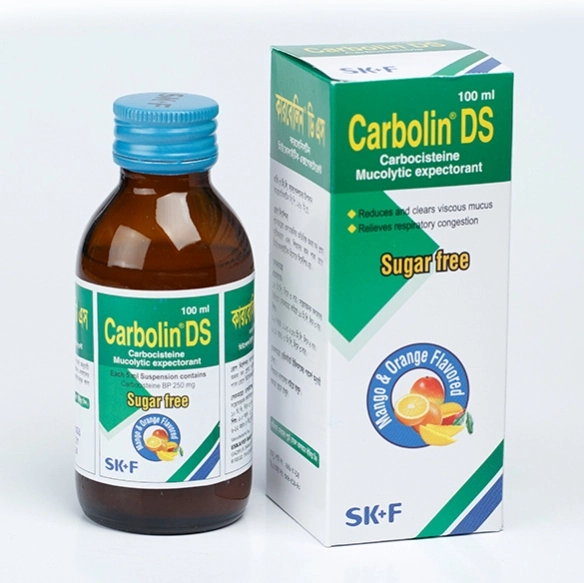
Introduction
Dyspnea and cough are common symptoms of chronic obstructive pulmonary disease (COPD) and other respiratory conditions characterized by increased mucus production. Individuals with COPD have a greater risk of pulmonary infection due to the growth and accumulation of viruses and bacteria in thick bronchial mucus. Carbocisteine is a mucolytic drug that alleviates respiratory symptoms and infections by reducing the viscosity of mucus, allowing it to be expelled.
Uses
Carbocisteine is a expectorant mucolytic used in the relief of respiratory of COPD and other conditions associated with increased mucus viscosity.
Carbocisteine is indicated over the counter and in prescription formulas to clear airway secretions in conditions associated with increased mucus.
Associated Conditions
Pharmacodynamics
Due to its mucolytic effects, carbocisteine significantly reduces sputum viscosity, cough, dyspnea and fatigue. Additionally, it prevents pulmonary infections by decreasing accumulated mucus in the respiratory tract; this is especially beneficial in preventing exacerbations of COPD caused by bacteria and viruses. It has in-vitro anti-inflammatory activity with some demonstrated action against free radicals.
Mechanism of Action
The hypersecretion of mucus characterizes serious respiratory conditions including asthma, cystic fibrosis (CF), and chronic obstructive pulmonary disease (COPD). It blocks bacterial adherence to cells, preventing pulmonary infections. Glycoproteins (fucomucins, sialomucins and sulfomucins) regulate the viscoelastic properties of bronchial mucus. Increased fucomucins can be found in the mucus of patients with COPD. Carbocisteine serves to restore equilibrium between sialomucins and fucomucins, likely by intracellular stimulation of sialyl transferase enzyme, thus reducing mucus viscosity.
A study found that L-carbocisteine can inhibit damage to cells by hydrogen peroxide (H2O2) by activating protein kinase B (Akt) phosphorylation, suggesting that carbocisteine may have antioxidant effects and prevent apoptosis of lung cells. There is some evidence that carbocisteine suppresses NF-κB and ERK1/2 MAPK signalling pathways, reducing TNF-alpha induced inflammation in the lungs, as well as other inflammatory pathways. An in-vitro study found that L-carbocisteine reduces intracellular adhesion molecule 1 (ICAM-1), inhibiting rhinovirus 14 infection, thereby reducing airway inflammation.
Absorption
Carbocisteine is rapidly absorbed in the gastrointestinal tract when taken orally with peak serum concentrations achieved within 1 to 1.7 hours.
Volume of Distribution
Carbocisteine penetrates well into the lung and bronchial secretions.
Protein Binding
Plasma protein binding information for carbocisteine is not readily available in the literature.
Route of Elimination
About 30% to 60% of an orally administered dose is detected unchanged in the urine.
Half Life
The plasma half-life of carbicostine is 1.33 hours.
Clearance
Clearance information for carbocisteine is not readily available in the literature.
Toxicity
The oral LD50 of carbocisteine in rats is >15000 mg/kg. An overdose with carbocisteine is likely to result in gastrointestinal discomfort with nausea and vomiting.
Food Interactions
- Take with or without food.
Dosage
Children: Normal daily dose is 20 mg/kg body weight in divided doses.
2-5 years: 62.5-125 mg 4 times daily.
6-12 years: 250 mg 3 times daily.
Infants: Dosage in infants has not been established.