Introduction
Human serum albumin is the most abundant protein in human blood plasma and plays a vital role in maintaining plasma oncotic pressure and circulating blood volume. It also functions as a transport protein by binding and carrying various substances, including electrolytes, fatty acids, hormones, bilirubin, and many medications.
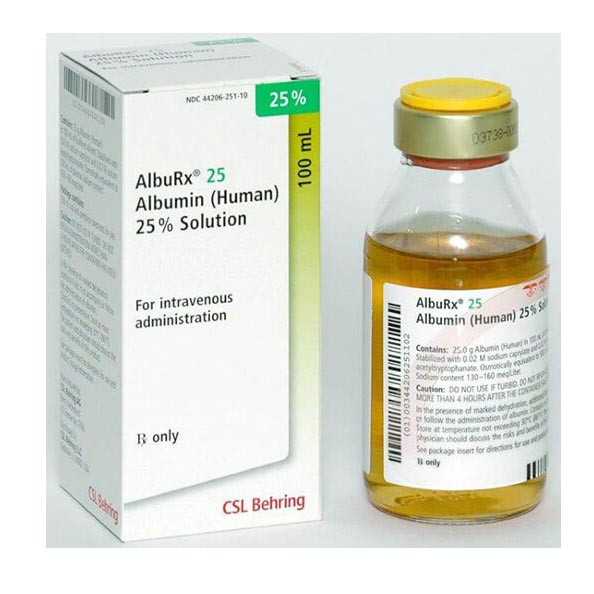
Human serum albumin preparations are used for plasma volume expansion and the treatment of conditions associated with hypoalbuminemia, shock, burns, and fluid loss. They are available in different concentrations, such as 5% and 25%, for various clinical applications.
Uses
Albumin human is a purified form of human serum albumin used to replace lost albumin in patients with hypoalbuminemia, to treat hypovolemia and ascites, and as a part of some diagnostic imaging kits.
Albuminex solution is indicated for adults and children for hypovolemia, ascites, hypoalbuminemia including from burns, acute nephrosis, acute respiratory distress syndrome and cardipulmonary bypass .
Associated Conditions
Pharmacodynamics
Serum albumin is a soluble, monomeric protein essential for maintaining and regulating the colloidal osmotic pressure of blood. It is utilized to increase the circulating plasma volume, which reduces hemoconcentration and blood viscosity. Albumin is also used as a transport protein that binds naturally occurring, therapeutic and toxic materials and drugs in the circulation .
Human albumin makes up over 50% the total protein in the plasma and represents about 10% of protein synthesis activity by the liver. Human Albumin 25% has a corresponding hyper-oncotic effect .
Mechanism of Action
The main function of albumin results from its contribution to plasma colloid oncotic pressure and transport function .
Albumin stabilizes circulating blood volume and carries hormones, enzymes, medicines, and toxins. Other physiological functions include antioxidant properties, free radical scavenging, in addition to maintenance capillary membrane integrity .
Exogenously administered albumin increases the oncotic pressure of the intravascular system, moving fluids from the interstitial space, thereby decreasing edema and increasing the circulating blood volume. The increase in volume reduces the concentration and viscosity of blood in patients with decreased circulating blood volume while maintaining cardiac output in shock. In dehydrated patients, negligible effects exist on circulating blood volume. In addition to the above albumin replaces protein in patients with hypoproteinemia until the cause of the deficiency can be determined .
This drug has thousands of endogenous and exogenous targets. Human albumin also binds and carries a plethora of hydrophobic molecules, such as endogenous (i.e., cholesterol, fatty acids, bilirubin, thyroxine) or exogenous substances (for example, drugs and toxins), transition metal ions, as well as gas (nitric oxide NO), with resulting implications for their solubilisation, transport, metabolism, and detoxification .
Volume of Distribution
Albumin is distributed throughout the extracellular space and more than 60% of the body albumin pool is located in the extravascular fluid space .
In healthy adults, less than 10% of infused albumin leaves the intravascular compartment during the first 2 hours following infusion of albumin. There is considerable individual variation in the effect of albumin on plasma volume, however , .
In some patients, the plasma volume can remain elevated for several hours. In critically ill patients, however, albumin can leak out of the vascular space in substantial amounts at an unpredictable rate that is difficult to predict .
Toxicity
In general, human albumin solutions are well-tolerated and no specific, clinically relevant alterations in organ function or coagulopathy have been substantiated .
The most common adverse reactions are rigors, hypotension, tachycardia with increased heart rate, fever, chills, nausea, vomiting, dyspnea and/or bronchospasm, skin rash/pruritus. Stop the infusion immediately if anaphylaxis, with or without shock is observed .
Hypervolemia may occur if the dosage and rate of infusion are not adjusted to the volume status of the patient. When clinical signs of cardiovascular overload occur (headache, dyspnea, jugular venous distention, increased blood pressure), the infusion must be slowed or stopped immediately .
Food Interactions
No interactions found.
Dosage
- Hypovolemia: Initial dose 25 g is suggested.
- Hypoalbuminemia: 50-75 gm
- Prevention of central volume fluid removed depletion after
- paracentesis due to cirrhotic ascites: 6-8 gm for every 1000 mL of ascitic.
- OHSS: 50 to 100 gm over 4 hours and repeated at 4-12 hour intervals as necessary. 10-50 gm; single infusion.
- ARDS: 25 g over 30 minutes and repeated at 8 hours for 3 days if necessary.
- Burns: Determined by direct observation of vital sign or measurement of either plasma oncotic pressure or protein content.
- arterial blood pressure and pulse rate
- central venous pressure
- pulmonary artery wedge pressure
- urine output
- electrolyte
- haematocrit / haemoglobin
Human albumin 5% may be given intravenously without further dilution. This concentration is approximately isotonic and iso-osmotic with citrated plasma. Albumin (Human) in this concentration provides additional fluid for plasma volume expansion. Therefore, when it is administered to patients with normal blood volume, the rate of infusion should be slow enough to prevent too rapid expansion of plasma volume.
In the treatment of shock in an adult patient an initial dose of 500 mL of the 5% albumin solution is given as rapidly as tolerated. If response within 30 minutes is inadequate, an additional 500 mL of 5% albumin solution may be given. The 50 mL dosage form would be appropriate for pediatric use, with a dose of 10-20 mL per kg of body weight infused intravenously at a rate up to 5-10 mL per minute. Therapy should be guided by the clinical response, blood pressure and an assessment of relative anemia. If more than 1000 mL are given, or if hemorrhage has occurred, the administration of packed red blood cells may be desirable.
In severe burns, immediate therapy should include large volumes of crystalloid with lesser amounts of 5% albumin solution to maintain an adequate plasma volume. After the first 24 hours, the ratio of albumin to crystalloid may be increased to establish and maintain a plasma albumin level of about 2.5 g/100 mL or a total serum protein level of about 5.2 g/100 mL. However, an optimal regimen for the use of colloids, electrolytes and water after severe burns has not been established.
The infusion of Albumin (Human) as a nutrient in the treatment of chronic hypoproteinemia is not recommended. In acute hypoproteinemia, 5% albumin may be used in replacing the protein lost in hypoproteinemic conditions. However, if edema is present or if large amounts of albumin are lost, Albumin (Human) 25% is preferred because of the greater amount of protein in the concentrated solution. Parenteral drug products should be inspected visually for particulate matter and discoloration prior to administration, whenever solution and container permit.