Introduction
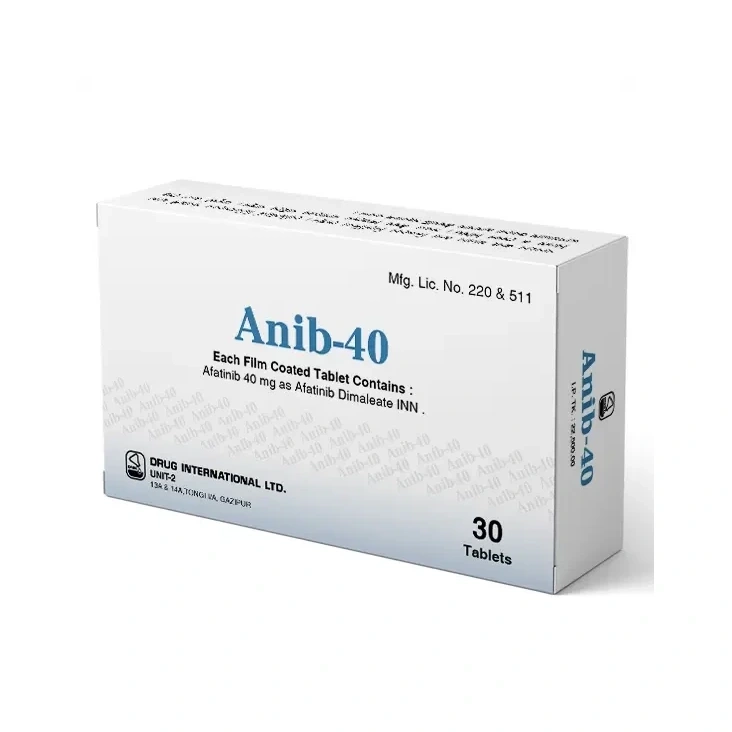
Afatinib is a 4-anilinoquinazoline tyrosine kinase inhibitor in the form of a dimaleate salt. For oral use, afatinib tablets are a first-line (initial) treatment for patients with metastatic non-small cell lung cancer (NSCLC) with common epidermal growth factor receptor (EGFR) mutations .
Uses
Afatinib is an antineoplastic agent used for the treatment of locally advanced or metastatic non-small cell lung cancer (NSCLC) with non-resistant EGFR mutations or resistance to platinum-based chemotherapy.
Afatinib is a kinase inhibitor indicated as monotherapy for the first-line treatment of (a) Epidermal Growth Factor Receptor (EGFR) TKI (tyrosine kinase inhibitor)-naive adult patients with locally advanced or metastatic non-small cell lung cancer (NSCLC) whose tumours have non-resistant EGFR mutations as detected by an FDA-approved test , and (b) adult patients with locally advanced or metastatic NSCLC of squamous histology progressing on or after platinum-based chemotherapy .
Recently, as of January 2018, the US FDA approved a supplemental New Drug Application for Boehringer Ingelheim's Gilotrif (afatinib) for the first line treatment of patients with metastatic non-small cell lung cancer (NSCLC) whose tumors have non-resistant epidermal growth factor receptor (EGFR) mutations as detected by an FDA-approved test . The new label includes data on three additional EGFR mutations: L861Q, G719X and S768I .
Associated Conditions
Pharmacodynamics
Aberrant ErbB signaling triggered by receptor mutations, and/or amplification, and/or receptor ligand overexpression contributes to the malignant phenotype . Mutation in EGFR defines a distinct molecular subtype of lung cancer .
In non-clinical disease models with ErbB pathway deregulation, afatinib as a single agent effectively blocks ErbB receptor signaling resulting in tumor growth inhibition or tumor regression . NSCLC tumors with common activating EGFR mutations (Del 19, L858R) and several less common EGFR mutations in exon 18 (G719X) and exon 21 (L861Q) are particularly sensitive to afatinib treatment in non-clinical and clinical settings . Limited non-clinical and/or clinical activity was observed in NSCLC tumors with insertion mutations in exon 20 .
The acquisition of a secondary T790M mutation is a major mechanism of acquired resistance to afatinib and gene dosage of the T790M-containing allele correlates with the degree of resistance in vitro . The T790M mutation is found in approximately 50% of patients' tumors upon disease progression on afatinib, for which T790M targeted EGFR TKIs may be considered as a next line treatment option . Other potential mechanisms of resistance to afatinib have been suggested preclinically and MET gene amplification has been observed clinically .
At the same time, the effect of multiple doses of afatinib (50 mg once daily) on cardiac electrophysiology and the QTc interval was evaluated in an open-label, single-arm study in patients with relapsed or refractory solid tumors . Ultimately, no large changes in the mean QTc interval (i.e., >20 ms) were detected in the study .
Mechanism of Action
Afatinib is a potent and selective, irreversible ErbB family blocker . Afatinib covalently binds to and irreversibly blocks signaling from all homo and heterodimers formed by the ErbB family members EGFR (ErbB1), HER2 (ErbB2), ErbB3 and ErbB4 .
In particular, afatinib covalently binds to the kinase domains of EGFR (ErbB1), HER2 (ErbB2), and HER4 (ErbB4) and irreversibly inhibits tyrosine kinase autophosphorylation, resulting in downregulation of ErbB signaling . Certain mutations in EGFR, including non-resistant mutations in its kinase domain, can result in increased autophosphorylation of the receptor, leading to receptor activation, sometimes in the absence of ligand binding, and can support cell proliferation in NSCLC . Non-resistant mutations are defined as those occurring in exons constituting the kinase domain of EGFR that lead to increased receptor activation and where efficacy is predicted by 1) clinically meaningful tumor shrinkage with the recommended dose of afatinib and/or 2) inhibition of cellular proliferation or EGFR tyrosine kinase phosphorylation at concentrations of afatinib sustainable at the recommended dosage according to validated methods . The most commonly found of these mutations are exon 21 L858R substitutions and exon 19 deletions .
Moreover, afatinib demonstrated inhibition of autophosphorylation and/or in vitro proliferation of cell lines expressing wild-type EGFR and in those expressing selected EGFR exon 19 deletion mutations, exon 21 L858R mutations, or other less common non-resistant mutations, at afatinib concentrations achieved in patients . In addition, afatinib inhibited in vitro proliferation of cell lines overexpressing HER2 .
Absorption
Following oral administration, time to peak plasma concentration (Tmax) is 2 to 5 hours . Maximum concentration (Cmax) and area under the concentration-time curve from time zero to infinity (AUC0-∞) values increased slightly more than dose proportional in the range of 20 to 50 mg . The geometric mean relative bioavailability of 20 mg tablets was 92% as compared to an oral solution .
Additionally, systemic exposure to afatinib is decreased by 50% (Cmax) and 39% (AUC0-∞), when administered with a high-fat meal compared to administration in the fasted state . Based on population pharmacokinetic data derived from clinical trials in various tumor types, an average decrease of 26% in AUCss was observed when food was consumed within 3 hours before or 1 hour after taking afatinib .
Volume of Distribution
The volume of distribution of afatinib recorded in healthy male volunteers is documented as 4500 L . Such a high volume of distribution in plasma suggests a potentially high tissue distribution .
Protein Binding
In vitro binding of afatinib to human plasma proteins is approximately 95% . Afatinib binds to proteins both non-covalently (traditional protein binding) and covalently .
Route of Elimination
In humans, excretion of afatinib is primarily via the feces . Following administration of an oral solution of 15 mg afatinib, 85.4% of the dose was recovered in the feces and 4.3% in urine . The parent compound afatinib accounted for 88% of the recovered dose .
Half Life
Afatinib is eliminated with an effective half-life of approximately 37 hours . Thus, steady-state plasma concentrations of afatinib were achieved within 8 days of multiple dosing of afatinib resulting in an accumulation of 2.77-fold (AUC0-∞) and 2.11-fold (Cmax) . In patients treated with afatinib for more than 6 months, a terminal half-life of 344 h was estimated .
Clearance
The apparent total body clearance of afatinib as recorded in healthy male volunteers is documented as being a high geometric mean of 1530 mL/min .
Toxicity
Most common adverse reactions (≥20%) are diarrhea, rash/dermatitis, acneiform, stomatitis, paronychia, dry skin, decreased appetite, pruritus .
Conversely, overdose in 2 healthy adolescents involving the ingestion of 360 mg each of afatinib (as part of a mixed drug ingestion) was associated with adverse events of nausea, vomiting, asthenia, dizziness, headache, abdominal pain and elevated amylase (< 1.5 times ULN) . Both individuals recovered from these adverse events .
Food Interactions
- Take separate from meals. Take at least one hour before or two hours after a meal.