Introduction
Abemaciclib is an antitumor agent and dual inhibitor of cyclin-dependent kinases 4 (CDK4) and 6 (CDK6) that are involved in the cell cycle and promotion of cancer cell growth in case of unregulated activity. On September 28, 2017, FDA granted approval of abemaciclib treatment under the market name Verzenio for the treatment of HR-positive and HER2-negative advanced or metastatic breast cancer that has progressed after unsuccessful endocrine therapy. It is either given alone in patients who has undergone endocrine therapy and chemotherapy after the metastasis of cancer, or in combination with Fulvestrant. Following oral treatment in patients with HR-positive, HER2-negative breast cancer, abemaciclib demonstrated increased progression-free survival rates and objective response rates. Abemaciclib has been used in trials studying the treatment of melanoma, lymphoma, neoplasm, solid tumor, and glioblastoma.
Uses
Abemaciclib is a medication used to treat HR+ HER2- advanced or metastatic breast cancer.
Indicated in combination with fulvestrant for the treatment of women with hormone receptor (HR)-positive, human epidermal growth factor receptor 2 (HER2)-negative advanced or metastatic breast cancer with disease progression following endocrine therapy.
Inidicated as monotherapy for the treatment of adult patients with HR-positive, HER2-negative advanced or metastatic breast cancer with disease progression following endocrine therapy and prior chemotherapy in the metastatic setting.
Associated Conditions
Pharmacodynamics
In combination with fulvestrant, the progression-free survival for patients with HR-positive, HER2-negative breast cancer was 16.4 months compared to 9.3 months for patients taking a placebo with fulvestrant. As a monotherapy, 19.7% of patients taking abemaciclib achieved complete or partial shrinkage of their tumors for a median 8.6 months after treatment . Abemaciclib induces cell cycle arrest and exerts an antitumor activity in human tumor xenograft models .
In patient investigations and a healthy volunteer study, abemaciclib is not shown to induce any clinically significant changes in the QTc interval .
Mechanism of Action
Regulation of cell cycle is crucial in maintaining proper cell growth; dysregulated cell cycle signalling pathway is a key component in inducing hyperproliferation of cells and tumor formation in various cancers. G1 to S phase cell cycle progression, or transition through the G1 restriction point (R), is promoted by the retinoblastoma tumor suppressor protein (Rb)-mediated pathway. Activation of Rb-mediated pathway requires the interaction of Cyclin-dependent kinases (CDK) 4 and 6 with D-type cyclins, which drives the formation of active CDK4/CDK6 and subsequent phosphorylation of Rb .
Rb is a tumor suppressant protein that inhibits proliferation through binding to and suppressing the activity of the E2F family of transcription factors . However, phosphorylation of Rb relieves suppression of E2F to allow expression of genes required for passage through the restriction point . This leads to increased expression of downstream signalling molecules and activity of protein kinases that promote the cell cycle progression and initiation of DNA replication. Phosphorylation of Rb and other proteins by CDK4/6 additionally leads to transcription of genes involved in cell cycle-independent activities including signal transduction, DNA repair transcriptional control, and mRNA processing .
Abemaciclib selectively inhibits CDK4 and CDK6 with low nanomolar potency, inhibits Rb phosphorylation resulting in a G1 arrest and inhibition of proliferation, and its activity is specific for Rb-proficient cells . Unlike other CDK inhibitors such as Palbociclib and Ribociclib, abemaciclib exhibits greater selectivity for CDK4 compared to CDK6 .
Absorption
The plasma concentration of the drug increases in a dose-proportional manner. Following a single oral dose administration of 200 mg abemaciclib, the mean peak plasma concentration (Cmax) of 158 ng/mL is reached after 6 hours. The median time to reach maximum plasma concentration (Tmax) ranges from 4-6 hours following an oral administration of abemaciclib over a range of 50–275 mg , but may range up to 24 hours . The absolute bioavailability of the drug is reported to be 45% .
Volume of Distribution
The geometric mean systemic volume of distribution is approximately 690.3 L (49% CV) .
Protein Binding
According to in vitro models using animal brain tissues, the protein binding of abemaciclib is approximately 95-98% . While abemaciclib demonstrated in vitro binding to serum albumin, alpha-1-acid glycoprotein and other human plasma proteins in a concentration-depedent manner, its major metabolites are also shown to bind to plasms proteins as well. The approximate bound fractions of M2, M18 and M20 are 93.4%, 96.8% and 97.8%, respectively .
Route of Elimination
Following a single oral dose of 150mg radiolabeled abemaciclib, approximately 81% of the total dose was recovered in feces while 3% of the dose was detected in urine. The majority of the drug is exceted as metabolites .
Half Life
The mean plasma elimination half-life for abemaciclib in patients was 18.3 hours (72% CV) .
Clearance
The geometric mean hepatic clearance (CL) of abemaciclib in patients was 26.0 L/h (51% CV) .
Toxicity
According to the bacterial reverse mutation (Ames) assay, abemaciclib and its active metbolites M2 and M20 did not display mutagenic properties. Abemaciclib was not clastogenic in vitro rat bone marrow micronucleus assay. Repeat-dose toxicity studies were performed to assess the effects of abemaciclib in testis, epididymis, prostate, and seminal vesicle at doses ≥10 mg/kg/day in rats and ≥0.3 mg/kg/day in dogs which exceed the recommeded therapeutic doses in humans. The findings included decreased organ weights, intratubular cellular debris, hypospermia, tubular distillation, atrophy and degeneration or necrosis .
Food Interactions
- Avoid grapefruit products. Grapefruit inhibits CYP3A metabolism, which may increase the serum concentration of abemaciclib.
- Avoid St. John's Wort. This herb induces CYP3A metabolism and may reduce serum levels of abemaciclib.
- Take at the same time every day.
- Take with or without food.
Dosage
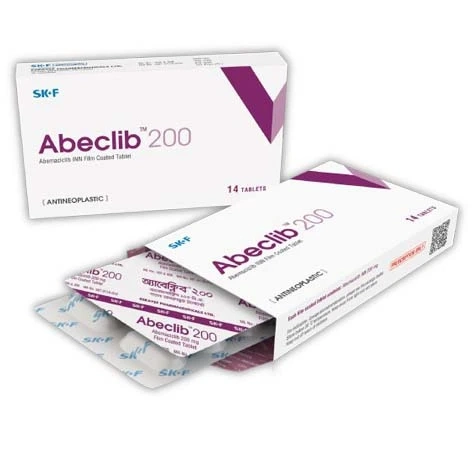
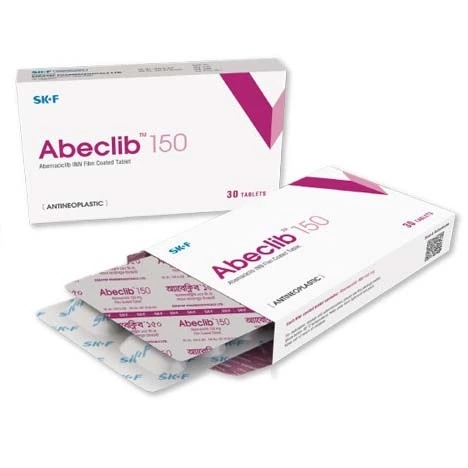
- Recommended starting dose in combination with fulvestrant, tamoxifen, or an aromatase inhibitor: 150 mg twice daily.
- Recommended starting dose as monotherapy: 200 mg twice daily.
- Dosing interruption and/or dose reductions may be required based on individual safety and tolerability.