Introduction
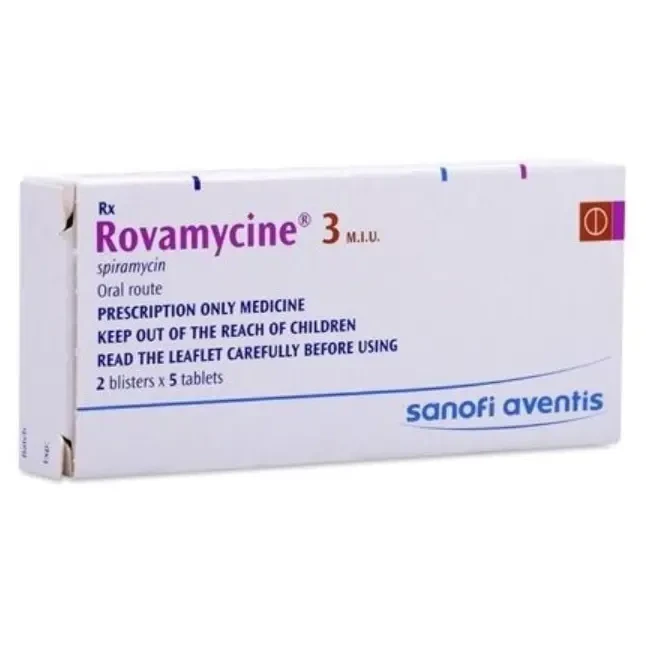
Spiramycin is a primarily bacteriostatic macrolide antimicrobial agent with activity against Gram-positive cocci and rods, Gram-negative cocci and also Legionellae, mycoplasmas, chlamydiae, some types of spirochetes, Toxoplasma gondii and Cryptosporidium. Spiramycin is a 16-membered ring macrolide discovered in 1952 as a product of Streptomyces ambofaciens that has been available in oral formulations since 1955, and parenteral formulations since 1987. Resistant organisms include Enterobacteria, pseudomonads, and moulds.
Uses
Spiramycin is a macrolide antimicrobial agent used in the treatment of various bacterial infections.
Macrolide antibiotic for treatment of various infections.
Associated Conditions
Pharmacodynamics
The absolute bioavailability of oral spiramycin is generally within the range of 30 to 40%. After a 1 g oral dose, the maximum serum drug concentration was found to be within the range 0.4 to 1.4 mg/L.
Mechanism of Action
The mechanism of action of macrolides has been a matter of controversy for some time. Spiramycin, a 16-membered macrolide, inhibits translocation by binding to bacterial 50S ribosomal subunits with an apparent 1 : 1 stoichiometry. This antibiotic is a potent inhibitor of the binding to the ribosome of both donor and acceptor substrates. The primary mechanism of action is done by stimulation of dissociation of peptidyl-tRNA from ribosomes during translocation.I
Absorption
The extent of absorption of Spiramycin was shown to be incomplete. Oral bioavailability ranges from 30-39%. Spiramycin has slower rate of absorption than Erythromycin. It has a high pKa (7.9) which could be a result of high degree of ionization in acidic medium of the stomach.
Volume of Distribution
The tissue distribution of spiramycin is extensive. The volume of distribution is in excess of 300 L, and concentrations achieved in bone, muscle, respiratory tract and saliva exceed those found in serum. Spiramycin showed high concentrations in tissues such as: lungs, bronchi, tonsils, and sinuses.
Protein Binding
Low level of protein binding (10-25%).
Route of Elimination
Fecal-biliary route is the primary route of elimination. The secondary route is renal-urinary route.
Half Life
Intravenous: Young persons (18 to 32 years of age): Approximately 4.5 to 6.2 hours. Elderly persons (73 to 85 years of age): Approximately 9.8 to 13.5 hours.
Oral: 5.5-8 hours, Rectal in children: 8 hours
Clearance
80% of the administered dose excreted in the bile, which makes the fecal-biliary route is the most important route of elimination. Enterohepatic recycling could also occur. Only 4 to 14% of an administered dose is eliminated through renal-urinary excretion route.
Toxicity
Cardiac toxicity, specifically QT prolongation (irregular heartbeat; recurrent fainting).
Cholestatic hepatitis (abdominal pain; nausea; vomiting; yellow eyes or skin).
Gastrointestinal toxicity, specifically acute colitis (abdominal pain and tenderness; bloody stools; fever).
Intestinal injury (abdominal pain and tenderness).
Ulcerated esophagitis (chest pain; heartburn).
Food Interactions
- No food interactions are expected.
Dosage
Children: The usual daily dosage is based on 150,000 l.U./kg body weight in 2 or 3 divided doses.