Introduction
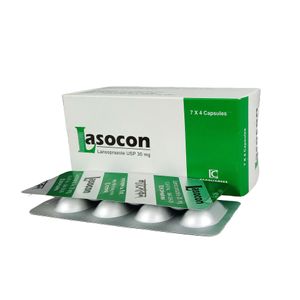
Zoton Capsule (Enteric Coated Pellets) 30 mg is a proton pump inhibitor (PPI) and is structurally classified as a substituted benzimidazole. It reduces gastric acid secretion by targeting gastric H,K-ATPase pumps and is thus effective at promoting healing in ulcerative diseases, and treating gastroesophageal reflux disease (GERD) along with other pathologies caused by excessive acid secretion.
Uses
Zoton Capsule (Enteric Coated Pellets) 30 mg is a proton pump inhibitor used to help gastrointestinal ulcers heal, to treat symptoms of gastroesophageal reflux disease (GERD), to eradicate Helicobacter pylori, and to treat hypersecretory conditions such as Zollinger-Ellison Syndrome.
Zoton Capsule (Enteric Coated Pellets) 30 mg is used to reduce gastric acid secretion and is approved for short term treatment of active gastric ulcers, active duodenal ulcers, erosive reflux oesophagitis, symptomatic gastroesophageal reflux disease, and non-steroidal anti-inflammatory drug (NSAID) induced gastric and duodenal ulcers. It may be used in the maintenance and healing of several gastric conditions including duodenal ulcers, NSAID related gastric ulcers, and erosive esophagitis. Zoton Capsule (Enteric Coated Pellets) 30 mg prevents recurrence of gastric ulcers in patients who have a documented history of gastric ulcers who also use NSAIDs chronically. Predictably, it is also useful in the management of hypersecretory conditions including Zollinger-Ellison syndrome. Zoton Capsule (Enteric Coated Pellets) 30 mg is effective at eradicating H. pylori when used in conjunction with amoxicillin and clarithromycin (triple therapy) or with amoxicillin alone (dual therapy).
Associated Conditions
Pharmacodynamics
Zoton Capsule (Enteric Coated Pellets) 30 mg decreases gastric acid secretion by targeting H+,K+-ATPase, which is the enzyme that catalyzes the final step in the acid secretion pathway in parietal cells. Conveniently, lansoprazole administered any time of day is able to inhibit both daytime and nocturnal acid secretion. The result is that lansoprazole is effective at healing duodenal ulcers, reduces ulcer-related pain, and offers relief from symptoms of heartburn Zoton Capsule (Enteric Coated Pellets) 30 mg also reduces pepsin secretion, making it a useful treatment option for hypersecretory conditions such as Zollinger-Ellison syndrome.[F4352]
Mechanism of Action
As a PPI, lansoprazole is a prodrug and requires protonation via an acidic environment to become activated. Once protonated, lansoprazole is able to react with cysteine residues, specifically Cys813 and Cys321, on parietal H+,K+-ATPase resulting in stable disulfides. PPI's in general are able to provide prolonged inhibition of acid secretion due to their ability to bind covalently to their targets.
Absorption
The oral bioavailability of lansoprazole is reported to be 80-90% and the peak plasma concentration(Cmax) is achieved about 1.7 hours after oral dosing. Food reduces the absorption of lansoprazole (both Cmax and AUC are reduced by 50-70%); therefore, patients should be instructed to take lansoprazole before meals.
Volume of Distribution
The apparent volume of distribution of lansoprazole is 0.4 L/kg.
Protein Binding
97% of lansoprazole is plasma protein bound.
Route of Elimination
A reported 14-23% of a lansoprazole is eliminated in the urine with this percentage range including both conjugated and unconjugated hydroxylated metabolites.
Half Life
One source reports the half life of lansoprazole to be 0.9 - 1.6 hours, while another source cites 0.9 - 2.1 hours. The general consensus is that lansoprazole has a short half life and is approximately 2 hours or less. These numbers may be misleading since it suggests that lansoprazole has a short duration of action when in practice, lansoprazole can effectively inhibit acid secretion for ~24 hours due to it's mechanism of action.
Clearance
The reported clearance of lansoprazole is 400-650 mL/min.
Toxicity
The most commonly reported adverse events occurring more frequently in lansoprazole treated patients compared to placebo include abdominal pain, constipation, diarrhea, and nausea. There is a case report of toxic epidermal necrolysis (TEN), which is a rare but very serious cutaneous reaction, caused by lansoprazole. The previously healthy patient presented with symptoms of TEN 15 days after starting lansoprazole to manage peptic disease. Although the use of PPI's is rarely associated with TEN, causation should be considered if a patient presents with TEN shortly after newly commencing a PPI.
In a single case report, a patient ingested 600 mg of lansoprazole and did not experience any adverse effects or symptoms of overdose. Overall, lansoprazole is well tolerated with relatively few adverse effects.
Zoton Capsule (Enteric Coated Pellets) 30 mg is classified as Pregnancy Category B. Although there are animal studies that suggest lansoprazole does not cause harm to the fetus, there is still a paucity of human data. Hence, lansoprazole should only be administered to pregnant women if other options with more safety data have been exhausted.
It is unknown if lansoprazole is excreted in human breast milk. It is worth mentioning that lansoprazole has been used safely in infants, and is therefore likely safe to use during breastfeeding.
Food Interactions
- Take before a meal. Take 30-60 minutes before meals.
Dosage
Duodenal ulcer: 30 mg daily in the morning for 4 weeks; maintenance 15 mg.
NSAID-associated duodenal or gastric ulcer: 15-30 mg daily for 4 weeks, followed by a further 4 weeks if not fully healed.
Zollinger-Ellison syndrome (and other hypersecretory conditions): Initially 60 mg once daily adjusted according to response; daily doses of 120 mg or more is given in two divided doses.
Gastroesophageal reflux disease: 30 mg daily in the morning for 4 weeks, followed by a further 4 weeks if not fully healed; maintenance 15-30 mg daily.
Acid-related dyspepsia: 15-30 mg daily in the morning for 2-4 weeks.