Introduction
To date, ozenoxacin has been used in trials studying the treatment of impetigo.
As of December 11, 2017 the FDA approved Ferrer Internacional S.A.'s Xepi (ozenoxacin 1%) as a topically applied cream indicated for the treatment of impetigo caused by Staphylococccus aureus or Streptococcus pyogenes in adult and pediatric patients 2 months of age and older.
Despite being a common and highly contagious bacerial skin infection that affects millions of children and adults in the United States each year, ozenoxacin cream is a novel, non-fluorinated quinolone that has demonstrated safe and effective therapy in both the adult and pediatric population.
Uses
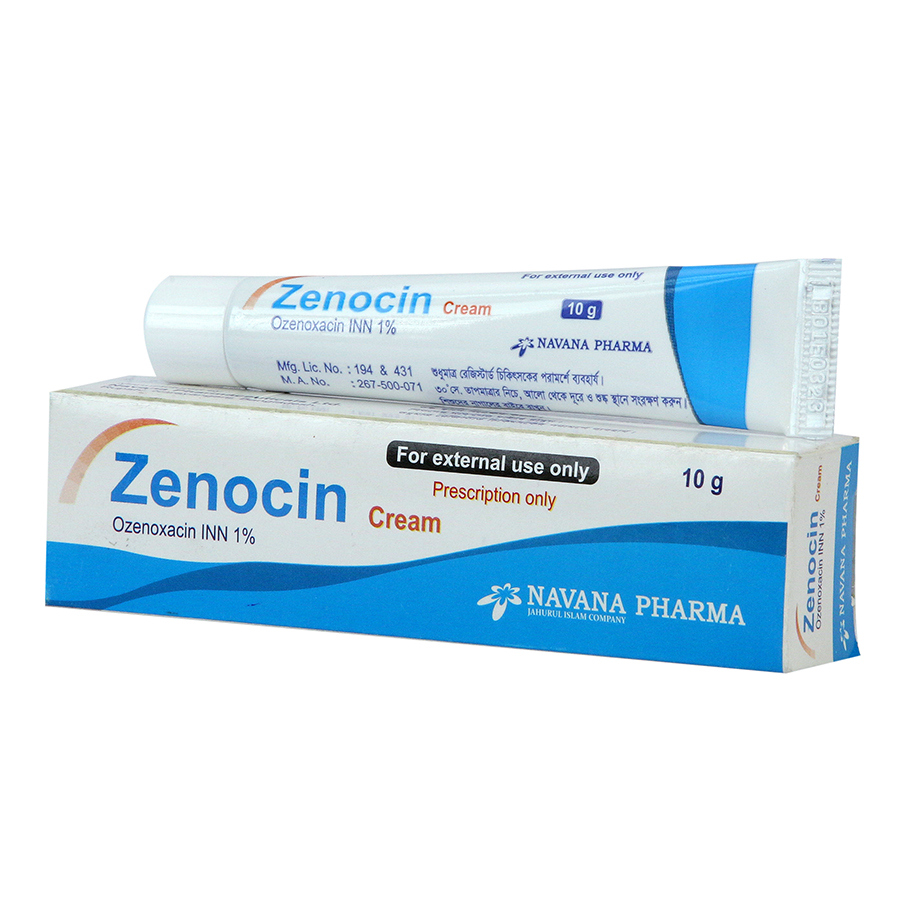
Zenocin Cream 1% w/w is a quinolone antibiotic used to treat impetigo caused by susceptible bacteria.
Zenocin Cream 1% w/w cream is indicated for the topical treatment of impetigo caused by Staphylococcus aureus or Streptococcus pyogenes in patients aged 2 months of age and older .
Associated Conditions
Pharmacodynamics
Although the exposure response relationship for ozenoxacin after it has been applied topically has not yet been studied, a formal relationship is unlikely because systemic exposure of ozenoxacin following its topical application has been measured to be negligible .
Mechanism of Action
Zenocin Cream 1% w/w is a quinolone antibiotic drug. And, like most quinolones, ozenoxacin predominately executes its mechanism of action by entering into bacterial cells and acting to inhibit the bacterial DNA replication enzymes DNA gyrase A and topoisomerase IV .
As DNA gyrase A and topoisomerase IV are essential to bacterial DNA replication activities including supercoiling, supercoil relaxation, chromosomal condensation, chromosomal decatenation and more, their inhibition is the principal action of ozenoxacin's mechanism and it has been demonstrated to be bactericidal against S. aureus and S. pyogenes organisms .
Absorption
Four studies were performed in which varying strengths of ozenoxacin cream, up to 2% (twice the concentration of the marketed formulation), were administered to 110 patients. Three of the studies examined systemic absorption in healthy subjects and in subjects having impetigo. The studies were performed with either single or repeated application of up to 1 g ozenoxacin cream to intact or abraded skin (up to 200 cm squared surface area). No systemic absorption was seen in 84 of 86 subjects, and negligible systemic absorption was seen at the level of detection (0.489 ng/mL) in 2 subjects .
Volume of Distribution
Zenocin Cream 1% w/w undergoes negligible systemic absorption after its topical administration . Subsequently, since negligible systemic absorption of ozenoxacin was observed in clinical studies, tissue distribution has not been investigated in humans either .
Protein Binding
The plasma protein binding of [14 C]-ozenoxacin is moderate at ~80-85% and does not appear to be dependent on concentration .
Route of Elimination
Studies regarding elimination and excretion have not yet been investigated in humans due to the negligible systemic absorption observed in clinical studies .
Clearance
Zenocin Cream 1% w/w undergoes negligible systemic absorption after its topical administration .
Toxicity
Zenocin Cream 1% w/w cream has the potential to cause rosacea and seborrheic dermatitis when administered topically on a patient. In clinical trials, only one adult patient treated with ozenoxacin cream reported such adverse reactions .
Much like other topical antibiotics, the prolonged use of ozenoxacin cream can result in the overgrowth of nonsusceptible bacteria and fungi. If such overgrowths develop into infections during therapy, discontinue use of the ozenoxacin cream and institue appropriate therapy for the infections .
Although clinical studies demonstrate negligible systemic absorption after topical administration of ozenoxacin, there are no formal available data on the use of ozenoxacin in pregnant women to inform any professional drug associated risk for use in pregnancy .
Although breastfeeding is not expected to result in exposure of the child to ozenoxacin owing to the negligible systemic absorption of ozenoxacin in humans following topical administration, no formal data are available regarding the presence of ozenoxacin in human milk and the effects of ozenoxacin on breasfed infants or on milk production .
Clinical experience with ozenoxacin cream has not identified differences in responses between elderly and younger patients .
The safety and effectiveness of ozenoxacin cream in pediatric patients 2 months and older is similar to that of adults, but the safety and effectiveness of ozenoxacin in pediatric patients younger than 2 months of age has not been formally establlished .
Long-term studies in animals to evaluate carcinogenic potential have not been conducted with ozenoxacin .
Zenocin Cream 1% w/w demonstrated no genotoxicity when evaluated in vitro for gene mutation and/or chromosomal effects in the Ames test, mouse lymphoma cell assay, or when evaluated in vivo in a rat micronucleus test with demonstrated systemic exposure .
Oral doses of ozenoxacin did not affect mating and fertility in male and female rats treated up to 500 mg/kg/day (about 8500 and 16,000 times respectively, the maximum human plasma concentration seen with dermal application of ozenoxacin 1% cream) .
Food Interactions
No interactions found.
Dosage
- Wash hands after applying Zenocin Cream 1% w/w cream.
- Zenocin Cream 1% w/w cream is for topical use only.
- Not for oral, ophthalmic, intranasal, or intravaginal use.
- The treated area may be covered with a sterile bandage or gauze dressing.