Introduction
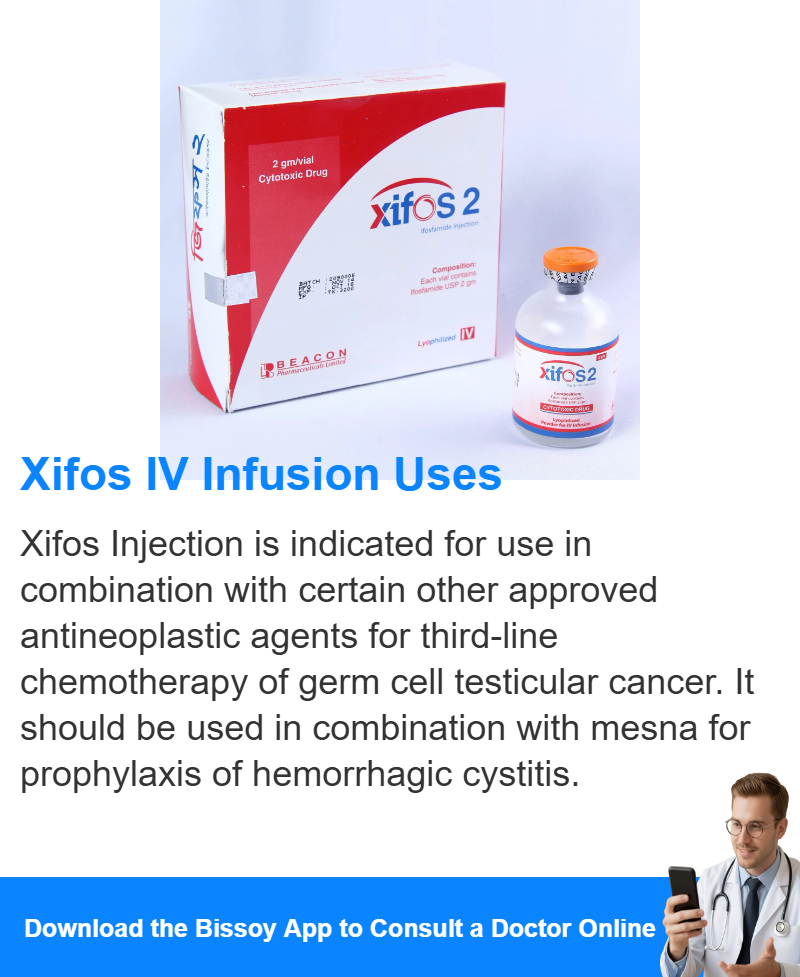
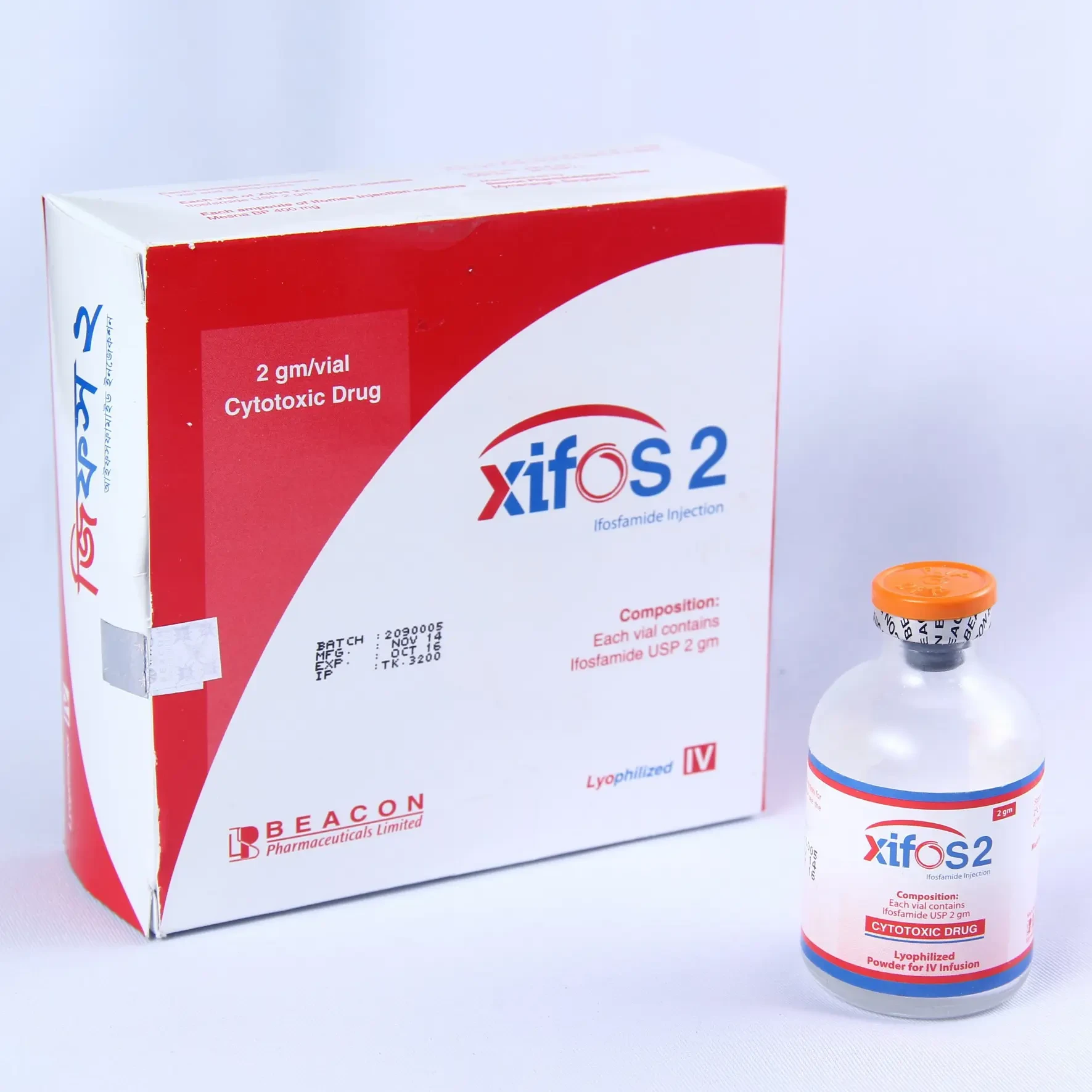
Xifos IV Infusion 2 gm/vial is a chemotherapeutic agent chemically related to the nitrogen mustards and a synthetic analog of cyclophosphamide. It is active as an alkylating agent and an immunosuppressive agent.
Uses
Xifos IV Infusion 2 gm/vial is an alkylating and immunosuppressive agent used in chemotherapy for the treatment of cancers, including testicular cancer, ovarian cancer, cervical cancer, osteocarcinoma, bladder cancer, small cell lung cancer, and non-Hodgkin's lymphoma.
Used as a component of various chemotherapeutic regimens as third-line therapy for recurrent or refractory germ cell testicular cancer. Also used as a component of various chemotherapeutic regimens for the treatment of cervical cancer, as well as in conjunction with surgery and/or radiation therapy in the treatment of various soft tissue sarcomas. Other indications include treatment of osteosarcoma, bladder cancer, ovarian cancer. small cell lung cancer, and non-Hodgkin's lymphoma.
Associated Conditions
Pharmacodynamics
Xifos IV Infusion 2 gm/vial requires activation by microsomal liver enzymes to active metabolites in order to exert its cytotoxic effects. Activation occurs by hydroxylation at the ring carbon atom 4 to form the unstable intermediate 4-hydroxyifosfamide. This metabolite than rapidly degrades to the stable urinary metabolite 4-ketoifosfamide. The stable urinary metabolite, 4-carboxyifosfamide, is formed upon opening of the ring. These urinary metabolites have not been found to be cytotoxic. N, N-bis (2-chloroethyl)-phosphoric acid diamide (ifosphoramide) and acrolein are also found. The major urinary metabolites, dechloroethyl ifosfamide and dechloroethyl cyclophosphamide, are formed upon enzymatic oxidation of the chloroethyl side chains and subsequent dealkylation. It is the alkylated metabolites of ifosfamide that have been shown to interact with DNA. Xifos IV Infusion 2 gm/vial is cycle-phase nonspecific.
Mechanism of Action
The exact mechanism of ifosfamide has not been determined, but appears to be similar to other alkylating agents. Xifos IV Infusion 2 gm/vial requires biotransformation in the liver by mixed-function oxidases (cytochrome P450 system) before it becomes active. After metabolic activation, active metabolites of ifosfamide alkylate or bind with many intracellular molecular structures, including nucleic acids. The cytotoxic action is primarily through the alkylation of DNA, done by attaching the N-7 position of guanine to its reactive electrophilic groups. The formation of inter and intra strand cross-links in the DNA results in cell death.
Volume of Distribution
Xifos IV Infusion 2 gm/vial volume of distribution (Vd) approximates the total body water volume, suggesting that distribution takes place with minimal tissue binding. Following intravenous administration of 1.5 g/m2 over 0.5 hour once daily for 5 days to 15 patients with neoplastic disease, the median Vd of ifosfamide was 0.64 L/kg on Day 1 and 0.72 L/kg on Day 5. When given to pediatric patients, the volume of distribution was 21±1.6 L/m^2.
Protein Binding
Xifos IV Infusion 2 gm/vial shows little plasma protein binding.
Route of Elimination
Xifos IV Infusion 2 gm/vial is extensively metabolized in humans and the metabolic pathways appear to be saturated at high doses. After administration of doses of 5 g/m2 of 14C-labeled ifosfamide, from 70% to 86% of the dosed radioactivity was recovered in the urine, with about 61% of the dose excreted as parent compound. At doses of 1.6–2.4 g/m2 only 12% to 18% of the dose was excreted in the urine as unchanged drug within 72 hours.
Half Life
7-15 hours. The elimination half-life increase appeared to be related to the increase in ifosfamide volume of distribution with age.
Clearance
- 2.4±0.33 L/h/m^2 [pediatric patients]
Toxicity
LD50 (mouse) = 390-1005 mg/kg, LD50 (rat) = 150-190 mg/kg. Side effects include nausea, vomiting and myelosuppression. Toxic effects include central nervous system toxicity (confusion, hallucinations) and urotoxic effects (cystitis, blood in urine).
Food Interactions
- Avoid alcohol. Ingesting alcohol may worsen nausea and vomiting caused by ifosfamide.
- Exercise caution with grapefruit products. Grapefruit inhibits the CYP3A4 metabolism of ifosfamide to its active metabolite, therefore reducing its efficacy.
- Exercise caution with St. John's Wort. Close monitoring is warranted as this herb induces the CYP3A4 metabolism of ifosfamide to its alkylating active metabolites, including, chloroacetaldehyde, a nephrotoxic and neurotoxic metabolite.