Introduction
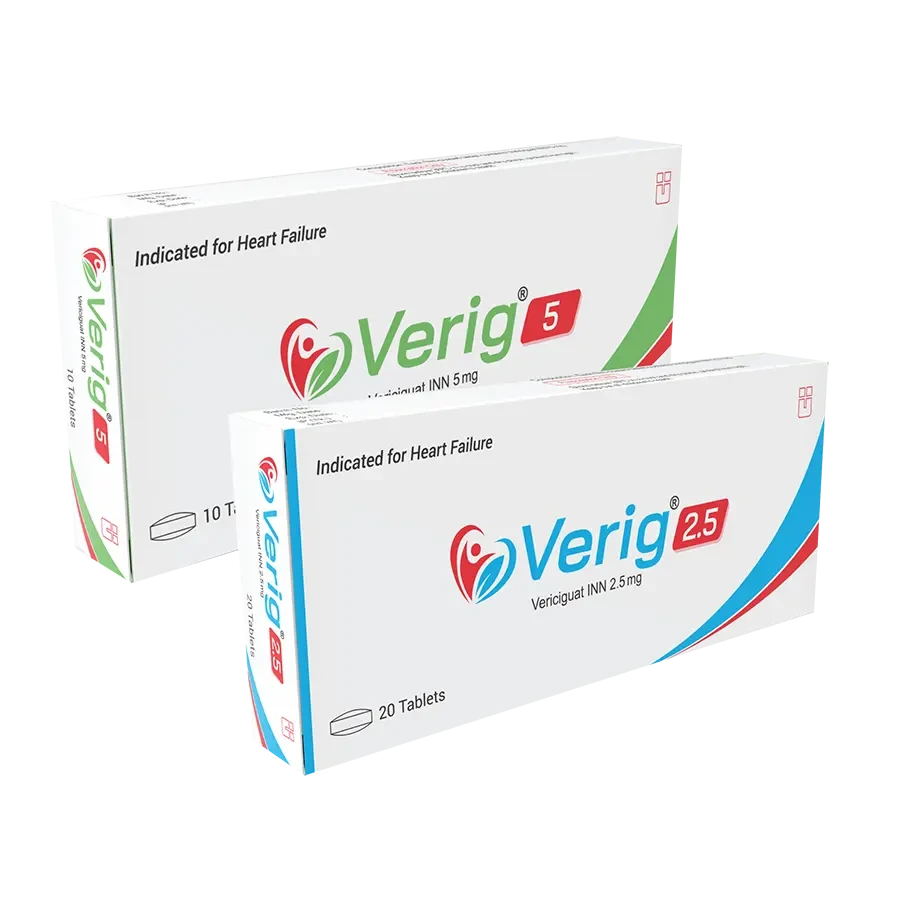
Verig Tablet 5 mg is an oral soluble guanylate cyclase (sGC) stimulator used to reduce the risk of cardiovascular death and hospitalization in adults with symptomatic chronic heart failure following a recent worsening event. It enhances the nitric oxide (NO)-sGC-cGMP signaling pathway by directly stimulating sGC, increasing cyclic guanosine monophosphate (cGMP) production, and improving myocardial and vascular function.
By restoring impaired cGMP signaling, vericiguat helps improve cardiac performance and reduce disease progression in patients with heart failure. Its long half-life supports convenient once-daily dosing.
Uses
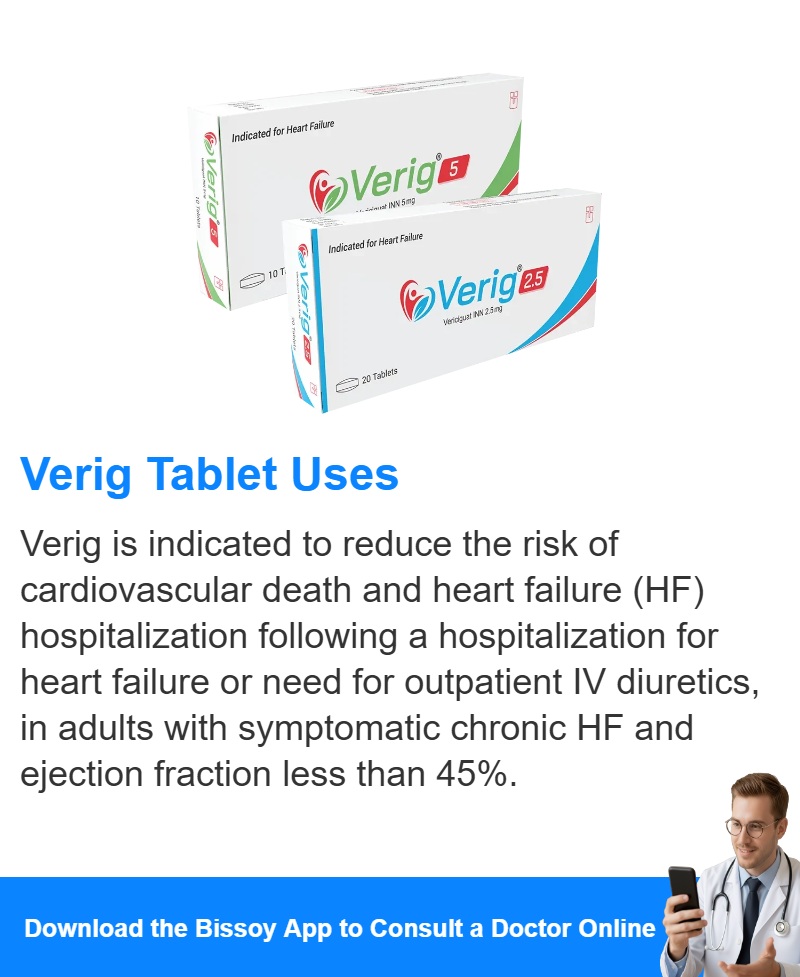
Verig Tablet 5 mg is a soluble guanylate cyclase stimulator used to reduce heart failure-related hospitalization and cardiovascular death in patients with chronic systolic heart failure.
Verig Tablet 5 mg is indicated in adults with symptomatic, chronic heart failure and an ejection fraction of 5
Associated Conditions
Pharmacodynamics
By directly stimulating the increased production of intracellular cyclic guanosine monophosphate (cGMP), vericiguat causes the relaxation of vascular smooth muscle and vasodilation. Verig Tablet 5 mg has a relatively long half-life (~30h) that allows for once-daily dosing.
Animal reproduction studies have demonstrated the potential for embryo-fetal toxicity when vericiguat is administered to pregnant females - defects in major vessel and heart formation, as well as spontaneous abortions/resorptions, were observed when vericiguat was administered to pregnant rabbits during organogenesis. The possibility of pregnancy should be excluded prior to beginning therapy with vericiguat, and adequate contraception should be used throughout therapy and for one month following cessation of treatment.
Mechanism of Action
Heart failure (HF) involves, amongst other morphologic and physiologic changes, the impaired synthesis of nitric oxide (NO) and decreased activity of soluble guanylate cyclase (sGC). Functioning normally, NO binds to sGC and stimulates the synthesis of intracellular cyclic guanosine monophosphate (cGMP), a second messenger involved in the maintenance of vascular tone, as well as cardiac contractility and remodeling. Defects in this pathway are thought to contribute to the myocardial and vascular dysfunction associated with heart failure and are therefore a desirable target in its treatment.
Verig Tablet 5 mg directly stimulates sGC by binding to a target site on its beta-subunit, bypassing the need for NO-mediated activation, and in doing so causes an increase in the production of intracellular cGMP that results in vascular smooth muscle relaxation and vasodilation.
Absorption
Following the administration of 10mg of vericiguat by mouth once daily, the average steady-state Cmax and AUC in patients with heart failure is 350 mcg/L and 6,680 mcg•h/L, respectively, with a Tmax of 1 hour. The absolute bioavailability of orally-administered vericiguat is approximately 93% when taken with food - co-administration with meals has been shown to reduce pharmacokinetic variability, increase Tmax to roughly 4 hours, and increase Cmax and AUC by 41% and 44%, respectively.
Volume of Distribution
In healthy subjects the steady-state volume of distribution of vericiguat is approximately 44 liters.
Protein Binding
Verig Tablet 5 mg is extensively (~98%) protein-bound in plasma, primarily to serum albumin.
Route of Elimination
Following the oral administration of radiolabeled vericiguat, approximately 53% of the administered radioactivity was recovered in the urine and 45% in the feces. A human mass balance study found that the portion recovered in the urine comprised approximately 40.8% N-glucuronide metabolite, 7.7% other metabolites, and 9% unchanged parent drug, while virtually the entire portion recovered in the feces comprised unchanged vericiguat.
Half Life
In patients with heart failure, the half-life of vericiguat is 30 hours.
Clearance
Verig Tablet 5 mg is a low-clearance drug, with an observed plasma clearance of 1.6 L/h in healthy volunteers and 1.3 L/h in patients with systolic heart failure.
Toxicity
Data regarding overdosage with vericiguat are unavailable. Doses of up to 15mg once daily (50% greater than the recommended maintenance dose) have been studied and found to be well-tolerated. Symptoms of overdose are likely to be consistent with the adverse effect profile of vericiguat and may therefore involve significant hypotension for which symptomatic and supportive measures should be provided. Dialysis is unlikely to be of benefit in vericiguat overdose given its high degree of protein binding.
Food Interactions
- Take with food. Administration with food has been shown to reduce pharmacokinetic variability and significantly improve absorption.
Dosage
Geriatric Patients: No dosage adjustment of Verig Tablet 5 mg is required in geriatric patients. No overall differences in safety or efficacy of Verig Tablet 5 mg were observed between patients aged 65 years and older compared to younger patients, but greater sensitivity of some older individuals cannot be ruled out.
Hepatic Impairment: No dosage adjustment of Verig Tablet 5 mg is recommended in patients with mild or moderate hepatic impairment.
Renal Impairment: No dosage adjustment of Verig Tablet 5 mg is recommended in patients with estimated glomerular filtration rate (eGFR) ≥15 mL/min/1.73m2 who are not on dialysis. Verig Tablet 5 mg has not been studied in patients with eGFR <15 mL/min/1.73m2 at treatment initiation or on dialysis.
Use in Children & Adolescents: Safety and effectiveness of Verig Tablet 5 mg have not been established in pediatric patients.