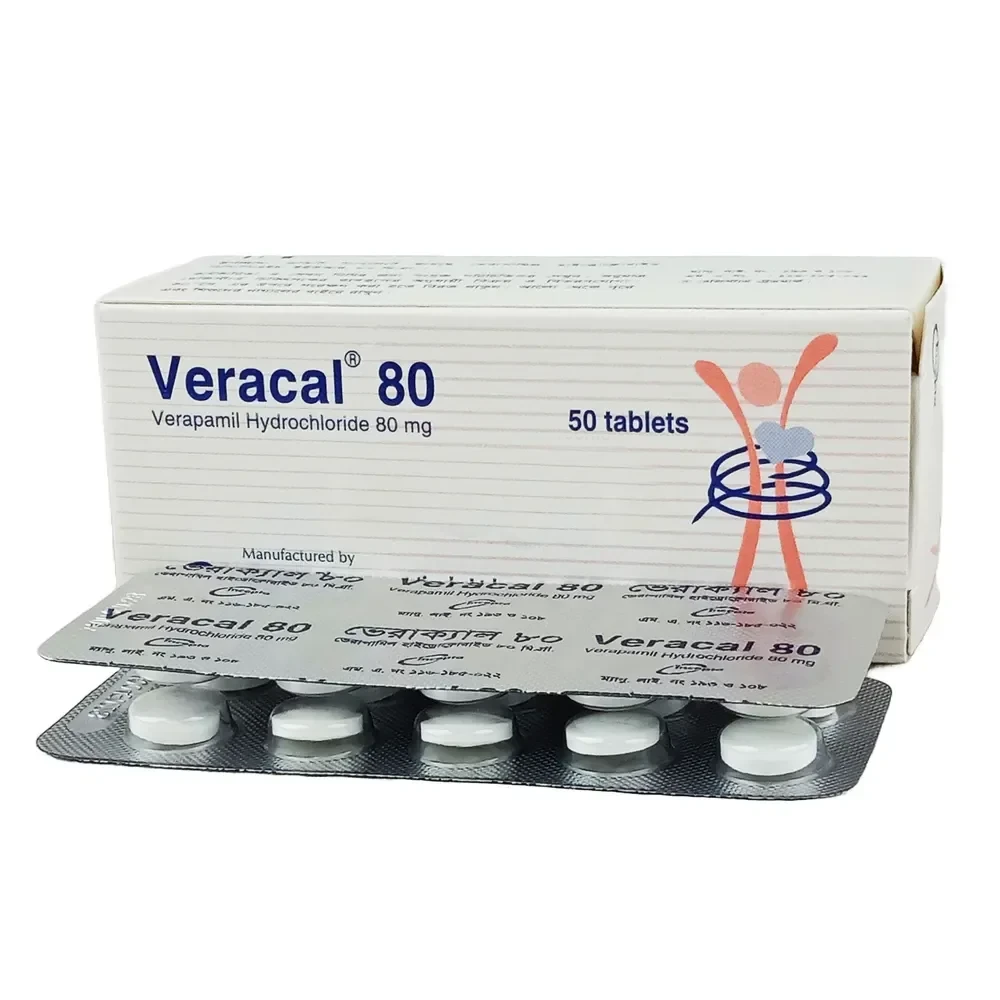
Introduction
Verapamil is a phenylalkylamine calcium channel blocker used in the treatment of high blood pressure, heart arrhythmias, and angina, and was the first calcium channel antagonist to be introduced into therapy in the early 1960s. It is a member of the non-dihydropyridine class of calcium channel blockers, which includes drugs like diltiazem and flunarizine, but is chemically unrelated to other cardioactive medications. Verapamil is administered as a racemic mixture containing equal amounts of the S- and R-enantiomer, each of which is pharmacologically distinct - the S-enantiomer carries approximately 20-fold greater potency than the R-enantiomer, but is metabolized at a higher rate.
Uses
Verapamil is a non-dihydropyridine calcium channel blocker used in the treatment of angina, arrhythmia, and hypertension.
Verapamil is indicated in the treatment of vasopastic (i.e. Prinzmetal's) angina, unstable angina, and chronic stable angina. It is also indicated to treat hypertension, for the prophylaxis of repetitive paroxysmal supraventricular tachycardia, and in combination with digoxin to control ventricular rate in patients with atrial fibrillation or atrial flutter. Given intravenously, it is indicated for the treatment of various supraventricular tachyarrhythmias, including rapid conversion to sinus rhythm in patients with supraventricular tachycardia and for temporary control of ventricular rate in patients with atrial fibrillation or atrial flutter.
Verapamil is commonly used off-label for prophylaxis of cluster headaches.
Associated Conditions
Pharmacodynamics
Verapamil is an L-type calcium channel blocker with antiarrhythmic, antianginal, and antihypertensive activity. Immediate-release verapamil has a relatively short duration of action, requiring dosing 3 to 4 times daily, but extended-release formulations are available that allow for once-daily dosing. As verapamil is a negative inotropic medication (i.e. it decreases the strength of myocardial contraction), it should not be used in patients with severe left ventricular dysfunction or hypertrophic cardiomyopathy as the decrease in contractility caused by verapamil may increase the risk of exacerbating these pre-existing conditions.
Mechanism of Action
Verapamil inhibits L-type calcium channels by binding to a specific area of their alpha-1 subunit,Cav1.2, which is highly expressed on L-type calcium channels in vascular smooth muscle and myocardial tissue where these channels are responsible for the control of peripheral vascular resistance and heart contractility. Calcium influx through these channels allows for the propagation of action potentials necessary for the contraction of muscle tissue and the heart's electrical pacemaker activity. Verapamil binds to these channels in a voltage- and frequency-dependent manner, meaning affinity is increased 1) as vascular smooth muscle membrane potential is reduced, and 2) with excessive depolarizing stimulus.
Verapamil's mechanism of action in the treatment of angina and hypertension is likely due to the mechanism described above. Inhibition of calcium influx prevents the contraction of vascular smooth muscle, causing relaxation/dilation of blood vessels throughout the peripheral circulation - this lowers systemic vascular resistance (i.e. afterload) and thus blood pressure. This reduction in vascular resistance also reduces the force against which the heart must push, decreasing myocardial energy consumption and oxygen requirements and thus alleviating angina.
Electrical activity through the AV node is responsible for determining heart rate, and this activity is dependent upon calcium influx through L-type calcium channels. By inhibiting these channels and decreasing the influx of calcium, verapamil prolongs the refractory period of the AV node and slows conduction, thereby slowing and controlling the heart rate in patients with arrhythmia.
Verapamil's mechanism of action in the treatment of cluster headaches is unclear, but is thought to result from an effect on other calcium channels (e.g. N-, P-, Q-, or T-type).
Verapamil is known to interact with other targets, including other calcium channels, potassium channels, and adrenergic receptors.
Absorption
More than 90% of orally administered verapamil is absorbed - despite this, bioavailability ranges only from 20% to 30% due to rapid biotransformation following first-pass metabolism in the portal circulation. Absorption kinetic parameters are largely dependent on the specific formulation of verapamil involved. Immediate-release verapamil reaches peak plasma concentrations (i.e. Tmax) between 1-2 hours following administration, whereas sustained-release formulations tend to have a Tmax between 6 - 11 hours.
AUC and Cmax values are similarly dependent upon formulation. Chronic administration of immediate-release verapamil every 6 hours resulted in plasma concentrations between 125 and 400 ng/mL. Steady-state AUC0-24h and Cmax values for a sustained-release formulation were 1037 ng∙h/ml and 77.8 ng/mL for the R-isomer and 195 ng∙h/ml and 16.8 ng/mL for the S-isomer, respectively.
Interestingly, the absorption kinetics of verapamil are highly stereospecific - following oral administration of immediate-release verapamil every 8 hours, the relative systemic availability of the S-enantiomer compared to the R-enantiomer was 13% after a single dose and 18% at steady-state.
Volume of Distribution
Verapamil has a steady-state volume of distribution of approximately 300L for its R-enantiomer and 500L for its S-enantiomer.
Protein Binding
Verapamil is extensively protein-bound in plasma. R-verapamil is 94% bound to serum albumin while S-verapamil is 88% bound. Additionally, R-verapamil is 92% bound to alpha-1 acid glycoprotein and S-verapamil is 86% bound.
Route of Elimination
Approximately 70% of an administered dose is excreted as metabolites in the urine and ≥16% in the feces within 5 days. Approximately 3% - 4% is excreted in the urine as unchanged drug.
Half Life
Single-dose studies of immediate-release verapamil have demonstrated an elimination half-life of 2.8 to 7.4 hours, which increases to 4.5 to 12.0 hours following repetitive dosing. The elimination half-life is also prolonged in patients with hepatic insufficiency (14 to 16 hours) and in the elderly (approximately 20 hours). Intravenously administered verapamil has rapid distribution phase half-life of approximately 4 minutes, followed by a terminal elimination phase half-life of 2 to 5 hours.
Clearance
Systemic clearance following 3 weeks of continuous treatment was approximately 340 mL/min for R-verapamil and 664 mL/min for S-verapamil. Of note, apparent oral clearance appears to vary significantly between single dose and multiple-dose conditions. The apparent oral clearance following single doses of verapamil was approximately 1007 mL/min for R-verapamil and 5481 mL/min for S-verapamil, whereas 3 weeks of continuous treatment resulted in apparent oral clearance values of approximately 651 mL/min for R-verapamil and 2855 mL/min for S-verapamil.
Toxicity
Verapamil's reported oral TDLo is 14.4 mg/kg in women and 3.429 mg/kg in men. The oral LD50 is 150 mg/kg in rats and 163 mg/kg in mice.
As there is no antidote for verapamil overdosage, treatment is largely supportive. Symptoms of overdose are generally consistent with verapamil's adverse effect profile (i.e. hypotension, bradycardia, arrhythmia) but instances of non-cardiogenic pulmonary edema have been observed following ingestion of large overdoses (up to 9 grams). In acute overdosage, consider the use of gastrointestinal decontamination with cathartics and/or bowel irrigation. Patients presenting with significant myocardial depression may require intravenous calcium, atropine, vasopressors, or other inotropes. Consider the formulation responsible for the overdose prior to treatment - sustained-release formulations may result in delayed pharmacodynamic effects, and these patients should be monitored closely for at least 48 hours following ingestion.
Food Interactions
- Avoid alcohol. Verapamil significantly inhibits the elimination of alcohol, leading to elevated blood alcohol levels.
- Avoid grapefruit products. Co-administration with grapefruit may significantly increase serum concentrations.
- Take with or without food. Recommendations vary from product to product - consult individual product monographs for additional information.
Dosage
Verapamil Tablet:
- The dose of Verapamil should be individualized by titration and the drug should be administered with food.
- For essential hypertension the initial dose should be given 180 mg in the morning. If adequate response is not obtained with 180 mg of Verapamil then the dose may be titrated by following manner: 240 mg each morning. 180 mg each morning plus 180 mg each evening. 240 mg every 12 hourly.
- For angina the usual dose is 80 mg to 120 mg three times a day.
- For arrythmias in digitalized patients, Verapamil should be given 240 mg to 360 mg in divided doses, depending on the severity of the condition. Divided doses up to 180 mg/day may occasionally be needed.
Verapamil Injection:
Adults: 5 mg slowly intravenously, in tachycardias and hypertensive crises, if necessary repeat after 5 to 10 minutes. Drip infusion to maintain the therapeutic effect: 5-10 mg/hour in physiological saline, glucose, laevulose or similar solutions, on average up to a total dose of 100 mg/day.Children:
- Newborn: 0.75-1 mg (0.3-0.4 ml)
- Infants: 0.75-2 mg (0.3-0.8 ml)
- Children age 1-5 years: 2-3 mg (0.8-1.2 ml)
- Age 6-14 years: 2.5-5 mg (1-2 ml)