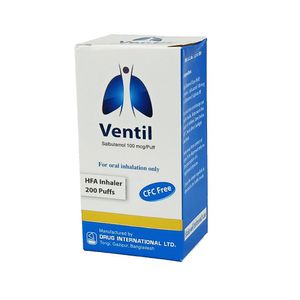
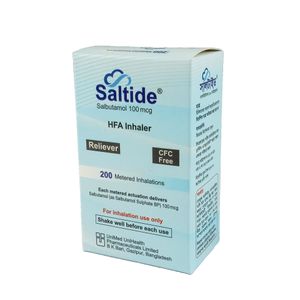
Introduction
Ventil Inhaler 100 mcg/puff is a short-acting, selective beta2-adrenergic receptor agonist used in the treatment of asthma and COPD. It is 29 times more selective for beta2 receptors than beta1 receptors giving it higher specificity for pulmonary beta receptors versus beta1-adrenergic receptors located in the heart. Ventil Inhaler 100 mcg/puff is formulated as a racemic mixture of the R- and S-isomers. The R-isomer has 150 times greater affinity for the beta2-receptor than the S-isomer and the S-isomer has been associated with toxicity. This lead to the development of levalbuterol, the single R-isomer of salbutamol. However, the high cost of levalbuterol compared to salbutamol has deterred wide-spread use of this enantiomerically pure version of the drug. Ventil Inhaler 100 mcg/puff is generally used for acute episodes of bronchospasm caused by bronchial asthma, chronic bronchitis and other chronic bronchopulmonary disorders such as chronic obstructive pulmonary disorder (COPD). It is also used prophylactically for exercise-induced asthma.
Uses
Ventil Inhaler 100 mcg/puff is a beta-2 adrenergic receptor agonist used to treat asthma, bronchitis, COPD, as well as prevent exercise induced bronchospasms.
Ventil Inhaler 100 mcg/puff is indicated for (i) the symptomatic relief and prevention of bronchospasm due to bronchial asthma, chronic bronchitis, reversible obstructive airway disease, and other chronic bronchopulmonary disorders in which bronchospasm is a complicating factor, and/or (ii) the acute prophylaxis against exercise-induced bronchospasm and other stimuli known to induce bronchospasm.
Associated Conditions
Pharmacodynamics
Ventil Inhaler 100 mcg/puff (INN) or albuterol (USAN), a moderately selective beta(2)-receptor agonist similar in structure to terbutaline, is widely used as a bronchodilator to manage asthma and other chronic obstructive airway diseases. The R-isomer, levalbuterol, is responsible for bronchodilation while the S-isomer increases bronchial reactivity. The R-enantiomer is available and sold in its pure form as levalbuterol and subsequently may produce fewer side-effects with only the R-enantiomer present - although this has not been formally demonstrated.
After oral and parenteral administration, stimulation of the beta receptors in the body, both beta-1 and beta-2, occurs because (a) beta-2 selectivity is not absolute, and (b) higher concentrations of salbutamol occur in the regions of these receptors with these modes of administration. This results in the beta-1 effect of cardiac stimulation, though not so much as with isoprenaline, and beta-2 effects of peripheral vasodilatation and hypotension, skeletal muscle tremor, and uterine muscle relaxation.
Metabolic effects such as hyperinsulinemia and hyperglycemia also may occur, although it is not known whether these effects are mediated by beta-1 or beta-2 receptors. The serum potassium levels have a tendency to fall.
Mechanism of Action
In vitro studies and in vivo pharmacologic studies have shown that salbutamol has a preferential effect on beta2-adrenergic receptors compared with isoproterenol. Although beta2 adrenoceptors are the predominant adrenergic receptors in bronchial smooth muscle and beta1 adrenoceptors are the predominant receptors in the heart, there are also beta2-adrenoceptors in the human heart comprising 10% to 50% of the total beta-adrenoceptors. The precise function of these receptors has not been established, but their presence raises the possibility that even selective beta2-agonists may have cardiac effects.
Activation of beta2-adrenergic receptors on airway smooth muscle leads to the activation of adenyl cyclase and to an increase in the intracellular concentration of cyclic-3′,5′-adenosine monophosphate (cyclic AMP). This increase of cyclic AMP leads to the activation of protein kinase A, which inhibits the phosphorylation of myosin and lowers intracellular ionic calcium concentrations, resulting in relaxation. Ventil Inhaler 100 mcg/puff relaxes the smooth muscles of all airways, from the trachea to the terminal bronchioles. Ventil Inhaler 100 mcg/puff acts as a functional antagonist to relax the airway irrespective of the spasmogen involved, thus protecting against all bronchoconstrictor challenges. Increased cyclic AMP concentrations are also associated with the inhibition of release of mediators from mast cells in the airway.
Ventil Inhaler 100 mcg/puff has been shown in most controlled clinical trials to have more effect on the respiratory tract, in the form of bronchial smooth muscle relaxation, than isoproterenol at comparable doses while producing fewer cardiovascular effects. Controlled clinical studies and other clinical experience have shown that inhaled albuterol, like other beta-adrenergic agonist drugs, can produce a significant cardiovascular effect in some patients, as measured by pulse rate, blood pressure, symptoms, and/or electrocardiographic changes.
A measurable decrease in airway resistance is typically observed within 5 to 15 minutes after inhalation of salbutamol. The maximum improvement in pulmonary function usually occurs 60 to 90 minutes after salbutamol treatment, and significant bronchodilator activity has been observed to persist for 3 to 6 hours.
Absorption
Following inhalation, salbutamol acts topically on bronchial smooth muscle and the drug is initially undetectable in the blood. After 2 to 3 hours low concentrations are seen, due presumably to the portion of the dose which is swallowed and absorbed in the gut.
In particular, the systemic levels of salbutamol are low after inhalation of recommended doses. A trial conducted in 12 healthy male and female subjects using a higher dose (1,080 mcg of albuterol base) showed that mean peak plasma concentrations of approximately 3 ng/mL occurred after dosing when salbutamol was delivered using propellant HFA-134a. The mean time to peak concentrations (Tmax) was delayed after administration of VENTOLIN (salbutamol) HFA (Tmax = 0.42 hours) as compared with CFC-propelled salbutamol inhaler (Tmax = 0.17 hours).
Volume of Distribution
The volume of distribution recorded for intravenously administered salbutamol has been recorded as 156 +/- 38 L.
Protein Binding
Ventil Inhaler 100 mcg/puff is only weakly bound to plasma proteins.
Route of Elimination
After oral administration, 58-78% of the dose is excreted in the urine in 24 hours, approximately 60% as metabolites. A small fraction is excreted in the feces.
Half Life
The elimination half-life of inhaled or oral salbutamol has been recorded as being between 2.7 and 5 hours while the apparent terminal plasma half-life of albuterol has been documented as being approximately 4.6 hours.
Clearance
The renal clearance of salbutamol has been documented as 272 +/- 38 ml/min after oral administration and 291 +/- 70 ml/min after intravenous administration. Furthermore, the renal clearance of the predominant sulfate conjugate metabolite was recorded as 98.5 +/- 23.5 ml/min following oral administration.
Toxicity
The expected signs and symptoms with overdosage of albuterol are those of excessive beta-adrenergic stimulation and/or occurrence or exaggeration of any of the signs and symptoms of beta-adrenergic stimulation (e.g., seizures, angina, hypertension or hypotension, tachycardia with rates up to 200 beats/min, arrhythmias, nervousness, headache, tremor, muscle cramps, dry mouth, palpitation, nausea, dizziness, fatigue, malaise, insomnia, hyperglycemia, hypokalemia, metabolic acidosis). In particular, the signs of salbutamol overdosage are significant tachycardia and/or significant muscle tremor.
Hypokalaemia may occur following overdosage with salbutamol. Serum potassium levels should be monitored.
Lactic acidosis has been reported in association with high therapeutic doses as well as overdoses of short-acting beta-agonist therapy, therefore monitoring for elevated serum lactate and consequent metabolic acidosis (particularly if there is persistence or worsening of tachypnea despite resolution of other signs of bronchospasm such as wheezing) may be indicated in the setting of overdose.
Ventil Inhaler 100 mcg/puff is categorized as Pregnancy Category C. There are no adequate and well-controlled trials with salbutamolc or albuterol sulfate in pregnant women. During worldwide marketing experience, various congenital anomalies, including cleft palate and limb defects, have been reported in the offspring of patients being treated with salbutamol. Some of the mothers were taking multiple medications during their pregnancies. No consistent pattern of defects can be discerned, and a relationship between salbutamol use and congenital anomalies has not been established. Animal reproduction studies in mice and rabbits revealed evidence of teratogenicity. Ventil Inhaler 100 mcg/puff should be used during pregnancy only if the potential benefit justifies the potential risk to the fetusLabel]. Women should be advised to contact their physicians if they become pregnant while taking salbutamol.
Since there exists a potential for beta-agonist interference with uterine contractility, the use of salbutamol during labour should be restricted to those patients in whom the benefits clearly outweigh the risk.
Plasma levels of albuterol sulfate and HFA-134a after inhaled therapeutic doses are very low in humans, but it is not known whether the components of salbutamol are excreted in human milk. Because of the potential for tumorigenicity shown for albuterol in animal studies and lack of experience with the use of salbutamol by nursing mothers, a decision should be made whether to discontinue nursing or to discontinue the drug, taking into account the importance of the drug to the mother. Caution should be exercised when salbutamol is administered to a nursing woman.
The safety and effectiveness of salbutamol in children younger than 4 years of age has not yet been established.
Clinical trials of VENTOLIN HFA did not include sufficient numbers of subjects aged 65 years and older to determine whether older subjects respond differently than younger subjects. Other reported clinical experience has not identified differences in responses between the elderly and younger patients. In general, dose selection for an elderly patient should be cautious, usually starting at the low end of the dosing range, reflecting the greater frequency of decreased hepatic, renal, or cardiac function, and of concomitant disease or other drug therapy.
The LD50 value was determined to be 1100 mg/kg (orally in mice).
Food Interactions
No interactions found.
Dosage
Children:
- 2-6 years: 2.5 ml syrup, 3-4 times daily
- 6-12 years: 5 ml syrup, 3-4 times daily
- Over 12 years: 5-10 ml syrup, 3-4 times daily (2-4 mg tablet, 3-4 times daily)
Ventil Inhaler 100 mcg/puff Respirator Solution: To be used with a suitable nebulizer device under the direction of a physician. The solution must not be injected or ingested.
Method-1 (Intermittent Administration):
- Adults (and the elderly): 0.5 ml-1.0 ml salbutamol up to four times a day. Up to 40mg per day can be given under strict medical direction in the hospital. 0.5-1 ml solution should be diluted to final volume of 2-4 ml with sterile normal saline solution. It will take time about 10 minutes.
- Ventil Inhaler 100 mcg/puff respiratory solution may be used undiluted for intermittent administration. For this 2.0 ml of the solution is placed in the nebulizer and the patient allowed to inhale until bronchodilation is achieved. This usually takes 3-5 minutes.
- Children under 12 years of age: 0.5 ml of the solution diluted to 2.0-4.0 ml with normal saline. Some children may however require higher doses of up to 1.0 ml of the solution. Intermittent treatment may be repeated four times a day.
Ventil Inhaler 100 mcg/puff nebulizer solution: To be used with a suitable nebulizer device under the direction of a physician. The solution must not be injected or ingested.
- Adults & Elderly: 2.5 mg to 5 mg Ventil Inhaler 100 mcg/puff up to 4 times a day. Up to 40 mg/day may be given under strict medical direction in the hospital.
- Children under 12 years: 2.5 mg up to 4 times a day. A higher dose up to 5 mg four times a day may be used if required.
Adults:
- Ventil Inhaler 100 mcg/puff I.V. infusion solution is used to prepare a solution for continuous intravenous infusion. It should not be injected undiluted. A suitable solution for infusion may be prepared by diluting 5 mL of Ventil Inhaler 100 mcg/puff I.V. infusion solution (1000 mcg/mL) in 500 mL of a chosen i.v. solution to provide a salbutamol concentration of 10 mcg/mL.
- The only recommended diluents are Sodium Chloride Injection, or Sodium Chloride and Dextrose Injection.
- Infusion rates providing 3 to 20 micrograms salbutamol/minute (0.3 to 2ml/minute of the above infusion solution) are usually adequate. Infusion rates can be started at 5 mcg of salbutamol/min., and can be increased to 10 mcg/min., and 20 mcg/min. at 15 - 30 minute intervals, if necessary.
- As with all parenteral drug products, intravenous admixtures should be inspected visually for clarity, particulate matter, precipitate, discoloration and leakage prior to administration.
- All unused admixtures of Ventil Inhaler 100 mcg/puff infusion solution with infusion fluids should be discarded 24 hours after preparation.
Ventil Inhaler 100 mcg/puff Inhalation Capsule:
- Adults: For the relief of bronchospasm and for managing intermittent episodes of asthma, one or two inhalation capsule may be administered as a single dose. The usual recommended dosage of Ventil Inhaler 100 mcg/puff inhalation capsule for inhalation for adults for maintenance or prophylactic therapy is the contents of one 200 microgram capsule every 4 to 6 hours using a device. In some patients, the contents of two 200 microgram capsules inhaled every 4 to 6 hours may be required. Large doses or more frequent administration is not recommended. The use of salbutamol powder for inhalation can be continued as medically indicated to control recurring/intermittent episodes of bronchospasm.
- Children: One Ventil Inhaler 100 mcg/puff inhalation capsule is the recommended dose for relief of acute bronchospasm in the maintenance of episodic asthma or before exercise of children 4 years of age and older. One inhalation should be administered for three or four times a day for routine maintenance or prophylactic therapy. This dosage may be increased to inhalation of two inhalation capsule, if necessary. The bronchodilator effect of each administration of inhaled Ventil Inhaler 100 mcg/puff inhalation capsule lasts for at least four hours. Such patients should be warned not to increase the dose of inhaler, but should seek medical advice immediately.
- Adults: 400 microgram
- Child: 200 microgram, 15-30 minutes prior to any physical exertion.