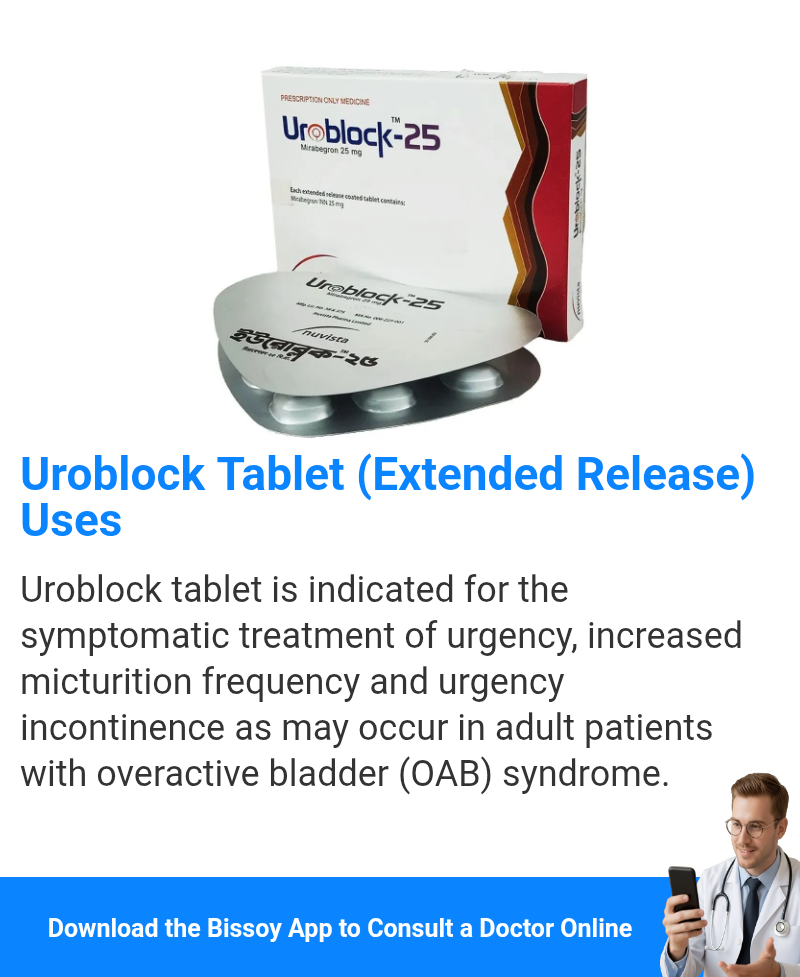
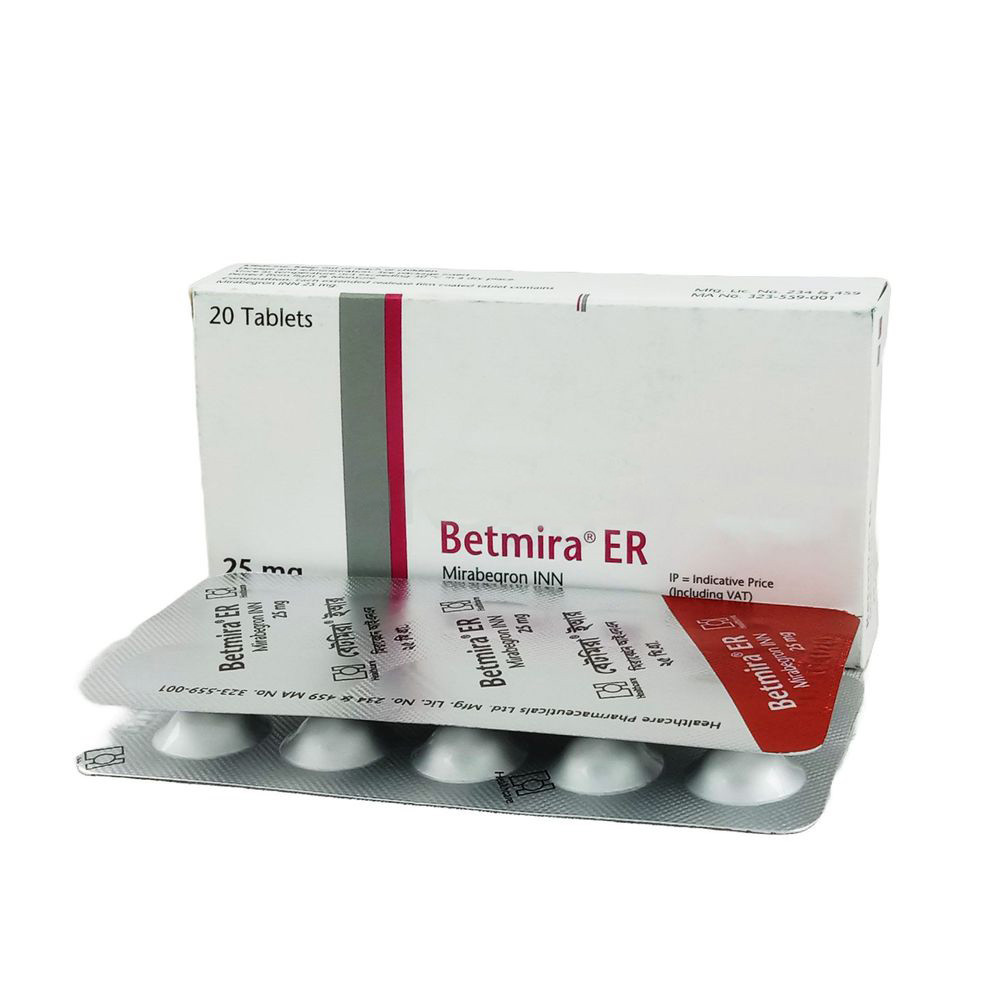
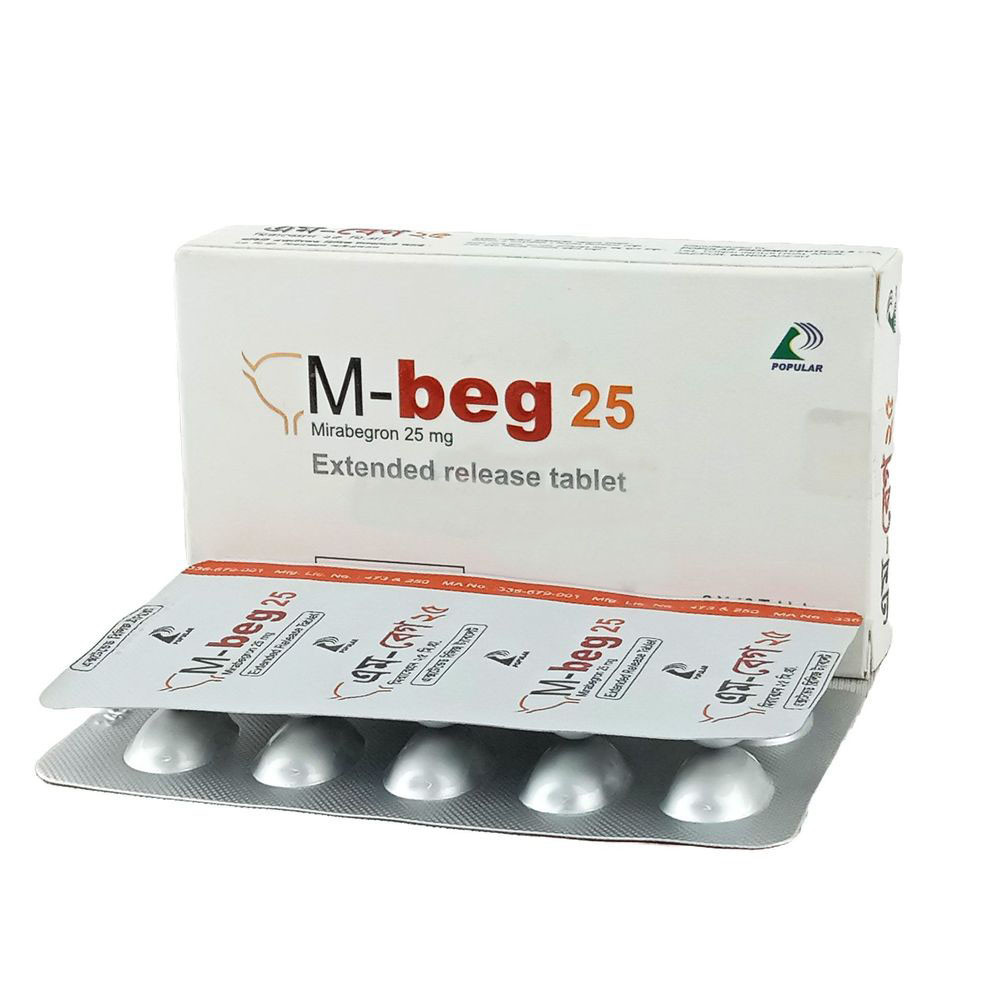
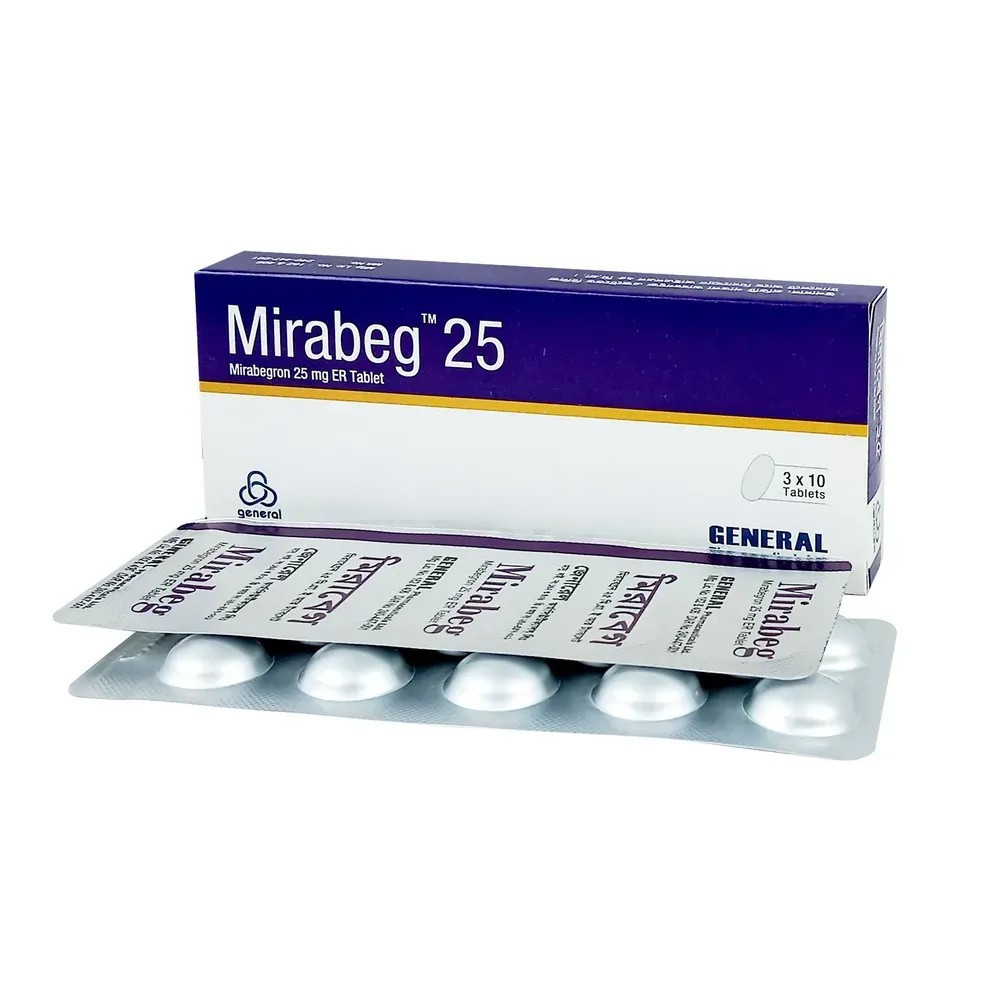
Introduction
Uroblock Tablet (Extended Release) 25 mg is a sympathomimetic $\beta_3$-adrenergic receptor agonist that relaxes bladder smooth muscle to treat overactive bladder symptoms in adults and neurogenic detrusor overactivity in pediatric patients. Unlike traditional options like solifenacin, it lacks significant antimuscarinic activity, resulting in a more favorable side-effect profile. Because its mechanism is complementary to antimuscarinics, it can also be used in combination therapy for refractory cases.
Uses
Uroblock Tablet (Extended Release) 25 mg is a beta-3 adrenergic agonist used to treat overactive bladder and neurogenic detrusor overactivity.
Uroblock Tablet (Extended Release) 25 mg is indicated for the treatment of overactive bladder (OAB) - with symptoms of urge urinary incontinence, urgency, and urinary frequency - either alone or in combination with solifenacin. It is also indicated for the treatment of neurogenic detrusor overactivity (NDO) in pediatric patients 3 years of age and older and weighing 35kg or more.
Associated Conditions
Pharmacodynamics
Uroblock Tablet (Extended Release) 25 mg exerts its pharmacologic effects by forcing bladder smooth muscle to relax, thereby expanding its capacity and relieving urgency. Uroblock Tablet (Extended Release) 25 mg does not appear to adversely affect the mean maximum flow rate or mean detrusor pressure at maximum flow rate in patients with lower urinary tract symptoms and bladder outlet obstruction (BOO), but should be used with in patients with BOO due to reports of significant urinary retention. Furthermore, mirabegron increases both blood pressure and heart rate in a dose-dependent manner and should therefore be used with caution in patients with severely uncontrolled hypertension or others for whom these increases may prove dangerous.
Mechanism of Action
Uroblock Tablet (Extended Release) 25 mg is a potent and selective agonist of beta-3 adrenergic receptors. The activation of beta-3 receptors relaxes detrusor smooth muscle during the storage phase of the urinary bladder fill-void cycle, which increases the bladder's storage capacity thereby alleviating feelings of urgency and frequency.
Absorption
The absolute bioavailability of orally administered mirabegron ranges from 29% at a dose of 25 mg to 35% at a dose of 50 mg. The Tmax for the extended-release tablet and suspension formulations are approximately 3.5 hours, while the Tmax for the granule formulation is 4-5 hours. Both Cmax and AUC increase more than dose proportionally - an increase in dose from 50mg to 100mg results in a 2.9- and 2.6-fold increase in Cmax and AUC, respectively, whereas an increase from 50mg to 200mg results in a 8.4- and 6.5-fold increase in Cmax and AUC, respectively.
Steady-state concentrations of mirabegron are achieved after approximately 7 days of once-daily administration.
Volume of Distribution
Following intravenous administration, mirabegron has an apparent steady-state volume of distribution (Vd) of 1670 L indicating extensive distribution.
Protein Binding
Uroblock Tablet (Extended Release) 25 mg is approximately 71% protein-bound in plasma, primarily to albumin and alpha-1-acid glycoprotein.
Route of Elimination
Of a 160mg radiolabeled dose administered to healthy volunteers, approximately 55% of the radioactivity was recovered in the urine and 34% in the feces. Approximately 25% of unchanged mirabegron was recovered in the urine while 0% was recovered in the feces.
Renal elimination is achieved primarily via active tubular secretion with some contribution by glomerular filtration.
Half Life
The mean terminal elimination half-life of mirabegron in adults being treated for overactive bladder is approximately 50 hours. In pediatric patients receiving the granule formulation for the treatment of neurogenic detrusor overactivity, the mean terminal elimination half-life is approximately 26-31 hours.
Clearance
Total plasma clearance following intravenous administration is approximately 57 L/h, with renal clearance accounting for roughly 25% at approximately 13 L/h.
Toxicity
At doses of up to 400mg in healthy volunteers (~8x the recommended maximum), reported symptoms of overdose included palpitations and increased heart rate. Symptoms of chronic overdosage are similar in presentation and may also include a rise in systolic blood pressure. In cases of overdosage, employ standard symptomatic and supportive measures in addition to ECG monitoring.
Food Interactions
- Take with food. While adults may take mirabegron with or without food, prescribing information recommends that children always co-administer mirabegron with food.
Dosage
Renal or hepatic impairment:
- Patients with severe renal impairment (ClCr 15 to 29 mL/min or eGFR 15 to 29 mL/min/1.73 m2) or moderate hepatic impairment (Child-Pugh Class B), the daily dose of Uroblock Tablet (Extended Release) 25 mg should not exceed 25 mg tablet once daily.
- Uroblock Tablet (Extended Release) 25 mg has not been studied in patients with end stage renal disease (GFR <15 mL/min/1.73 m2 or patients requiring haemodialysis) or severe hepatic impairment (Child Pugh Class C) and it is therefore not recommended for use in these patient populations.
Paediatric population: The safety and efficacy of Uroblock Tablet (Extended Release) 25 mg in children below 18 years of age have not yet been established.