Introduction
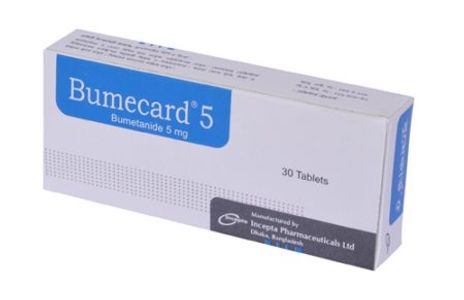
Urinide Tablet 5 mg is a sulfamyl diuretic.
Uses
Urinide Tablet 5 mg is a sulfamyl diuretic used to treat edema in congestive heart failure, hepatic and renal disease, and nephrotic syndrome.
For the treatment of edema associated with congestive heart failure, hepatic and renal disease including the nephrotic syndrome.
Associated Conditions
Pharmacodynamics
Urinide Tablet 5 mg is a loop diuretic of the sulfamyl category to treat heart failure. It is often used in patients in whom high doses of furosemide are ineffective. There is however no reason not to use bumetanide as a first choice drug. The main difference between the two substances is in bioavailability. Urinide Tablet 5 mg has more predictable pharmacokinetic properties as well as clinical effect. In patients with normal renal function, bumetanide is 40 times more effective than furosemide.
Mechanism of Action
Urinide Tablet 5 mg interferes with renal cAMP and/or inhibits the sodium-potassium ATPase pump. Urinide Tablet 5 mg appears to block the active reabsorption of chloride and possibly sodium in the ascending loop of Henle, altering electrolyte transfer in the proximal tubule. This results in excretion of sodium, chloride, and water and, hence, diuresis.
Absorption
Urinide Tablet 5 mg is completely absorbed (80%), and the absorption is not altered when taken with food. Bioavailability is almost complete.
Protein Binding
97%
Route of Elimination
Oral administration of carbon-14 labeled Bumex to human volunteers revealed that 81% of the administered radioactivity was excreted in the urine, 45% of it as unchanged drug. Biliary excretion of Bumex amounted to only 2% of the administered dose.
Half Life
60-90 minutes
Clearance
- 0.2 - 1.1 mL/min/kg [preterm and full-term neonates with respiratory disorders]
- 2.17 mL/min/kg [neonates receiving bumetanide for volume overload]
- 1.8 +/- 0.3 mL/min/kg [geriatric subjects]
- 2.9 +/- 0.2 mL/min/kg [younger subjects]
Toxicity
Overdosage can lead to acute profound water loss, volume and electrolyte depletion, dehydration, reduction of blood volume and circulatory collapse with a possibility of vascular thrombosis and embolism. Electrolyte depletion may be manifested by weakness, dizziness, mental confusion, anorexia, lethargy, vomiting and cramps. Treatment consists of replacement of fluid and electrolyte losses by careful monitoring of the urine and electrolyte output and serum electrolyte levels.
Food Interactions
- Take with food. Food reduces irritation.
Dosage
By IV Injection: 1-2 mg, repeated after 20 minutes if necessary. Elderly, 500 micrograms (1 ml of Bumecard) daily may be sufficient.
By IV Infusion: 2-5 mg over 30-60 minutes.Elderly, 500 micrograms (1 ml of Bumecard) daily may be sufficient.
By IM Injection: 1 mg initially then adjusted according to response, Elderly 500 micrograms (1 ml of Bumecard) daily may be sufficient.
Paediatric use: Safety and effectiveness in paediatric patients below the age of 18 have not been established.