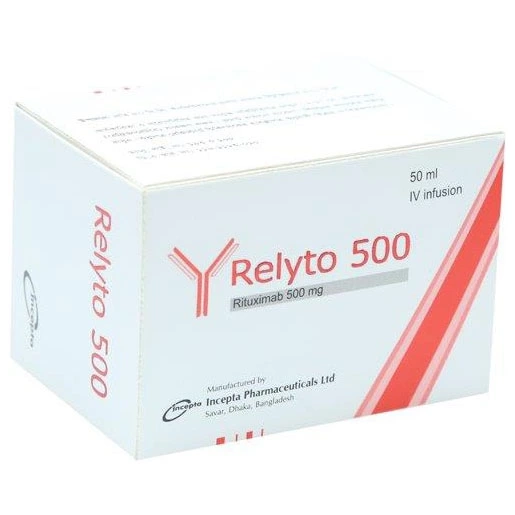
Introduction
Truxima IV Infusion 10 mg/ml is a genetically engineered chimeric murine/human monoclonal antibody directed against the CD20 antigen found on the surface of normal and malignant B lymphocytes. The antibody is an IgG1 kappa immunoglobulin containing murine light and heavy-chain variable region sequences and human constant region sequences , . It was originally approved by the U.S. FDA in 1997 as a single agent to treat patients with B-cell Non-Hodgkin's Lymphoma (NHL) , however, has now been approved for a variety of conditions . On November 28, 2018, the US FDA approved Truxima, the first biosimilar to Rituxan (Truxima IV Infusion 10 mg/ml) .
Uses
Truxima IV Infusion 10 mg/ml is a monoclonal anti-CD20 antibody used to treat non-Hodgkin's lymphoma, chronic lymphocytic leukemia, Wegener's granulomatosis, pemphigus vulgaris, and rheumatoid arthritis.
Truxima IV Infusion 10 mg/ml is indicated in the following conditions :
Non–Hodgkin’s Lymphoma (NHL)
Chronic Lymphocytic Leukemia (CLL)
Rheumatoid Arthritis (RA) in combination with methotrexate in adult patients with moderately-to severely-active RA
Granulomatosis with Polyangiitis (GPA) (Wegener’s Granulomatosis) and Microscopic Polyangiitis (MPA)
Moderate to severe Pemphigus Vulgaris (PV) in adult patients
The biosimilar (approved in November 2018), Truxima, is indicated For the treatment of adult patients with CD20-positive, B-cell non-Hodgkin’s lymphoma (NHL) to be used as a single agent or in combination with chemotherapy .
In September 2019, the rituximab injection was approved along with glucocorticoids to manage granulomatosis with polyangiitis (GPA) in addition to microscopic polyangiitis (MPA) in children of at least 2 years of age .
Associated Conditions
Pharmacodynamics
Truxima IV Infusion 10 mg/ml binds to the CD20 antigen, which is predominantly expressed on mature B cells and on >90% of B-cell non-Hodgkin's lymphomas . The antibody leads to selective killing of B-cells. The following are the pharmacodynamic outcomes for various conditions, including non- Hodgkin's Lymphoma :
Non-Hodgkin’s Lymphoma (NHL) In Non-Hodgkin's Lymphoma patients, the administration of rituximab led to the depletion of circulating and tissue-based B cells. Among 166 patients in Study 1, circulating CD19-positive B cells were depleted within the first three weeks, showing sustained depletion for up to 6-9 months post-treatment in 83% of treated patients. B-cell recovery began at approximately 6 months and median B-cell levels returned to normal by 12 months following the completion of treatment . There were sustained and statistically significant decreases in serum IgM and IgG levels measured from 5-11 months following rituximab administration; 14% of patients showed IgM and/or IgG serum levels below the normal range .
Rheumatoid Arthritis In rheumatoid arthritis (RA) patients, treatment with rituximab induced the depletion of peripheral B lymphocytes, with the majority of patients showing near-complete depletion (CD19 counts below the lower limit of quantification, 20 c-lls/μl) within 2 weeks after the first dose of rituximab. The majority of treated patients showed peripheral B-cell depletion, sustained for a minimum of 6 months. A small percentage of patients (~4%) had peripheral B-cell depletion that was sustained for more than 3 years after one course of treatment. Total serum immunoglobulin levels, IgM, IgG, and IgA were decreased at 6 months with the greatest change observed in IgM. At Week 24 of the first cycle of rituximab treatment, small percentages of patients experienced decreases in IgM (10%), IgG (2.8%), and IgA (0.8%) levels below the lower limit of normal (LLN). When rituximab was administered to RA patients during repeated rituximab treatment, 23.3%, 5.5%, and 0.5% of patients experienced decreases in IgM, IgG, and IgA concentrations below LLN at any time after receiving rituximab, respectively. The clinical consequences of decreases in immunoglobulin levels in RA patients treated with rituximab are not clear at this time. Treatment with rituximab in patients with RA was associated with a decreased level of several biologic markers of inflammation such as interleukin-6 (IL-6), C-reactive protein (CRP), serum amyloid protein (SAA), S100 A8/S100 A9 heterodimer complex (S100 A8/9), anti-citrullinated peptide (anti-CCP), and RF and was found to decrease disease symptoms .
Granulomatosis with Polyangiitis (GPA) (Wegener’s Granulomatosis) and Microscopic Polyangiitis In GPA and MPA patients, peripheral blood CD19 B-cells were depleted to less than 10 cells/μl after the first two infusions of rituximab and remained at the same level in most (84%) patients through Month 6 of the treatment. By Month 12, most patients (81%) demonstrated signs of B-cell return with counts >10 cells/μL. By Month 18, the majority of patients (87%) had counts >10 cells/μL .
Mechanism of Action
Truxima IV Infusion 10 mg/ml is a monoclonal antibody that targets the CD20 antigen, which is expressed on the surface of pre-B and mature B-lymphocytes , , , . After binding to CD20, rituximab mediates B-cell lysis (or breakdown). The possible mechanisms of cell lysis include complement dependent cytotoxicity (CDC) and antibody dependent cell-mediated cytotoxicity (ADCC) .
Truxima IV Infusion 10 mg/ml belongs to the immunoglobulin G1 (IgG1) sub-class, consisting of a murine variable region (Fab region) and a human constant region (Fc region). The Fab region has variable sections that define a specific target antigen, allowing the antibody to attract and secure its exclusive antigen, specifically the binding of rituximab (IgG1) to CD20 on pre-B and mature B lymphocytes. The Fc region is the tail end of the antibody that communicates with cell surface receptors to activate the immune system, in this case, a sequence of events leading to the depletion of circulating B lymphocytes by complement-dependent cell lysis, antibody-dependent cellular cytotoxicity, as well as apoptosis .
In regards to the mechanism of action in rheumatoid arthritis, B cells are thought to play a role in the pathogenesis of rheumatoid arthritis (RA) and the associated condition of chronic synovitis. B cells may act at various sites in the autoimmune/inflammatory process, including through production of rheumatoid factor (RF) and other autoantibodies, antigen presentation, T-cell activation, and/or the production of proinflammatory cytokines . The administration of rituximab in this condition has been shown to result in significant clinical and symptomatic improvements , .
Absorption
Following the administration of 2 doses of rituximab in patients with rheumatoid arthritis (RA), the mean (± S.D.; % CV) concentrations after the first infusion (Cmax first) and second infusion (Cmax second) were : 157 ( ± 46; 29%) and 183 ( ± 55; 30%) mcg/mL, and 318 ( ± 86; 27%) and 381 ( ± 98; 26%) mcg/mL for the 2 × 500 mg and 2 × 1000 mg doses, respectively .
Volume of Distribution
3.1 L in Rheumatoid Arthritis
4.5 L in Granulomatosis with polyangitis and microscopic polyangitis
Route of Elimination
Likely eliminated through the reticuloendothelial system .
Half Life
Non-Hodgkin's Lymphoma: Based on a population pharmacokinetic analysis of data from 298 Non-Hodgkin's Lymphoma (NHL) patients who received rituximab once weekly or once every three weeks, the estimated median terminal elimination half-life was 22 days (range, 6.1 to 52 days) .
Rheumatoid Arthritis: Mean terminal elimination half-life was 18.0 days in patients with rheumatoid arthritis Based on a population pharmacokinetic analysis of data from 2005 RA patients who received rituximab .
Chronic Lymphocytic Leukemia (CLL): Pharmacokinetics were studied in 21 patients with CLL receiving rituximab according to the recommended dose and schedule. The estimated median terminal half-life of rituximab was 32 days (range, 14-62 days) .
Granulomatosis with Polyangitis and Microscopic Polyangitis: Based on the population pharmacokinetic analysis of data in 97 GPA and MPA patients who received 375 mg/m2 rituximab once weekly by intravenous infusion for four weeks, the estimated median terminal elimination half-life was 23 days (range, 9 to 49 days) .
Clearance
Rheumatoid Arthritis: 0.335 L/day
Granulomatosis with Polyangitis and Microscopic Polyangitis: 0. 312 L/day
Patients with higher CD19-positive cell counts or larger measurable tumor lesions at pretreatment had a higher clearance .
Toxicity
Oral LD50: 27 mg/kg (mouse and rat)
Inhalation LD50: 32 mg/m3 (mouse) and 37 mg/m3 (rat)
Skin LD50: 20 mg/kg (rabbit) and 50 mg/kg (rat)
Carcinogenesis, Mutagenesis, Impairment of Fertility No long-term animal studies have been performed to establish the carcinogenic or mutagenic potential of rituximab or to determine potential effects on fertility in males or females .
Embryo-Fetal toxicity: Can cause neonatal harm. Advise of potential risk to neonates and use of effective contraception .
Food Interactions
No interactions found.
Dosage
First Infusion: Standard Infusion: Initiate infusion at a rate of 50 mg/hr. In the absence of infusion toxicity, increase infusion rate by 50 mg/hr increments every 30 minutes, to a maximum of 400 mg/hr.
For Pediatric Patients with mature B-cell NHL/B-AL: Initiate infusion at a rate of 0.5 mg/kg/hr (maximum 50 mg/hr). In the absence of infusion toxicity, increase infusion rate by 0.5 mg/kg/hr every 30 minutes, to a maximum of 400 mg/hr.
Subsequent Infusions: Standard Infusion: Initiate infusion at a rate of 100 mg/hr. In the absence of infusion toxicity, increase rate by 100 mg/hr increments at 30-minute intervals, to a maximum of 400 mg/hr. For Previously Untreated Follicular NHL and DLBCL adult patients: If patients did not experience a Grade 3 or 4 infusion-related adverse event during Cycle 1, a 90-minute infusion can be administered in Cycle 2 with a glucocorticoid-containing chemotherapy regimen. Initiate at a rate of 20% of the total dose given in the first 30 minutes and the remaining 80% of the total dose given over the next 60 minutes. If the 90-minute infusion is tolerated in Cycle 2, the same rate can be used when administering the remainder of the treatment regimen (through Cycle 6 or 8). Patients who have clinically significant cardiovascular disease or who have a circulating lymphocyte count greater than or equal to 5,000/mm3 before Cycle 2 should not be administered the 90-minute infusion.
Recommended Dose for Non-Hodgkin’s Lymphoma (NHL): The recommended dose is 375 mg/m 2 as an intravenous infusion according to the following schedules
Relapsed or Refractory, Low-Grade or Follicular, CD20-Positive, B-Cell NHL: It should be administered once weekly for 4 or 8 doses.
Retreatment for Relapsed or Refractory, Low-Grade or Follicular, CD20-Positive, B-Cell NHL: It should be administered once weekly for 4 doses.
Previously Untreated, Follicular, CD20-Positive, B-Cell NHL: It should be administered on Day 1 of each cycle of chemotherapy for up to 8 doses. In patients with complete or partial response, initiate Truxima IV Infusion 10 mg/ml maintenance eight weeks following completion of a rituximab product in combination with chemotherapy. It should be administered as a single-agent every 8 weeks for 12 doses.
Non-progressing, Low-Grade, CD20-Positive, B-Cell NHL, after first-line CVP chemotherapy: Following completion of 6-8 cycles of CVP chemotherapy, It should be administered once weekly for 4 doses at 6-month intervals to a maximum of 16 doses.
Diffuse Large B-Cell NHL: It should be administered on Day 1 of each cycle of chemotherapy for up to 8 infusions.
Pediatric patients aged 6 months and older with previously untreated mature B-cell NHL/B-AL: Truxima IV Infusion 10 mg/ml is given in combination with systemic Lymphome Malin B (LMB) chemotherapy. In total, six infusions of Truxima IV Infusion 10 mg/ml are given, two doses during each of the induction courses, COPDAM1 and COPDAM2, and one dose during each of the two consolidation courses of CYM/CYVE.
Recommended Dose for Chronic Lymphocytic Leukemia (CLL): The recommended dose is 375 mg/m 2 the day prior to the initiation of FC chemotherapy, then 500 mg/m 2 on Day 1 of cycles 2-6 (every 28 days).
Recommended Dose for Rheumatoid Arthritis (RA): Truxima IV Infusion 10 mg/ml should be administered as two-1,000 mg intravenous infusions separated by 2 weeks. Glucocorticoids administered as methylprednisolone 100 mg intravenous or its equivalent 30 minutes prior to each infusion are recommended to reduce the incidence and severity of infusion-related reactions. Subsequent courses should be administered every 24 weeks or based on clinical evaluation, but not sooner than every 16 weeks. Truxima IV Infusion 10 mg/ml is given in combination with methotrexate.
Recommended Dose for Granulomatosis with Polyangiitis (GPA) (Wegener’s Granulomatosis) and Microscopic Polyangiitis (MPA): Truxima IV Infusion 10 mg/ml should be administered as a 375 mg/m 2 intravenous infusion once weekly for 4 weeks for patients with active GPA or MPA. Glucocorticoids administered as methylprednisolone 1,000 mg intravenously per day for 1 to 3 days followed by oral prednisone as per clinical practice. This regimen should begin within 14 days prior to or with the initiation of Truxima IV Infusion 10 mg/ml and may continue during and after the 4 week induction course of Truxima IV Infusion 10 mg/ml treatment.
Recommended Dose for Pemphigus Vulgaris (PV): Truxima IV Infusion 10 mg/ml should be administered as two-1,000 mg intravenous infusions separated by 2 weeks in combination with a tapering course of glucocorticoids.
Maintenance treatment: Truxima IV Infusion 10 mg/ml should be administered as a 500 mg intravenous infusion at Month 12 and every 6 months thereafter or based on clinical evaluation.
Treatment of relapse: Truxima IV Infusion 10 mg/ml should be administered as a 1,000 mg intravenous infusion on relapse, and consider resuming or increasing the glucocorticoid dose based on clinical evaluation. Subsequent infusions of Truxima IV Infusion 10 mg/ml may be administered no sooner than 16 weeks following the previous infusion.