Introduction
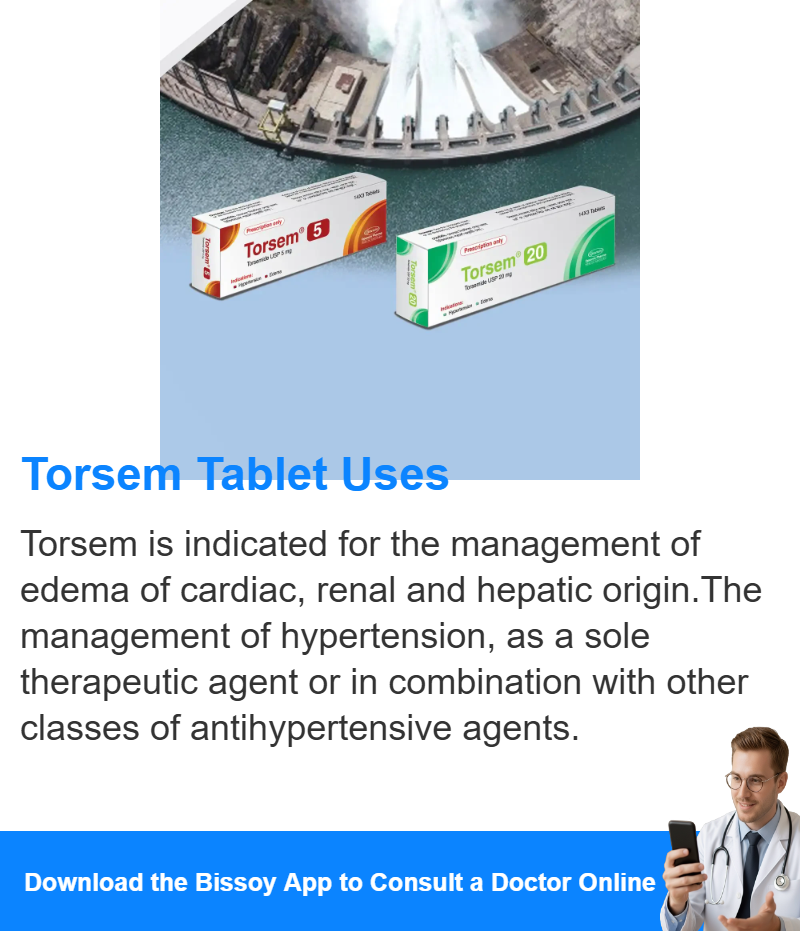
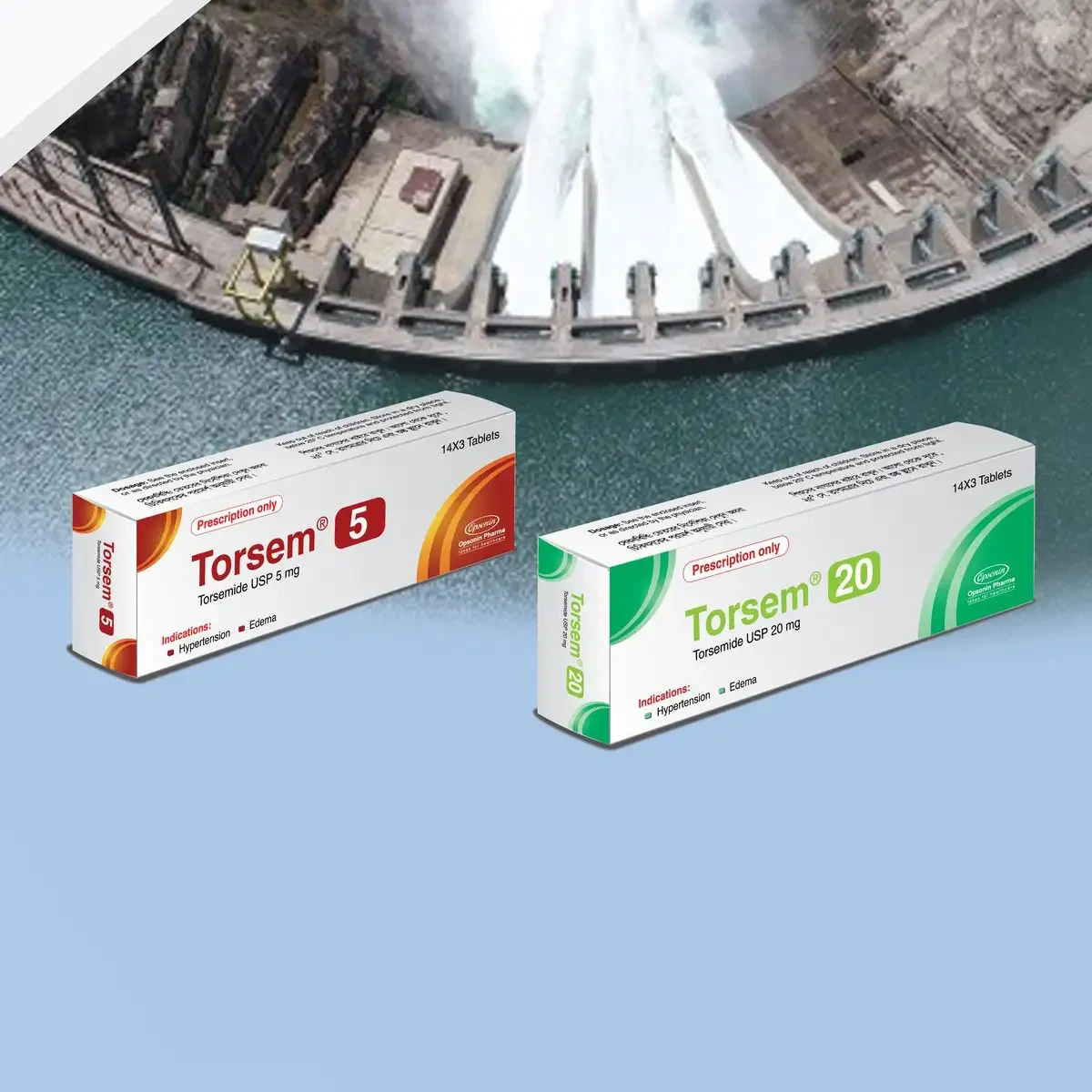
Torsem Tablet 20 mg is a high-ceiling loop diuretic. Structurally, it is a pyridine-sulfonylurea used as an antihypertensive agent.
Uses
Torsem Tablet 20 mg is a diuretic used to treat hypertension and edema associated with heart failure, renal failure, or liver disease.
Torsem Tablet 20 mg is indicated for the treatment of edema associated with congestive heart failure, renal or hepatic diseases. From this condition, it has been observed that torasemide is very effective in cases of kidney failure.
As well, torasemide is approved to be used as an antihypertensive agent either alone or in combination with other antihypertensives.
Associated Conditions
Pharmacodynamics
It is widely known that administration of torasemide can attenuate renal injury and reduce the severity of acute renal failure. This effect is obtained by increasing urine output and hence, facilitating fluid, acid-base and potassium control. This effect is obtained by the increase in the excretion of urinary sodium and chloride.
Several reports have indicated that torasemide presents a long-lasting diuresis and less potassium excretion which can be explained by the effect that torasemide has on the renin-angiotensin-aldosterone system. This effect is very similar to the effect observed with the administration of combination therapy with furosemide and spironolactone and it is characterized by a decrease in plasma brain natriuretic peptide and improved measurements of left ventricular function.
Above the aforementioned effect, torasemide presents a dual effect .in which the inhibition of aldosterone which donates torasemide with a potassium-sparing action.
Torsem Tablet 20 mg has been shown to reduce extracellular fluid volume and blood pressure in hypertensive patients suffering from chronic kidney disease. As well, some reports have indicated that torasemide can reduce myocardial fibrosis by reducing the collagen accumulation. This effect is suggested to be related to the decrease in aldosterone which in order has been shown to reduce the production of the enzyme procollagen type I carboxy-terminal proteinase which is known to be overexpressed in heart failure patients.
Mechanism of Action
As mentioned above, torasemide is part of the loop diuretics and thus, it acts by reducing the oxygen demand in the medullary thick ascending loop of Henle by inhibiting the Na+/K+/Cl- pump on the luminal cell membrane surface. This action is obtained by the binding of torasemide to a chloride ion-binding site of the transport molecule.
Torsem Tablet 20 mg is known to have an effect in the renin-angiotensin-aldosterone system by inhibiting the downstream cascade after the activation of angiotensin II. This inhibition will produce a secondary effect marked by the reduction of the expression of aldosterone synthase, TGF-B1 and thromboxane A2 and a reduction on the aldosterone receptor binding.
Absorption
Torsem Tablet 20 mg is the diuretic with the highest oral bioavailability even in advanced stages of chronic kidney disease. This bioavailability tends to be higher than 80% regardless of the patient condition. The maximal serum concentration is reported to be of 1 hour and the absorption parameters are not affected by its use concomitantly with food.
Volume of Distribution
The volume of distribution of torasemide is 0.2 L/kg.
Protein Binding
Torsem Tablet 20 mg is found to be highly bound to plasma proteins, representing over 99% of the administered dose.
Route of Elimination
Torsem Tablet 20 mg is mainly hepatically processed and excreted in the feces from which about 70-80% of the administered dose is excreted by this pathway. On the other hand, about 20-30% of the administered dose is found in the urine.
Half Life
The average half-life of torasemide is 3.5 hours.
Clearance
The clearance rate of torasemide is considerably reduced by the presence of renal disorders.
Toxicity
The oral LD50 of torasemide in the rat is 5 g/kg. When overdose occurs, there is a marked diuresis with the danger of loss of fluid and electrolytes which has been seen to lead to somnolence, confusion, hypotension, hyponatremia, hypokalemia, hypochloremic alkalosis, hemoconcentration dehydration and circulatory collapse. This effects can include some gastrointestinal disturbances.
There is no increase in tumor incidence with torasemide and it is proven to not be mutagenic, not fetotoxic or teratogenic.
Food Interactions
- Take with or without food. Food delays the Cmax by 30 minutes but does not impact efficacy.
Dosage
Chronic renal failure: The usual initial oral dose is 20 mg once daily. lf the diuretic response is inadequate, the dose should be titrated upward by approximately doubling until the desired diuretic response is obtained. Single doses higher than 200mg have not been adequately studied.
Hepatic cirrhosis: The usual initial oral dose is 5 mg or 10 mg once daily, administered together with an aldosterone antagonist or a potassium sparing diuretic. If the diuretic response is inadequate, the dose should be titrated upward by approximately doubling until the desired diuretic response is obtained. Single doses higher than 40 mg have not been adequately studied. Chronic use of any diuretic in hepatic disease has not been studied in adequate and well-controlled trials.
Hypertension: The usual initial oral dose is 2.5-5 mg once daily. If the 5 mg dose does not provide adequate reduction of blood pressure within 4 to 6 weeks, the dose may be increased to 10 mg once daily. If the response to 10 mg is insufficient, an additional antihypertensive should be added to the treatment regimen.