Introduction
Aminoglycosides, many of which are derived directly from Streptomyces spp., are concentration-dependent bactericidal antibiotics with a broad spectrum of activity against Gram-positive and Gram-negative organisms. Inhaled tobramycin is notable for its use in treating chronic Pseudomonas aeruginosa infections in cystic fibrosis patients, as P. aeruginosa is notoriously inherently resistant to many antibiotics. However, tobramycin can also be administered intravenously and topically to treat a variety of infections caused by susceptible bacteria. Its use is limited in some cases by characteristic toxicities such as nephrotoxicity and ototoxicity, yet it remains a valuable option in the face of growing resistance to front-line antibiotics such as β-lactams and cephalosporins.
Uses
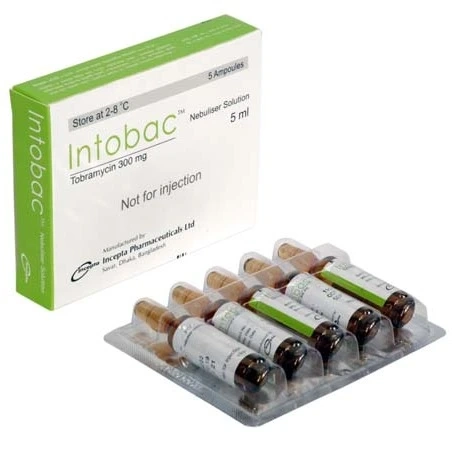
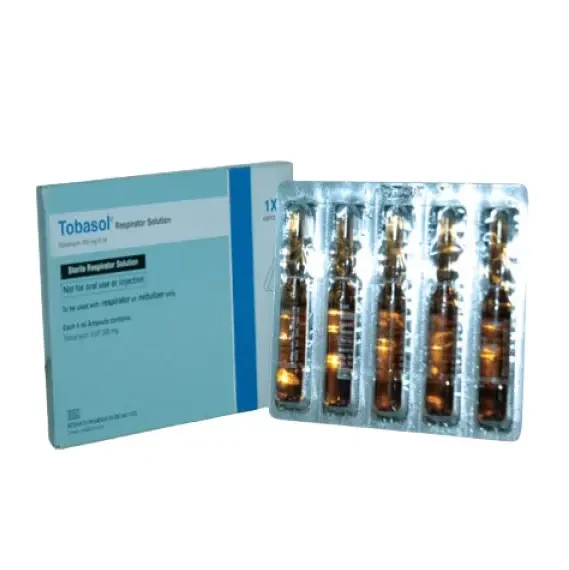
Tobicin Nebuliser Solution 300 mg/5 ml is an aminoglycoside antibiotic used to treat cystic fibrosis-associated bacterial, lower respiratory tract, urinary tract, eye, skin, bone, and skin structure infections.
Inhaled tobramycin is indicated for the management of cystic fibrosis patients with Pseudomonas aeruginosa, but is not recommended in patients under six years of age, those with forced expiratory volume in 1 second (FEV1) 80% predicted, or in those with Burkholderia cepacia.
Tobicin Nebuliser Solution 300 mg/5 ml applied topically to the eyes is indicated for the treatment of external eye (and adjoining structure) infections by susceptible bacteria.
Tobicin Nebuliser Solution 300 mg/5 ml injection is indicated in adult and pediatric patients for the treatment of serious bacterial infections, including septicemia (caused by P. aeruginosa, Escherichia coli, and Klebsiella spp.), lower respiratory tract infections (caused by P. aeruginosa, Klebsiella spp., Enterobacter spp., Serratia spp., E. coli, and Staphylococcus aureus, both penicillinase and non-penicillinase-producing strains), serious central-nervous-system infections (meningitis, caused by susceptible organisms), intra-abdominal infections including peritonitis (caused by E. coli, Klebsiella spp., and Enterobacter spp.), skin, bone, and skin structure infections (caused by P. aeruginosa, Proteus spp., E. coli, Klebsiella spp., Enterobacter spp., Serratia spp. and S. aureus), and complicated and recurrent urinary tract infections (caused by P. aeruginosa, Proteus spp., E. coli, Klebsiella spp., Enterobacter spp., Serratia spp., S. aureus, Providencia spp., and Citrobacter spp.). Aminoglycosides, including tobramycin, should generally not be used in uncomplicated urinary tract infections or staphylococcal infections unless less toxic antibiotics cannot be used and the bacteria in question are known to be sensitive to aminoglycosides.
As with all antibiotics, tobramycin use should be limited to cases where bacterial infections are known or strongly suspected to be caused by sensitive organisms, and the possible emergence of resistance should be monitored closely.
Associated Conditions
Pharmacodynamics
Tobicin Nebuliser Solution 300 mg/5 ml is an aminoglycoside antibiotic derived from the actinomycete Streptomyces tenebrarius. It has a broad spectrum of activity against Gram-negative bacteria, including Enterobacteriaceae, Escherichia coli, Klebsiella pneumoniae, Morganella morganii, Moraxella lacunata, Proteus spp., Haemophilus spp., Acinetobacter spp., Neisseria spp., and, importantly, Pseudomonas aeruginosa. Aminoglycosides also generally retain activity against the biothreat agents Yersinia pestis and Francisella tularensis. In addition, aminoglycosides are active against some Gram-positive bacteria such as Staphylococcus spp., including methicillin-resistant (MRSA) and vancomycin-resistant strains, Streptococcus spp., and Mycobacterium spp.
Like other aminoglycosides, tobramycin is taken up and retained by proximal tubule and cochlear cells in the kidney and ear, respectively, and hence carries a risk of nephrotoxicity and ototoxicity. There is also a risk of neuromuscular block, which may be more pronounced in patients with preexisting neuromuscular disorders such as myasthenia gravis or Parkinson's disease. Aminoglycosides can cross the placenta, resulting in total, irreversible, bilateral congenital deafness in babies born to mothers who were administered an aminoglycoside during pregnancy. Due to the low systemic absorption of inhaled and topical tobramycin formulations, these effects are more pronounced with injected tobramycin than with other formulations. However, all formulations carry a risk of hypersensitivity reactions, including potentially fatal cutaneous reactions such as Stevens-Johnson syndrome and toxic epidermal necrolysis.
Mechanism of Action
Tobicin Nebuliser Solution 300 mg/5 ml is a 4,6-disubstituted 2-deoxystreptamine (DOS) ring-containing aminoglycoside antibiotic with activity against various Gram-negative and some Gram-positive bacteria. The mechanism of action of tobramycin has not been unambiguously elucidated, and some insights into its mechanism rely on results using similar aminoglycosides. In general, like other aminoglycosides, tobramycin is bactericidal and exhibits both immediate and delayed killing, which are attributed to different mechanisms, as outlined below.
Aminoglycosides are polycationic at physiological pH, such that they readily bind to bacterial membranes ("ionic binding"); this includes binding to lipopolysaccharide and phospholipids within the outer membrane of Gram-negative bacteria and to teichoic acid and phospholipids within the cell membrane of Gram-positive bacteria. This binding displaces divalent cations and increases membrane permeability, which allows aminoglycoside entry. Additional aminoglycoside entry ("energy-dependent phase I") into the cytoplasm requires the proton-motive force, allowing access of the aminoglycoside to its primary intracellular target of the bacterial 30S ribosome. Mistranslated proteins produced as a result of aminoglycoside binding to the ribosome (see below) integrate into and disrupt the cell membrane, which allows more of the aminoglycoside into the cell ("energy-dependent phase II"). Hence, tobramycin and other aminoglycosides have both immediate bactericidal effects through membrane disruption and delayed bactericidal effects through impaired protein synthesis; observed experimental data and mathematical modelling support this two-mechanism model.
Inhibition of protein synthesis was the first recognized effect of aminoglycoside antibiotics. Structural and cell biological studies suggest that aminoglycosides bind to the 16S rRNA in helix 44 (h44), near the A site of the 30S ribosomal subunit, altering interactions between h44 and h45. This binding also displaces two important residues, A1492 and A1493, from h44, mimicking normal conformational changes that occur with successful codon-anticodon pairing in the A site. Overall, aminoglycoside binding has several negative effects, including inhibiting translation initiation and elongation and ribosome recycling. Recent evidence suggests that the latter effect is due to a cryptic second binding site situated in h69 of the 23S rRNA of the 50S ribosomal subunit. Also, by stabilizing a conformation that mimics correct codon-anticodon pairing, aminoglycosides promote error-prone translation; mistranslated proteins can incorporate into the cell membrane, inducing the damage discussed above.
Although direct mutation of the 16S rRNA is a rare resistance mechanism, due to the gene being present in numerous copies, posttranscriptional 16S rRNA modification by 16S rRNA methyltransferases (16S-RMTases) at the N7 position of G1405 or the N1 position of A1408 are common resistance mechanisms in aminoglycoside-resistant bacteria. These mutants also further support the proposed mechanism of action of aminoglycosides. Direct modification of the aminoglycoside itself through acetylation, adenylation, and phosphorylation by aminoglycoside-modifying enzymes (AMEs) are also commonly encountered resistance mutations. Finally, due to the requirement for active transport of aminoglycosides across bacterial membranes, they are not active against obligately anaerobic bacteria.
Absorption
Tobicin Nebuliser Solution 300 mg/5 ml administered by inhalation in cystic fibrosis patients showed greater variability in sputum as compared to serum. After a single 112 mg dose, the serum Cmax was 1.02 ± 0.53 μg/mL, which was reached in one hour (Tmax), while the sputum Cmax was 1048 ± 1080 μg/g. Comparatively, for a 300 mg dose, the serum Cmax was 1.04 ± 0.58 μg/mL, which was also reached within one hour, while the sputum Cmax was 737 ± 1028 μg/g. The systemic exposure (AUC0-12) was also similar between the two doses, at 4.6 ± 2.0 μg∙h/mL for the 112 mg dose and 4.8 ± 2.5 μg∙h/mL for the 300 mg dose. When tobramycin was administered over a four-week cycle at 112 mg twice daily, the Cmax measured one hour after dosing ranged from 1.48 ± 0.69 μg/mL to 1.99 ± 0.59 μg/mL.
Volume of Distribution
Inhalation tobramycin had an apparent volume of distribution in the central compartment of 85.1 L for a typical cystic fibrosis patient.
Protein Binding
Tobicin Nebuliser Solution 300 mg/5 ml binding to serum proteins is negligible.
Route of Elimination
Tobicin Nebuliser Solution 300 mg/5 ml is primarily excreted unchanged in the urine.
Half Life
Tobicin Nebuliser Solution 300 mg/5 ml has an apparent serum terminal half-life of ~3 hours following a single 112 mg inhaled dose in cystic fibrosis patients.
Clearance
Inhaled tobramycin has an apparent serum clearance of 14.5 L/h in cystic fibrosis patients aged 6-58 years.
Toxicity
Toxicity information regarding tobramycin is not readily available. Patients experiencing an overdose are at an increased risk of severe adverse effects such as nephrotoxicity, ototoxicity, neuromuscular blockade, and respiratory failure/paralysis. Symptomatic and supportive measures are recommended; hemodialysis may help clear excess tobramycin. Accidental ingestion of tobramycin is unlikely to result in an overdose, as aminoglycosides are poorly absorbed in the gastrointestinal tract.
Poor gastrointestinal absorption is reflected in animal studies. When administered by the intraperitoneal or subcutaneous route, the LD50 for mice and rats ranges from 367-1030 mg/kg while the oral LD50 values are more than 7500 mg/kg.
Food Interactions
No interactions found.