Introduction
Levothyroxine is a synthetically produced form of thyroxine, a major endogenous hormone secreted by the thyroid gland. Levothyroxine is used primarily to treat hypothyroidism, a condition where the thyroid gland is no longer able to produce sufficient quantities of the thyroid hormones T4 (tetraiodothyronine or thyroxine) and T3 (triiodothyronine or Liothyronine), resulting in diminished down-stream effects of these hormones. Without sufficient quantities of circulating thyroid hormones, symptoms of hypothyroidism begin to develop such as fatigue, increased heart rate, depression, dry skin and hair, muscle cramps, constipation, weight gain, memory impairment, and poor tolerance to cold temperatures.
In response to Thyroid Stimulating Hormone (TSH) release by the pituitary gland, a normally functioning thyroid gland will produce and secrete T4, which is then converted through deiodination (by type I or type II 5′-deiodinases) into its active metabolite T3. While T4 is the major product secreted by the thyroid gland, T3 exerts the majority of the physiological effects of the thyroid hormones; T4 and T3 have a relative potency of ~1:4 (T4:T3). T4 and T3 act on nearly every cell of the body, but have a particularly strong effect on the cardiac system. As a result, many cardiac functions including heart rate, cardiac output, and systemic vascular resistance are closely linked to thyroid status.
Prior to the development of levothyroxine, Thyroid, porcine or desiccated thyroid, used to be the mainstay of treatment for hypothyroidism. However, this is no longer recommended for the majority of patients due to several clinical concerns including limited controlled trials supporting its use. Desiccated thyroid products contain a ratio of T4 to T3 of 4.2:1, which is significantly lower than the 14:1 ratio of secretion by the human thyroid gland. This higher proportion of T3 in desiccated thyroid products can lead to supraphysiologic levels of T3 which may put patients at risk of thyrotoxicosis if thyroid extract therapy is not adjusted according to the serum TSH.
Uses
Levothyroxine is a synthetic T4 hormone used to treat hypothyroidism that can be used along with surgery and radioiodine therapy to manage thyrotropin-dependent well-differentiated thyroid cancer.
Levothyroxine is indicated as replacement therapy in primary (thyroidal), secondary (pituitary) and tertiary (hypothalamic) congenital or acquired hypothyroidism. It is also indicated as an adjunct to surgery and radioiodine therapy in the management of thyrotropin-dependent well-differentiated thyroid cancer.
Associated Conditions
Pharmacodynamics
Oral levothyroxine is a synthetic hormone that exerts the same physiologic effect as endogenous T4, thereby maintaining normal T4 levels when a deficiency is present.
Levothyroxine has a narrow therapeutic index and is titrated to maintain a euthyroid state with TSH (thyroid stimulating hormone) within a therapeutic range of 0.4–4.0 mIU/L. Over- or under-treatment with levothyroxine may have negative effects on growth and development, cardiovascular function, bone metabolism, reproductive function, cognitive function, emotional state, gastrointestinal function and glucose and lipid metabolism. The dose of levothyroxine should be titrated slowly and carefully and patients should be monitored for their response to titration to avoid these effects. TSH levels should be monitored at least yearly to avoid over-treating with levothyroxine which can result in hyperthyroidism (TSH 15
As many cardiac functions including heart rate, cardiac output, and systemic vascular resistance are closely linked to thyroid status, over-treatment with levothyroxine may result in increases in heart rate, cardiac wall thickness, and cardiac contractility and may precipitate angina or arrhythmias, particularly in patients with cardiovascular disease and in elderly patients. In populations with any cardiac concerns, levothyroxine should be initiated at lower doses than those recommended in younger individuals or in patients without cardiac disease. Patients receiving concomitant levothyroxine and sympathomimetic agents should be monitored for signs and symptoms of coronary insufficiency. If cardiac symptoms develop or worsen, reduce the levothyroxine dose or withhold for one week and restart at a lower dose.
Increased bone resorption and decreased bone mineral density may occur as a result of levothyroxine over-replacement, particularly in post-menopausal women. The increased bone resorption may be associated with increased serum levels and urinary excretion of calcium and phosphorous, elevations in bone alkaline phosphatase and suppressed serum parathyroid hormone levels. Administer the minimum dose of levothyroxine that achieves the desired clinical and biochemical response to mitigate this risk.
Addition of levothyroxine therapy in patients with diabetes mellitus may worsen glycemic control and result in increased antidiabetic agent or insulin requirements. Carefully monitor glycemic control after starting, changing or discontinuing levothyroxine.
Mechanism of Action
Levothyroxine is a synthetically prepared levo-isomer of the thyroid hormone thyroxine (T4, a tetra-iodinated tyrosine derivative) that acts as a replacement in deficiency syndromes such as hypothyroidism. T4 is the major hormone secreted from the thyroid gland and is chemically identical to the naturally secreted T4: it increases metabolic rate, decreases thyroid-stimulating hormone (TSH) production from the anterior lobe of the pituitary gland, and, in peripheral tissues, is converted to T3. Thyroxine is released from its precursor protein thyroglobulin through proteolysis and secreted into the blood where is it then peripherally deiodinated to form triiodothyronine (T3) which exerts a broad spectrum of stimulatory effects on cell metabolism. T4 and T3 have a relative potency of ~1:4.
Thyroid hormone increases the metabolic rate of cells of all tissues in the body. In the fetus and newborn, thyroid hormone is important for the growth and development of all tissues including bones and the brain. In adults, thyroid hormone helps to maintain brain function, food metabolism, and body temperature, among other effects. The symptoms of thyroid deficiency relieved by levothyroxine include slow speech, lack of energy, weight gain, hair loss, dry thick skin and unusual sensitivity to cold.
The thyroid hormones have been shown to exert both genomic and non-genomic effects. They exert their genomic effects by diffusing into the cell nucleus and binding to thyroid hormone receptors in DNA regions called thyroid hormone response elements (TREs) near genes. This complex of T4, T3, DNA, and other coregulatory proteins causes a conformational change and a resulting shift in transcriptional regulation of nearby genes, synthesis of messenger RNA, and cytoplasmic protein production. For example, in cardiac tissues T3 has been shown to regulate the genes for α- and β-myosin heavy chains, production of the sarcoplasmic reticulum proteins calcium-activated ATPase (Ca2+-ATPase) and phospholamban, β-adrenergic receptors, guanine-nucleotide regulatory proteins, and adenylyl cyclase types V and VI as well as several plasma-membrane ion transporters, such as Na+/K+–ATPase, Na+/Ca2+ exchanger, and voltage-gated potassium channels, including Kv1.5, Kv4.2, and Kv4.3. As a result, many cardiac functions including heart rate, cardiac output, and systemic vascular resistance are closely linked to thyroid status.
The non-genomic actions of the thyroid hormones have been shown to occur through binding to a plasma membrane receptor integrin aVb3 at the Arg-Gly-Asp recognition site. From the cell-surface, T4 binding to integrin results in down-stream effects including activation of mitogen-activated protein kinase (MAPK; ERK1/2) and causes subsequent effects on cellular/nuclear events including angiogenesis and tumor cell proliferation.
Absorption
Absorption of orally administered T4 from the gastrointestinal tract ranges from 40% to 80% with the majority of the levothyroxine dose absorbed from the jejunum and upper ileum. T4 absorption is increased by fasting, and decreased in malabsorption syndromes and by certain foods such as soybeans, milk, and dietary fiber. Absorption may also decrease with age. In addition, many drugs affect T4 absorption including bile acide sequestrants, sucralfate, proton pump inhibitors, and minerals such as calcium (including in yogurt and milk products), magnesium, iron, and aluminum supplements. To prevent the formation of insoluble chelates, levothyroxine should generally be taken on an empty stomach at least 2 hours before a meal and separated by at least 4 hours from any interacting agents.
Protein Binding
Circulating thyroid hormones are greater than 99% bound to plasma proteins, including thyroxine-binding globulin (TBG), thyroxine-binding prealbumin (TBPA) and albumin (TBA). The higher affinity of both TBG and TBPA for T4 partially explains the higher serum levels, slower metabolic clearance and longer half-life of T4 compared to T3. Protein-bound thyroid hormones exist in reverse equilibrium with small amounts of free hormone where only unbound hormone is metabolically active.
Route of Elimination
Thyroid hormones are primarily eliminated by the kidneys. A portion of the conjugated hormone reaches the colon unchanged and is eliminated in the feces. Approximately 20% of T4 is eliminated in the stool. Urinary excretion of T4 decreases with age.
Half Life
T4 half-life is 6 to 7 days. T3 half-life is 1 to 2 days.
Toxicity
LD50=20 mg/kg (orally in rat). Hypermetabolic state indistinguishable from thyrotoxicosis of endogenous origin. Symptoms of thyrotoxicosis include weight loss, increased appetite, palpitations, nervousness, diarrhea, abdominal cramps, sweating, tachycardia, increased pulse and blood pressure, cardiac arrhythmias, tremors, insomnia, heat intolerance, fever, and menstrual irregularities.
Food Interactions
- Avoid calcium supplements/calcium rich foods. Calcium may interfere with the absorption of this drug by forming an insoluble complex. Separate medication administration by at least 4 hours.
- Avoid grapefruit products. Grapefruit may delay the absorption of this medication.
- Avoid iron supplements. Iron may interfere with the absorption of this drug by forming an insoluble complex. Separate medication administration by at least 4 hours.
- Avoid multivalent ions. Examples include iron, magnesium, and calcium. These are often found in antacids, vitamins, and supplements - separate medication administration by at least 4 hours.
- Do not take with bran and high fiber foods. Dietary fiber, soybean flour, cottonseed meal, and walnuts may reduce the absorption of levothyroxine.
- Take on an empty stomach. Levothyroxine should be taken on an empty stomach 30-60 minutes prior to the first meal of the day.
Dosage
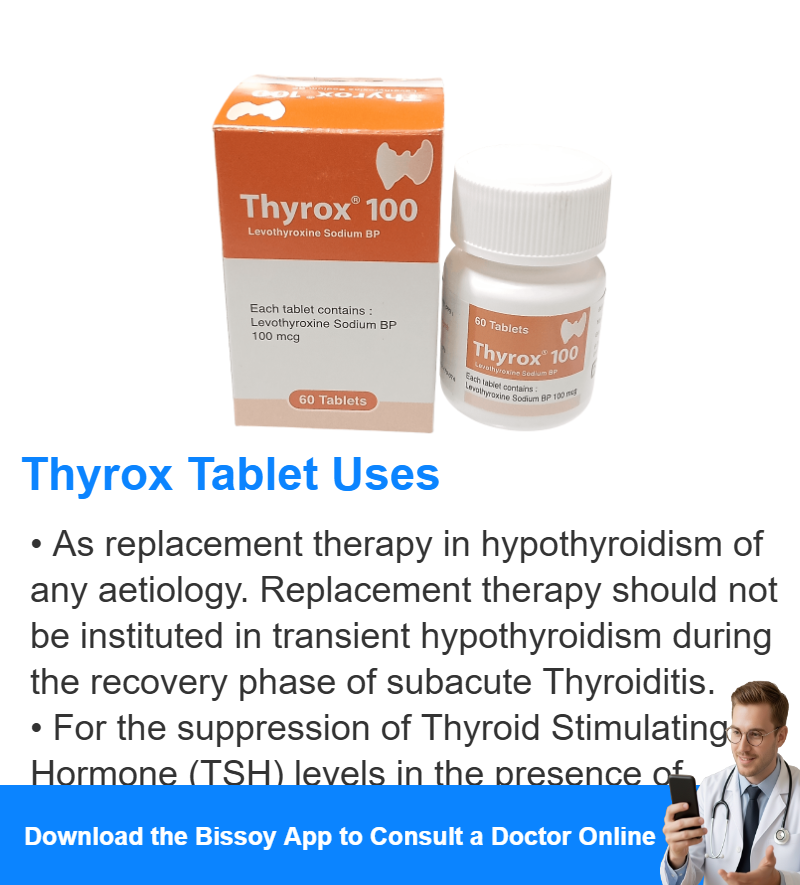
- Initial starting dose: 25-50 mcg/day, with gradual increments in dose at 6-8 week intervals, as needed. The Thyrox Tablet 100 mcg dose is generally adjusted in 12.5-25 mcg increments until the patient with primary hypothyroidism is clinically euthyroid and the serum TSH has normalized.
- In patients with severe hypothyroidism: Initial dose is 12.5-25 mcg/day with increases of 25 mcg/day every 2-4 weeks, accompanied by clinical and laboratory assessment,until the TSH level is normalized.
- In patients with secondary (pituitary) or tertiary (hypothalamic) hypothyroidism: Thyrox Tablet 100 mcg dose should be titrated until the patient is clinically euthyroid and the serum free - T4 level is restored to the upper half of the normal range.
- For patients older than 50 years or for patients under 50 years of age with underlying cardiac disease: 1.7 mcg/kg/day.
Pediatric Dosage (Infants and Children): In children with chronic or severe hypothyroidism, initial dose of 25 mcg/day with increments of 25 mcg every 2-4 weeks until the desired effect is achieved. Hyperactivity in an older child can be minimized if the starting dose is one-fourth of the recommended full replacement dose and the dose is then increased on a weekly basis by an amount equal to one-fourth the full recommended replacement dose until the full recommended replacement dose is reached.
- 0-3 months: 10-15 mcg/kg/day
- 3-6 months: 8-10 mcg/kg/day
- 6-12 months: 6-8 mcg/kg/day
- 1-5 years: 5-6 mcg/kg/day
- 6-12 years: 4-5 mcg/kg/day
- >12 years but growth and puberty incomplete: 2-3 mcg/kg/day
- Growth and puberty complete: 1.7 mcg/kg/day.