Introduction
A thiourea antithyroid agent. Propythiouracil inhibits the synthesis of thyroxine and inhibits the peripheral conversion of throxine to tri-iodothyronine. It is used in the treatment of hyperthyroidism. (From Martindale, The Extra Pharmacopeoia, 30th ed, p534)
Uses
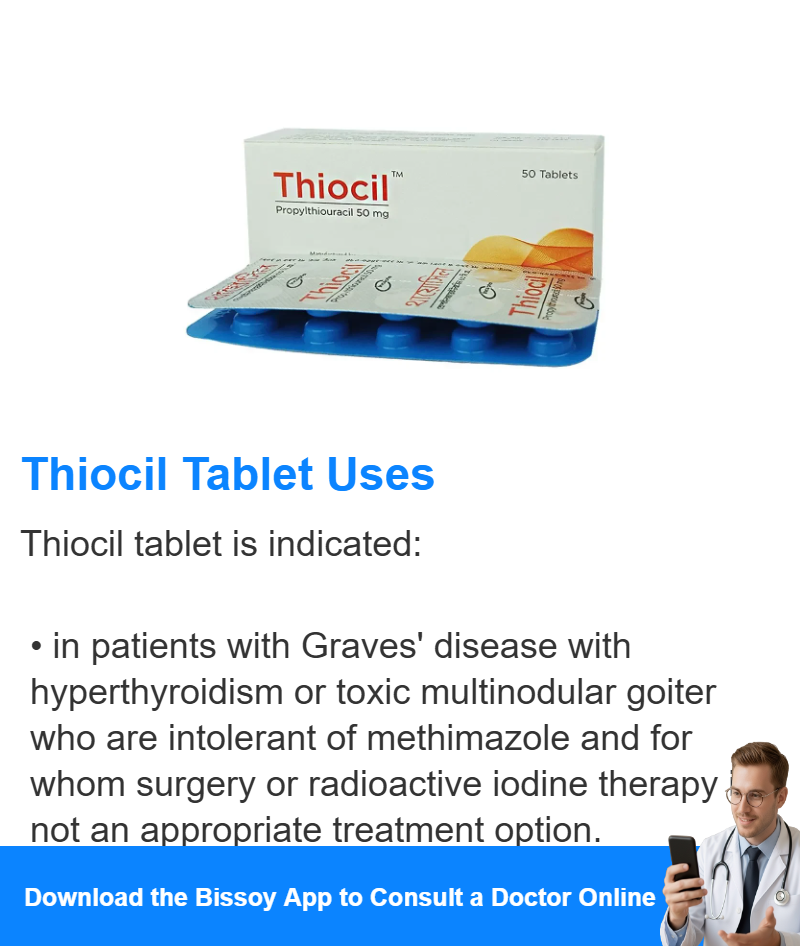
Thiocil Tablet 50 mg is a thiourea antithyroid agent used to treat hyperthyroidism.
Used to manage hyperthyroidism which is due to an overactive thyroid gland (Grave's disease).
Associated Conditions
Pharmacodynamics
Thiocil Tablet 50 mg is a thiourea antithyroid agent. Grave's disease is the most common cause of hyperthyroidism. It is an autoimmune disease where an individual's own antibodies attach to thyroid stimulating hormone receptors within cells of the thyroid gland and then trigger overproduction of thyroid hormone. The two thyroid hormones manufactured by the thyroid gland, thyroxine (T4) and triiodothyronine (T3), are formed by combining iodine and a protein called thyroglobulin with the assistance of an enzyme called peroxidase. PTU inhibits iodine and peroxidase from their normal interactions with thyroglobulin to form T4 and T3. This action decreases thyroid hormone production. PTU also interferes with the conversion of T4 to T3, and, since T3 is more potent than T4, this also reduces the activity of thyroid hormones. The actions and use of propylthiouracil are similar to those of methimazole.
Mechanism of Action
Thiocil Tablet 50 mg binds to thyroid peroxidase and thereby inhibits the conversion of iodide to iodine. Thyroid peroxidase normally converts iodide to iodine (via hydrogen peroxide as a cofactor) and also catalyzes the incorporation of the resulting iodide molecule onto both the 3 and/or 5 positions of the phenol rings of tyrosines found in thyroglobulin. Thyroglobulin is degraded to produce thyroxine (T4) and tri-iodothyronine (T3), which are the main hormones produced by the thyroid gland. Therefore propylthiouracil effectively inhibits the production of new thyroid hormones.
Absorption
Well absorbed following oral administration.
Protein Binding
82%
Route of Elimination
Thiocil Tablet 50 mg is readily absorbed and is extensively metabolized. Approximately 35% of the drug is excreted in the urine, in intact and conjugated forms, within 24 hours.
Half Life
2 hours
Toxicity
Oral, rat: LD50 = 1250 mg/kg.
Food Interactions
- Take at the same time every day.
Dosage
Adults: The initial dose is 300 mg daily. In patients with severe hyperthyroidism, very large goiters, or both, the initial dose may be increased to 400 mg daily; an occasional patient will require 600 to 900 mg daily initially. The usual maintenance dose is 100 to 150 mg daily.
Pediatric Patients: Thiocil Tablet 50 mg is generally not recommended for use in pediatric patient except in rare instances in which other alternative therapies are not appropriate options. Studies evaluating appropriate dosing regimen have not been conducted in the pediatric population although general practice would suggest initiation of therapy in patients 6 years or older at a dosage of 50 mg daily with careful upward titration based on clinical response and evaluation of TSH and free T4 levels. Although cases of severe liver injury have been reported with doses as low as 50 mg/day, most cases were associated with doses of 300 mg/day and higher.
Geriatric Patients: Reported clinical experience has not identified differences in responses between the elderly and younger patients. In general, dose selection for an elderly patient should be cautious reflecting the greater frequency of decreased hepatic, renal, or cardiac function, and of concomitant disease or other drug therapy.