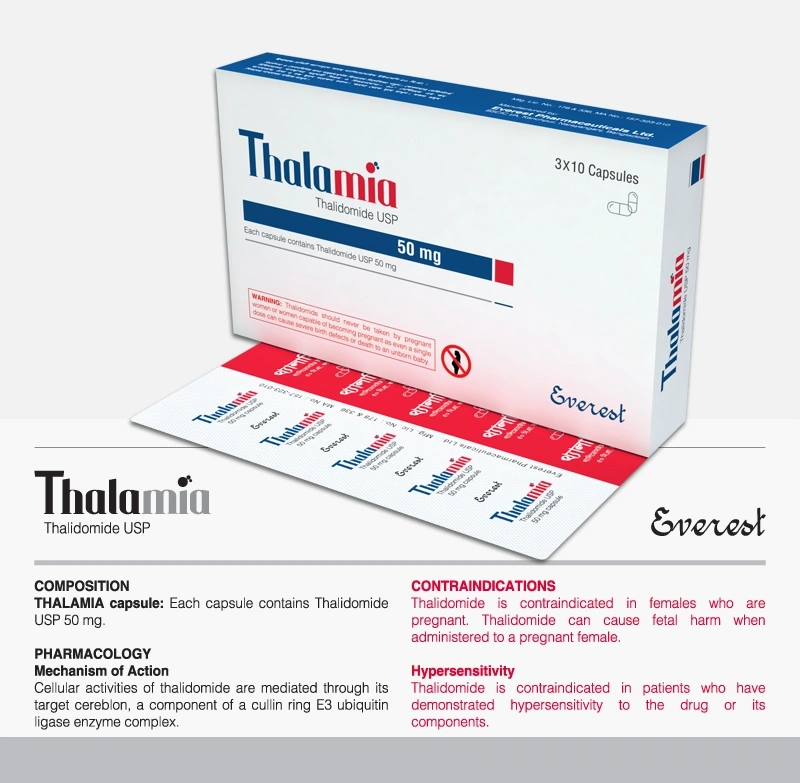
Introduction
A piperidinyl isoindole originally introduced as a non-barbiturate hypnotic, but withdrawn from the market due to teratogenic effects. It has been reintroduced and used for a number of immunological and inflammatory disorders. Thalimide Capsule 50 mg displays immunosuppresive and anti-angiogenic activity. It inhibits release of tumor necrosis factor-alpha from monocytes, and modulates other cytokine action. [PubChem]
Uses
Thalimide Capsule 50 mg is a medication used to treat newly diagnosed multiple myeloma and erythema nodosum leprosum.
For the acute treatment of the cutaneous manifestations of moderate to severe erythema nodosum leprosum (ENL). Also for use as maintenance therapy for prevention and suppression of the cutaneous manifestations of ENL recurrence.
Associated Conditions
Pharmacodynamics
Thalimide Capsule 50 mg is an immunomodulatory agent with a spectrum of activity that is not fully characterized. Thalimide Capsule 50 mg is racemic — it contains both left and right handed isomers in equal amounts: one enantiomer is effective against morning sickness, and the other is teratogenic. The enantiomers are converted to each other in vivo. That is, if a human is given D-thalidomide or L-thalidomide, both isomers can be found in the serum. Hence, administering only one enantiomer will not prevent the teratogenic effect in humans.
Mechanism of Action
In patients with erythema nodosum leprosum (ENL) the mechanism of action is not fully understood. Available data from in vitro studies and preliminary clinical trials suggest that the immunologic effects of this compound can vary substantially under different conditions, but may be related to suppression of excessive tumor necrosis factor-alpha (TNF-a) production and down-modulation of selected cell surface adhesion molecules involved in leukocyte migration. For example, administration of thalidomide has been reported to decrease circulating levels of TNF-a in patients with ENL, however, it has also been shown to increase plasma TNF-a levels in HIV-seropositive patients. As a cancer treatment, the drug may act as a VEGF inhibitor.
Absorption
The absolute bioavailability has not yet been characterized in human subjects due to its poor aqueous solubility. In studies of both healthy volunteers and subjects with Hansen’s disease, the mean time to peak plasma concentrations (Tmax) ranged from 2.9 to 5.7 hours indicating that thalidomide is slowly absorbed from the gastrointestinal tract.
Protein Binding
55% and 66% for the (+)R and (−)S enantiomers, respectively.
Route of Elimination
Thalimide Capsule 50 mg itself has less than 0.7% of the dose excreted in the urine as unchanged drug.
Half Life
The mean half-life of elimination ranges from approximately 5 to 7 hours following a single dose and is not altered upon multiple dosing.
Toxicity
The R-configuration and the S-configuration are more toxic individually than the racemic mixture. The LD50 could not be established in mice for racemic thalidomide, whereas LD50 values for the R and S configurations are reported to be 0.4 to 0.7 g/kg and 0.5 to 1.5 g/kg, respectively.
Food Interactions
- Avoid alcohol. Ingesting alcohol may increase the drowsiness caused by thalidomide.
- Take after a meal. Wait at least 1 hour after eating before taking thalidomide.
Dosage
Erythema Nodosum Leprosum: The recommended dose of thalidomide for an episode of cutaneous ENL is 100 to 300 mg/day once daily orally with water, preferably at bedtime and at least 1 hour after the evening meal.
Dosing for patients weighing less than 50 kilograms should be initiated at the low end of the dose range.
Higher dosage range should be considered for patients with a severe cutaneous ENL reaction, or in those who have previously required higher doses to control the reaction (possibly up to 400 mg/day) once daily at bedtime or in divided doses with water, at least 1 hour after meals. Concomitant use of corticosteroids should be considered in patients with moderate to severe neuritis associated with a severe ENL reaction. Steroid usage can be tapered and discontinued when the neuritis has ameliorated.
Higher dosage of Thalimide Capsule 50 mg should be continued until signs and symptoms of active reaction have subsided, usually a period of at least 2 weeks. Patients may then be tapered off medication in 50 mg decrements every 2 to 4 weeks.